

Impressive battleships continued to have a place in the naval imagination into the 1930s and 1940s, as the capital ships of their day. All the major nations were still building them. It simply appeared necessary to have ships that were at least as powerful as those of your potential foes.
But by 1941, the scenarios originally envisaged for Bismarck’s deployment no longer applied. Now that she was fully commissioned, Hitler was impatient to see her utilised. So, having built the Bismarck, at no small diversion of resources, the Kriegsmarine were in something of a quandary as to how to use her.
Although powerful, Bismarck by herself could not be turned against the many and varied forces of the Royal Navy without serious risk of loss.
So Operation Rheinübung, ‘Exercise Rhine’, was conceived. The Bismarck was sent off to sea under strict orders not to engage with the Royal Navy unless there was a good chance of success. Her objective was to strike at merchant shipping in the Atlantic. Hitler was only interested in striking British warships insofar as they were protecting the supply of goods across the Atlantic.
More than that, this large, impressive ship, designed to project power, had to depart in secret. She was to attempt to break out into the Atlantic unseen.
Such a notable ship was not going to move unnoticed by friend, foe or neutral. She would have to slide close past the coasts of Denmark (occupied) and Sweden (neutral), then refuel in Norway (occupied).
Once in the open ocean, Bismarck had to face a new threat.
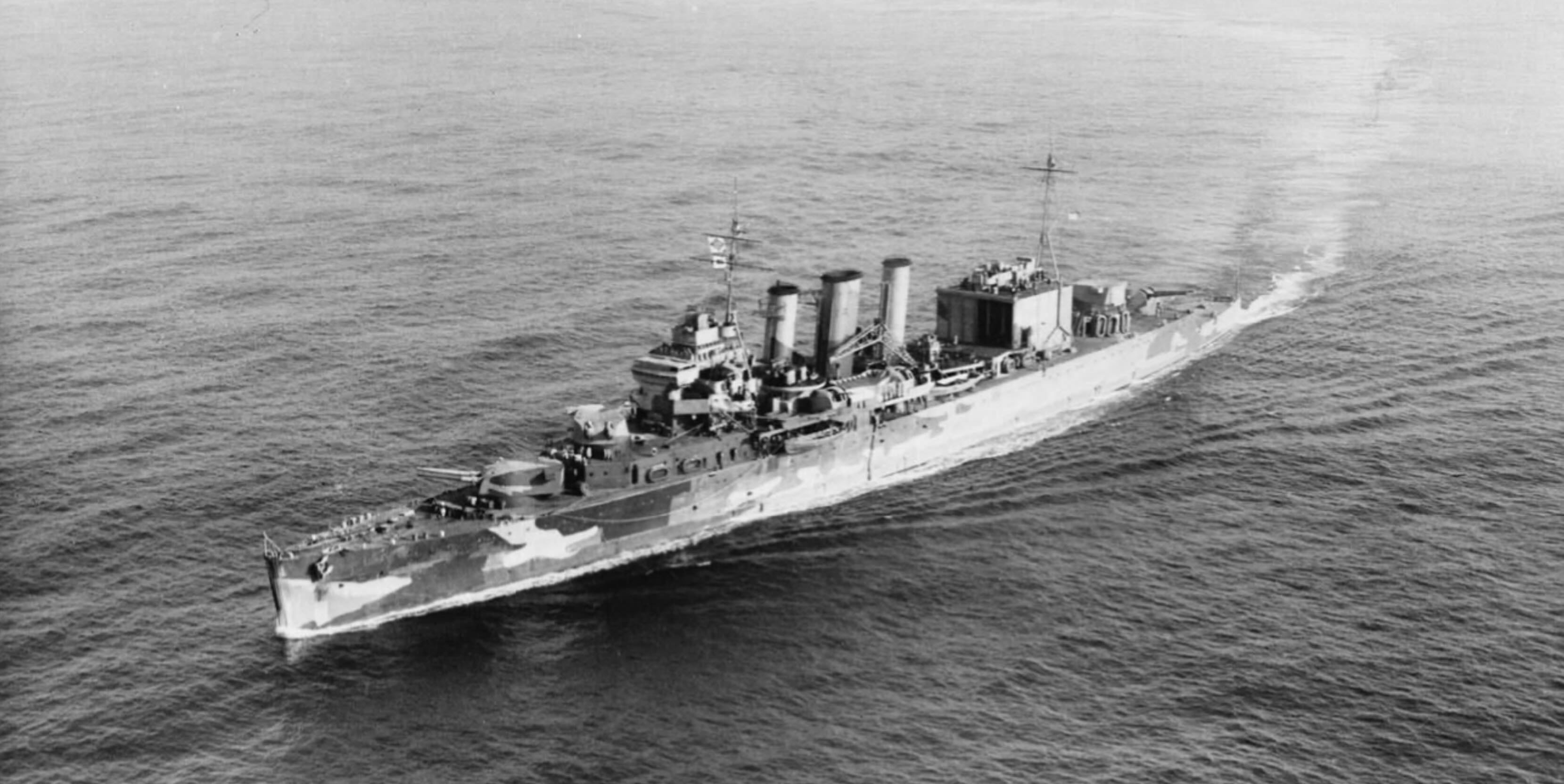
Alan Raven1 highlights the innovative use of radar, recently installed on the cruiser Suffolk:
The Bismarck episode was the first instance in history where extended tracking of surface targets was made by radar, and not by a dedicated surface-warning set, but by a gunnery set fitted on the Suffolk. This ship had very recently become operational after a ten-month repair, at the end of which, she was fitted with a Type 279 air-warning set, and a Type 284 gunnery set. The aerials for Type 284 were attached to the roof of the main director, which had to sweep to allow the radar set to perform a search. Although not designed to operate in a search mode to allow radar coverage, this could be done, but in a judicious manner, because constant training of the director would have a negative effect on its mechanism.
On the 23rd, before making contact with the Bismarck, the Type 284 set was being used as a navigational aid, allowing a patrol distance to be maintained within 24,000 yards off the ice shelf, when visibility ranges were less than eight miles. Although the first sighting was at 1922, it was not until 1934 that radar contact was made. Of the six initial sighting reports sent to Admiralty, five were based upon data from the Type 284 radar.
From 2043 to 2154, Bismarck was within visual range that varied from 15 to 18 miles. At 2154 Bismarck entered a rainstorm at a speed of 28 knots and was tracked and held by the 284 until visual touch was regained at 2258.
The above will give the reader an idea of how effective Type 284 radar was for tracking targets in very poor weather, in spite of not having automatic all-round sweep ability, as many later surface-warning sets had. When the Bismarck was in visual contact, the radar was not used for tracking in order to reduce the wear on the training mechanism of the director. Shadowing by a combination of visual and radar continued until about 0326 on the 25th, when radar contact was lost. From the time of first sighting at 1922 on the 23rd to 0326 on the 25th when contact was lost, the Bismarck was at no greater a distance from Suffolk than 18 miles.
The use of Suffolks radar was not only the first time that radar had been used for an extended period of time for tracking surface targets, but also the longest ever recorded! Throughout, the set performed well, without any breakdowns, and was a superb example of tactical use made without any prior training or written procedure laid down.
The use of Type 284 in its designed function was mixed, but when Bismarck tried to ambush the Suffolk between 1805 and 1855 on the 24th, Suffolk made use of her Type 284, first to avoid, and then when firing her 8in guns in return fire, she obtained a straddle at a range of 20,700 yards using radar ranges.
The successful use of this set highlights well the somewhat poor performance of Type 286m radar as was fitted in Norfolk. This had been installed in the ship at the end ofthe first week of May. There had been problems in getting Type 286m to properly perform; all the spare valves had been used and as a consequence, when the ship sailed from Scapa Flow to patrol the Denmark Strait, this set had to be ‘nursed’, meaning that it had to be shut down periodically.
In addition to being nursed, the range on a large ship was only about 14,000 yards, compared to the 26,000 yards of Type 284, but its greatest deficiency was the fixed aerial array that was fitted at the masthead. In order to track a target the ship itself had to be steered in the direction of same, so that when Bismarck made turns, especially toward the ship, contact would of course be lost when the tracking vessel had to turn away. Also, its poor resolution made it unsuitable for gunnery purposes.
© *Alan Raven 2019, ‘British Cruiser Warfare: The Lessons of the Early War 1939–1941’. Reproduced courtesy of Naval Institute Press and Pen & Sword Publishers Ltd.

Alan Raven: British Cruiser Warfare: The Lessons of the Early War 1939–1941