

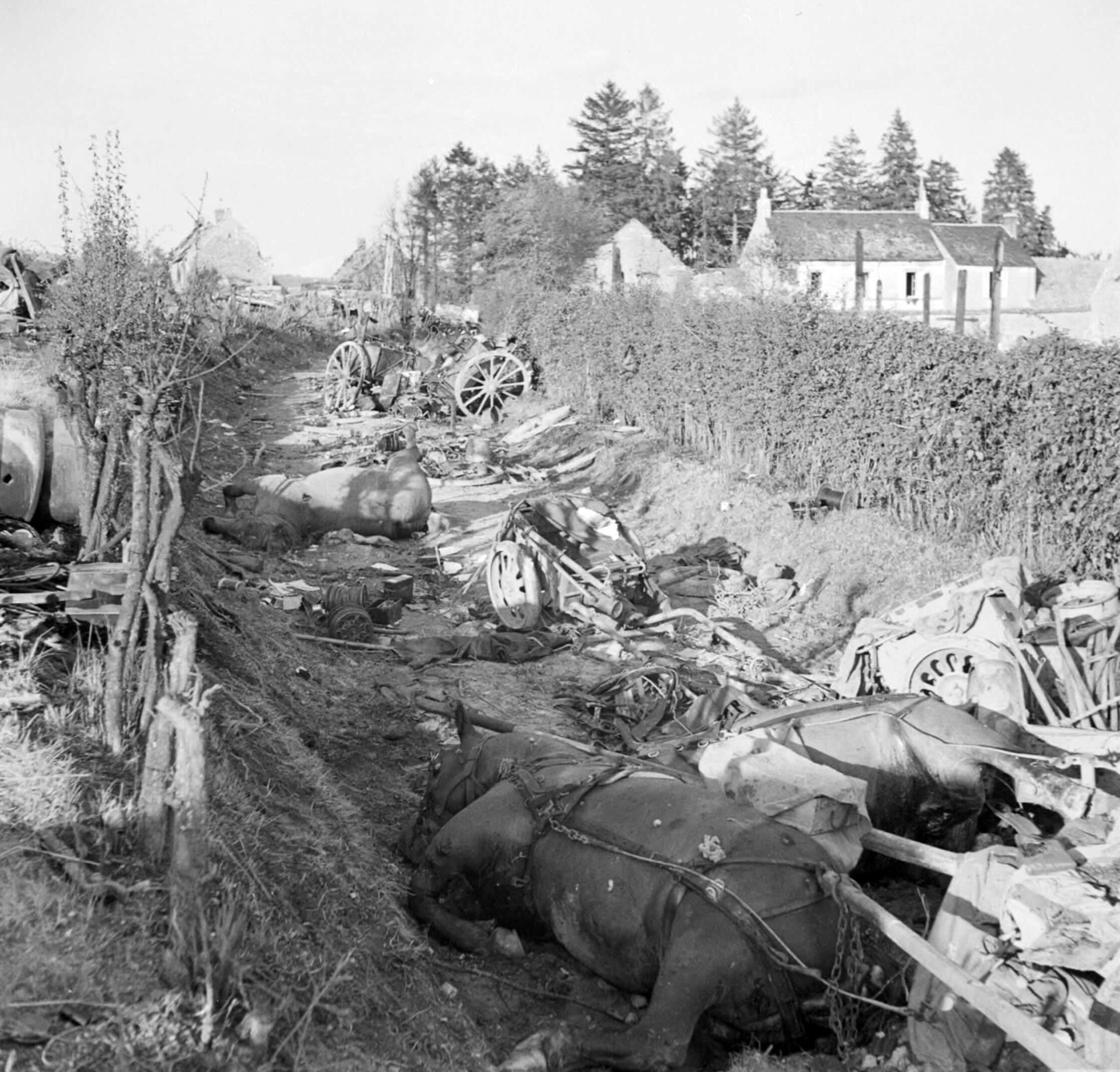
A new title from Tim Saunders deserves to be featured. I have previously covered ‘Arras Counter-Attack 1940’ and ‘Hill 112’. Saunders’ histories are based on close study of primary sources, building a detailed picture of how battles unfolded, including personal recollections by men from both sides alongside unit war diaries written at the time. In August 1944, the hard-fought struggle for Normandy was coming to a bloody finale as the Germans found themselves trapped in the Falaise pocket.
The 8th Battalion, The Rifle Brigade (8 RB) fought in co-ordination with the tanks of 23rd Hussars (23 H), both arrived in Normandy about a week after D-Day. As a motorised infantry battalion, 8 RB were the fruit of new thinking in the British Army as to how infantry should fight alongside tanks. In Company with Tanks: 8th Rifle Brigade in Normandy describes how that unfolded in practice, how the British fought a series of battles from Operations EPSOM through to GOODWOOD and BLUECOAT, until after significant casualties, they finally had the Germans cornered:
20 August
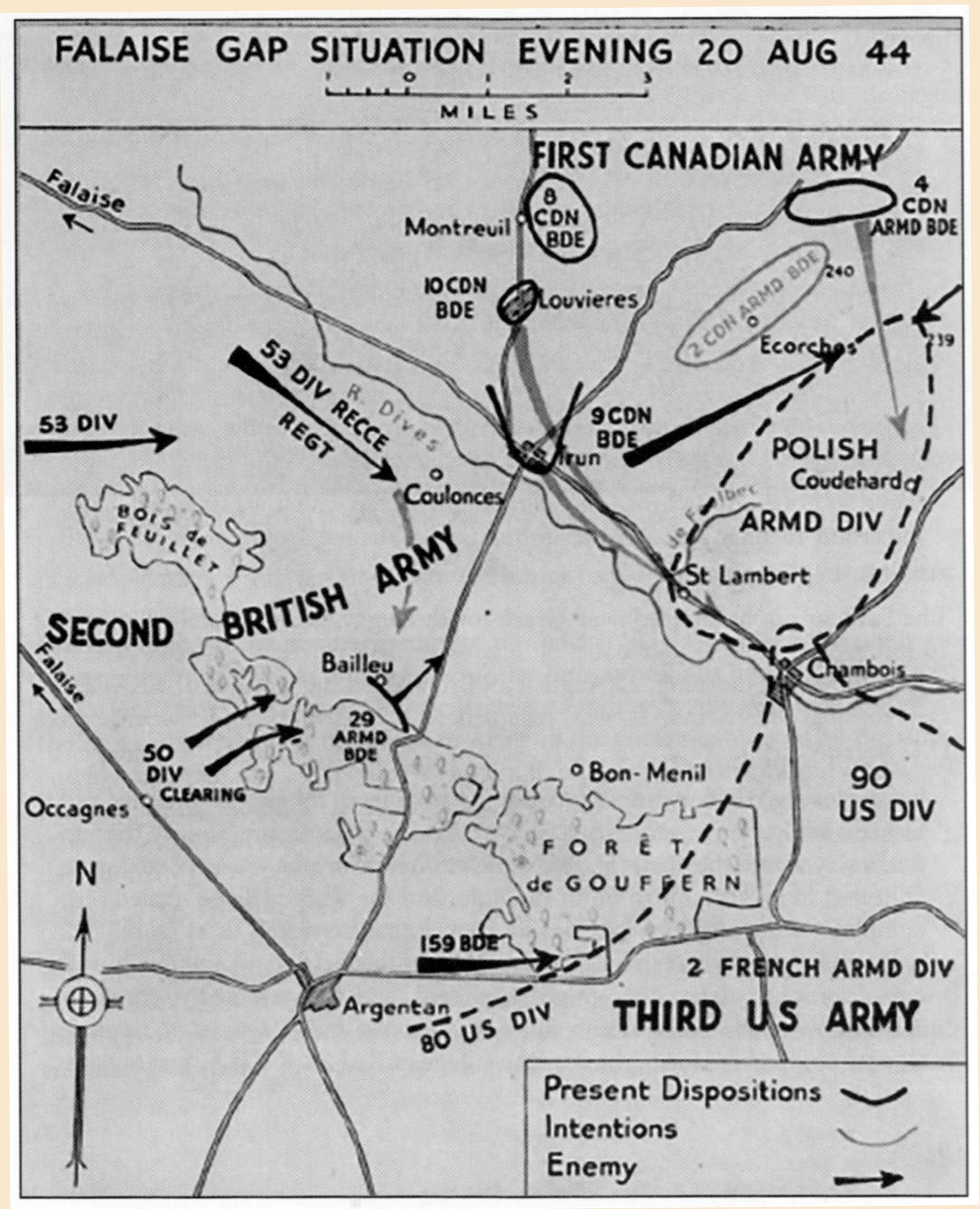
The fight to close the Falaise Pocket farther east had been underway for days, and 8 RB/23 H battlegroup were now in the main part of it, where the Germans were still doing their best to escape through the narrowing but rapidly closing neck. As far as the advance through the Forêt de Gouffern to the extant objectives on the other side was concerned, the brigade advance was slow, being constrained by boundaries to the south with the 3rd US Armoured Division and control measures to the north. These were necessary to prevent the battlegroup from being shelled by friendly artillery or attacked by the Allied tactical air forces. In addition, ‘the whole area was infested with Germans.’
That morning, G Company and A Squadron resumed the advance, as described by Major Bell:
The position at Cui next morning was exactly the same as when we had left it the night before, with the exception that this time we were not greeted by any hostile fire. The village contained a large hospital which was full of German wounded, and which seemed to have an enormous medical staff, many of whom I am quite sure acquired Red Cross armbands a very short time before we arrived on the scene. There were large numbers of seriously wounded Germans and some German nurses, who when not on duty appeared to be practising their feminine charms most effectively and blatantly on the walking wounded cases.
The two wounded Sherman crewmen were found in the house and evacuated down the British medical chain. While the German prisoners were secured, the other two company squadron groups sent patrols forward to the Falaise-Argentan road. However, as they approached the forest, B Squadron came under fire and lost a tank to a pair of Panthers but, outnumbered in the resulting engagement, the panzers were in turn knocked out by B and C Squadrons’ Shermans.
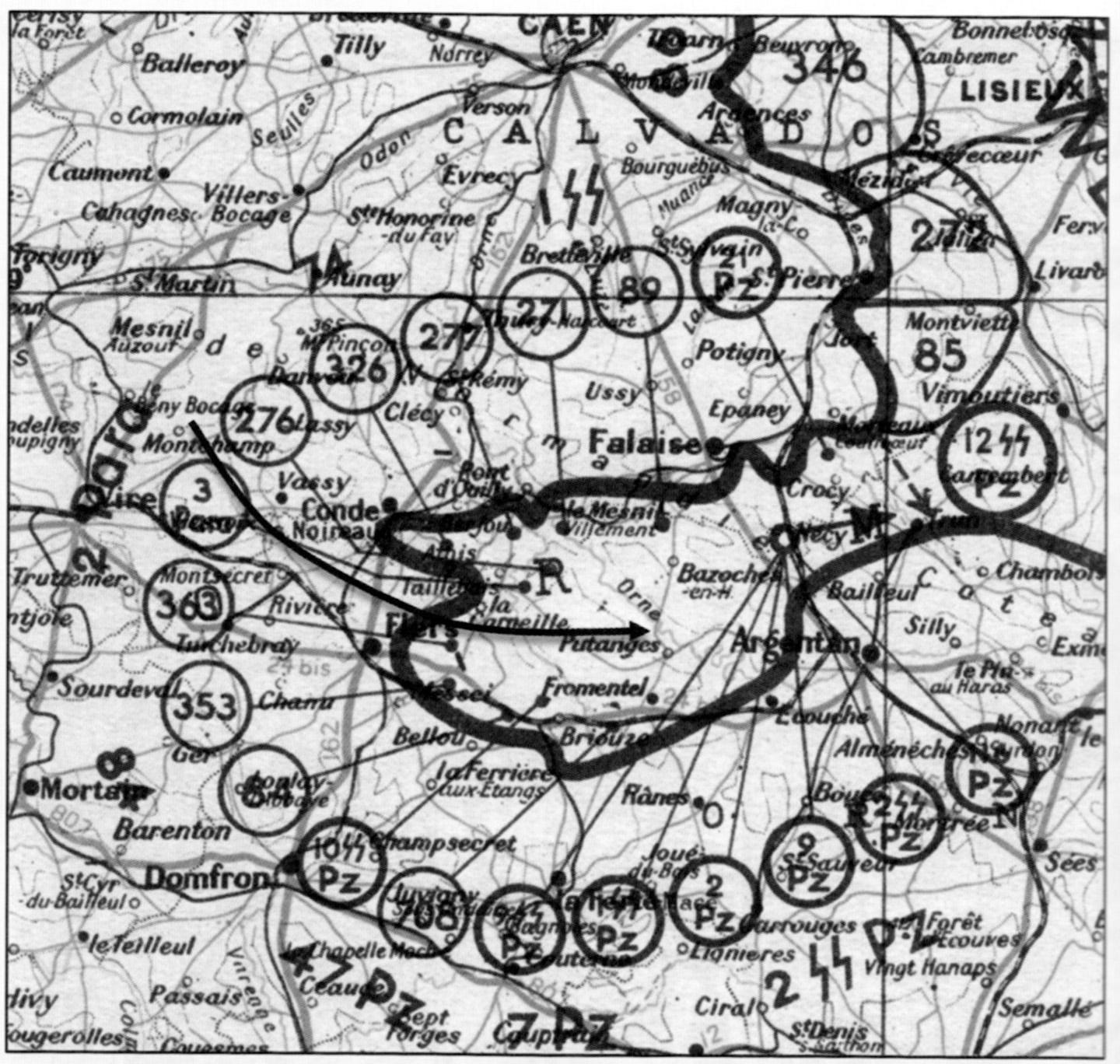
Now it was the turn of the infantry to advance to the forest, but the farther 8 RB progressed into the Falaise Pocket, the grimmer the scenes of destruction became. Rifleman Jefferson of E Company, 17 Anti-Tank Platoon, described what he saw in his journal:
We moved forward slowly. The whole scene became increasingly more indescribable. The whole area was strewn with dead Germans and horses and wrecked transport, guns and knocked-out tanks of every description. We had to pick our way through the wreckage. Sometimes there was no other way through the devastation but to drive over the corpses. The stench was overpowering. Prisoners were giving themselves up in their hundreds.8 Sergeant Hicks provides a more graphic description:
The retreating Germans were mercilessly strafed by our air forces as they had no protection at all from the Luftwaffe. I vividly recall seeing the result column caught on a main road. It was not only littered with the debris of burning tanks and numerous other types of armoured vehicles and lorries but also scores of dead horses, which the Germans had been using to draw guns and ammunition limbers.
It reminded me of black-and-white photographs I had seen of similar situations in the First World War. You had to see it in the flesh, in Techni- colour, with the road literally awash with blood and entrails, human corpses in grotesque positions and to cap it all a sickly stench over the scene like an invisible fog.
I don’t know how I stopped myself from throwing up. I think we were all rather stunned by what we could see. The conversation was practically nil except for exclamations such as ‘My God’ and ‘Bloody Hell’ and such like. Of some of the damage and carnage our air force had wrought on a German. The road was obviously impassable, and we were glad to find an alternative route across fields and to get away from the ghastly mess.
At 1600 hours, G Company and A Squadron took over the lead in the forest: After crossing the Falaise-Argentan highway at Occagnes, we approached the Foret de Gouffern with a certain amount of caution, as several clearly camouflaged objects could be seen in the edge of the wood. Under cover of smoke, and after we had brought down a few precautionary rounds of gunfire on the wood itself, a patrol went forward and fired a P.I.A.T. bomb at one of these objects.
A direct hit was scored, but on clear examination the object turned out to be an abandoned German tank and the other objects we had seen in addition also turned out to be the same. Accordingly, a section of carriers moved forward, but the leading one went up on a mine and once again the advance was slowed down. The woods either side of the road obviously had to be cleared by the motor platoons on foot and this plan was set in motion. More traces of mines were found and blown down trees had been pulled across the road, but with the aid of our sappers these were cleared and the vehicles began moving forward again.
While the riflemen cleared through the forest, the tank crews of 23 H had more time to take in the scene around them amidst the shell-torn trees: Occasionally there was a burnt-out lorry or car in the ditch, and sometimes the blackened and twisted corpses of men were visible side-by-side, while other crushed, torn bodies lay around. Again, and everywhere, there was the smell of burning and decay.
The battle group reached their objectives overlooking the village of Bailleul. Below was the valley, which had become the final killing area, scattered with ‘the pulverised remnants of the German Army in Normandy’.
It was not just the German dead and wounded that Rifleman Jefferson recalled coming across but individuals and groups of bewildered German soldiers:
Some wore the unmistakable [runic] sign of the crack SS troops, still their arrogant selves. The prisoners were a nuisance to us. We simply bypassed them and sent them back in long columns. Bulldozer tanks tried to clear the roads. There was simply nowhere to push some of the German debris; it was piled so high. Literally thousands of German dead lay around.
On 20 August, the divisional cage processed some 900 POWs, while 13 RHA batteries advanced with the battle groups, ‘poured round after round into the pocket at targets identified by an Auster air OP aircraft’.
One notable set of POWs exemplifies the extent of the dislocation of Seventh Army’s command and control, when G Company captured their first German general: It was at this stage that 12 Platoon, moving forward on foot, captured [Lieutenant] General Kurt Badinsky, commanding 271 Infantry Division, and his entire staff. An old lady rushed up to them and told them there were some Germans in a certain farmhouse; on closer inspection, a General was seen at the window and was immediately covered while the remainder of the Platoon surrounded the buildings.
Staff officers, clerks, and orderlies came tumbling out, and, very soon, the complete Divisional Headquarters personnel were assembled in the courtyard, being enthusiastically searched. The old General, who had no idea what was happening around him, and who had no division left to command, was particularly anxious to surrender to an officer and refused to believe Michael Anderson was one, and when I arrived on the scene, I had considerable difficulty in making him believe that I was not a non-commissioned officer. He found it very hard to believe that the dress of British officers in action was almost identical to that of their men, and when the Colonel arrived, looking equally dusty and shabby, he was never more exasperated.
A request was granted to him to say goodbye to his staff and, after much heel-clicking and saluting, the first live German General we had ever seen was driven away to captivity, leaving behind him two very fine cars, which were very quickly snapped up. These two cars were described as ‘streamlined and crammed with arrogant and immaculate German staff officers’, who were ‘passed back to Brigade Headquarters with little ceremony’.
However: ‘With great difficulty, we managed to get a resplendent Horch, while Colonel Hunter took over an equally magnificent Lincoln Zephyr.’ Harboured on the southern edge of the pocket, 23 H describe the night air being ‘filled with planes and flares and tire long rumblings and vivid flashes of explosions’.
For G Company: ‘The ceaseless pounding by our guns and aircraft of the remnants of the German Seventh Army in the pocket continued all the time, and for once that sort of sound was rhythm to our ears.’ During 20 and 21 August, the fight for the Allies to close the Falaise Pocket was over, with German counterattacks to facilitate the escape of the remnants of the Seventh Army having been defeated.
© Tim Saunders 2026, In Company with Tanks: 8th Rifle Brigade in Normandy. Reproduced courtesy of Pen & Sword Publishers Ltd.

Affiliate Links
Recently on World War II Today ...

