Lodz, the second largest city in Poland, had a Jewish population of around 200,000 at the outbreak of war. This was one of the largest Jewish communities in the world. After the Germans occupied Poland the Nazis moved quickly to force all the Jews in the main cities into ghettos.
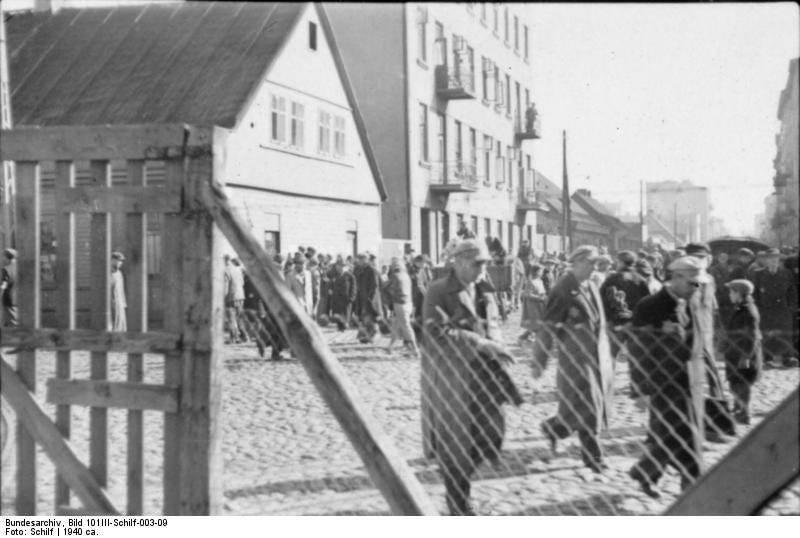
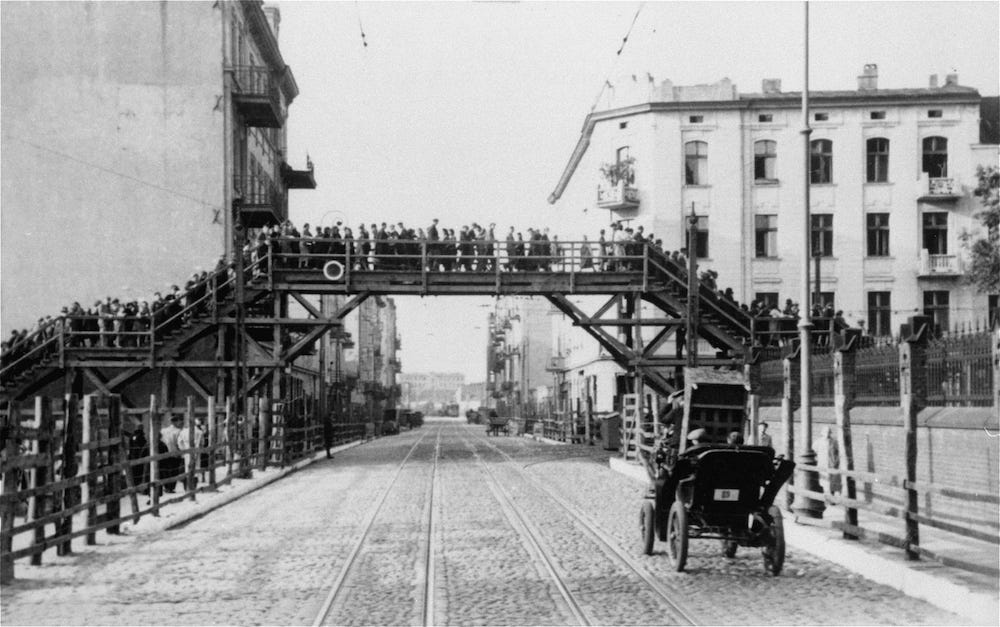
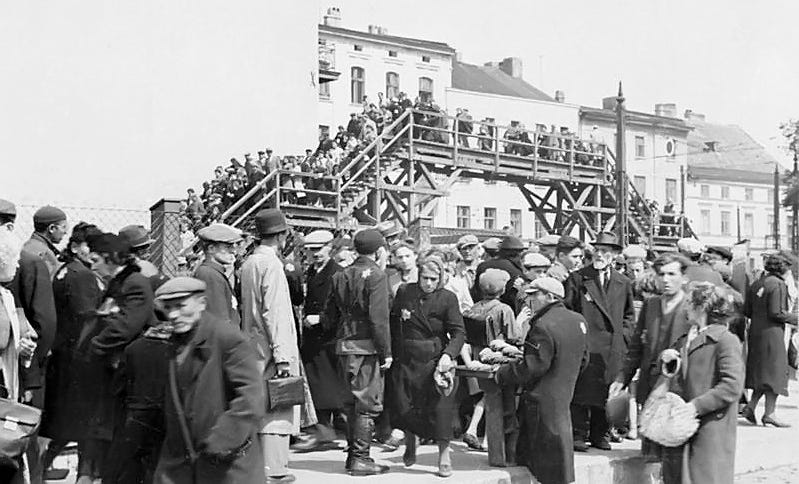
These were in effect open prisons, fenced off from the rest of the world. The areas designated for the Jews were massively overcrowded - typically whole families would share one room. The food allowed into the ghettos was deliberately set at starvation levels. Images taken by a German photographer show the consequences in the larger ghetto in Warsaw.
Survival became a desperate matter. The smuggling of food and medicine was organised at many levels. Organised crime worked through corrupt German and Polish officials to bring in supplies, whilst at an individual level many children were engaged in the risky business of creeping outside the ghetto.
The Order Service man who had been on duty … is now receiving medical attention.
There are many accounts of life and death in the ghetto contained in The Chronicle of the Lodz Ghetto, 1941-19441. They often make grim reading. This was a collective diary by a number of scholars to record the conditions in the ghetto as fully as possible. It was clearly written as a matter of record for the future.
There is one account from the 1st August 1941 which suggests that the Nazis did not always have the upper hand:
The Smuggler Zawadzki who recently escaped from Hospital No 1, where he had been under guard by the Order Service, was apprehended in the city and placed under arrest.
When interrogated, he stated that he had executed his escape with the aid of a Jew and had paid a policeman 500 marks for his help. The Order Service man who had been on duty in the hospital was summoned to Kripo (German criminal police), and in spite of his passionate assurances that he was innocent, was only released two days later. He is now receiving medical attention.
Zawadzki, a fourteen-year-old boy, was the major smuggler both into and out of the ghetto. He supplied saccharine, vaccines, medicines, etc, and earned colossal sums of money.
His escape was executed in a highly ingenious manner: Zawadzki stated that he wanted to go to the bathroom, where the stalls were set up so that the user's feet were visible. When, after a rather long time, the patient had not come out and did not respond to knocks, the door was forced open. To their astonishment it was discovered that Zawadzki had left his shoes to deceive the guard while he escaped through a window.