

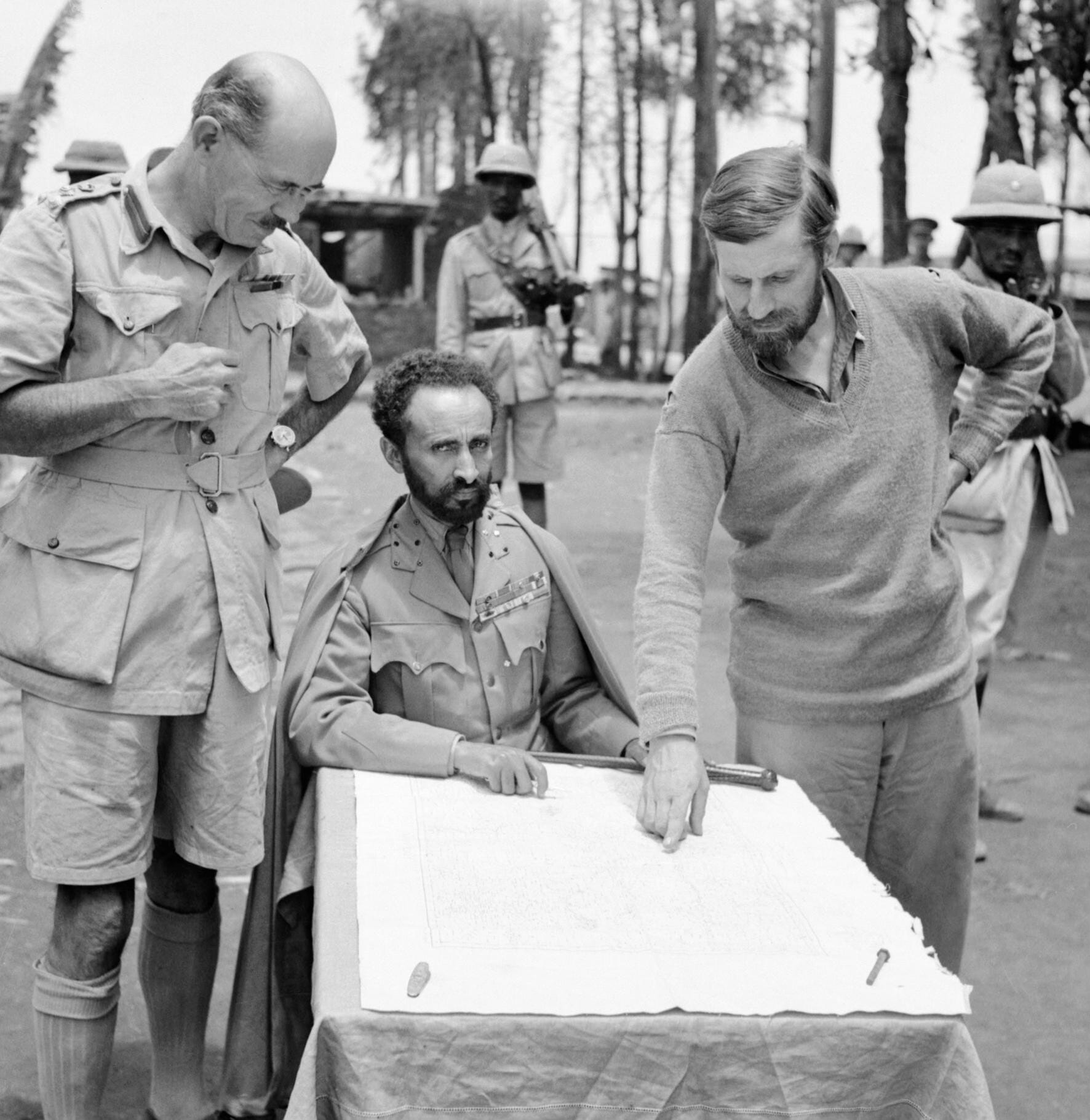
The Commander in Chief , Middle East, Sir Archibald Wavel, was responsible for four significant campaigns. He had been successful in North Africa against the Italians, but now faced the Germans in Greece. In East Africa, there was a continuing struggle to defeat the Italians in their former colonies in Eritrea and Ethiopia (then commonly known as Abyssinia) and in Somalia. The Italian occupation of the African coastline leading to the entrance to the Red Sea meant that the Axis could threaten shipping bound for the Suez Canal, which was now becoming the only lifeline for supplying British forces in the Mediterranean.
The war being fought in Ethiopia was unconventional in many respects. The British commander Orde Wingate, later famous for another guerrilla force in Burma, led a group of British officers in charge of local ‘boys’, from different ethnic groups. These ‘Patriots’ were loyal to Haille Selassie the Emperor, regarded by some as a Messiah, who had been usurped by the Italian. But the different ethnic groups were not always loyal to one side, could be swayed by some of the renegade members of Ethiopian royalty, and were not always very disciplined.
This somewhat complicated story of some very colourful characters in the shifting fortunes of war is told by David Shirreff in Bare Feet and Bandoliers, the product of some wide ranging research from a many sources. The following excerpt takes up the tale at the beginning of April 1941:
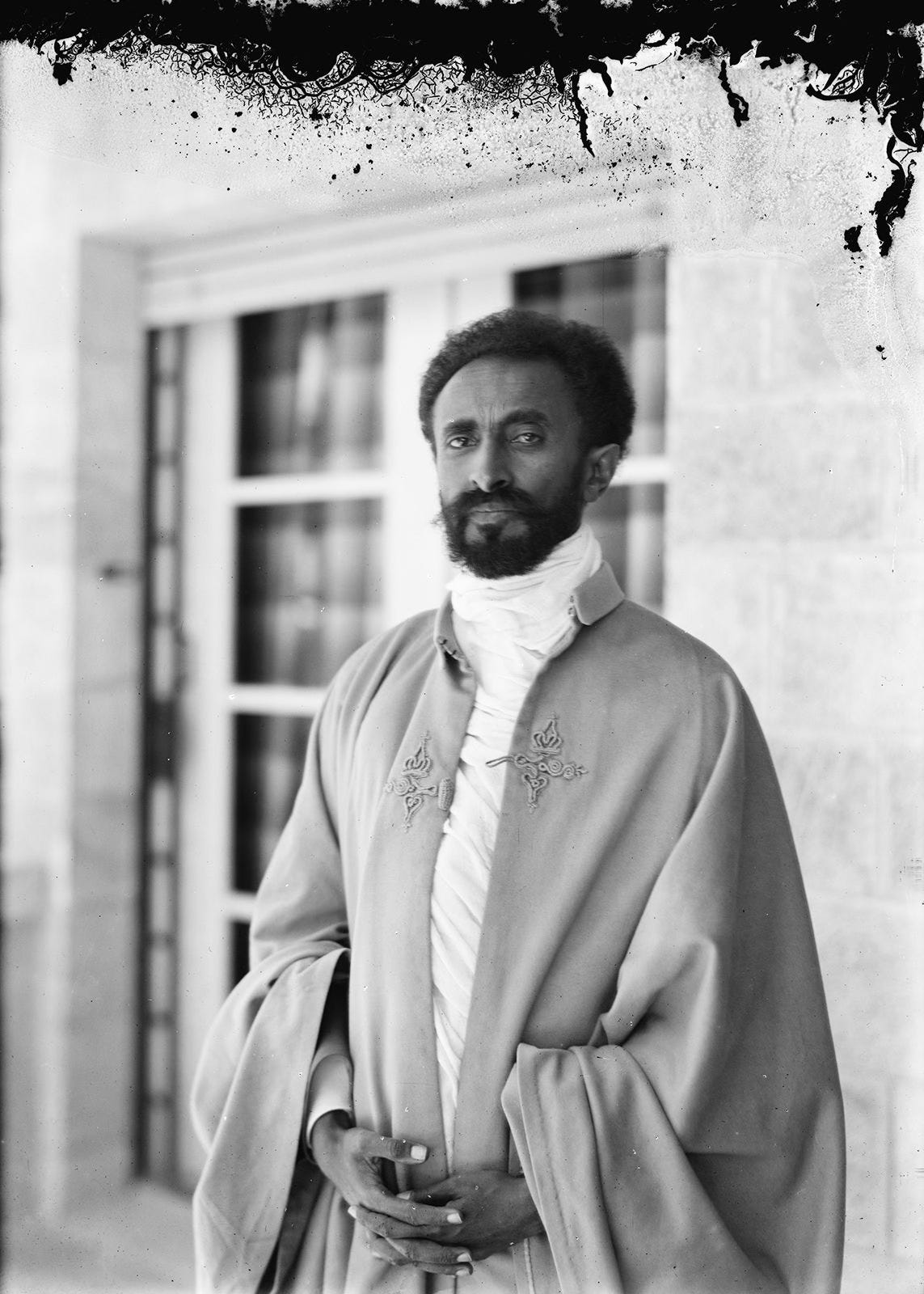
[The local British commander of rebel forces] Johnson, ordered by Boustead to ‘get in front of the Italians and do what damage he could’, had taken up an ambush position with his small force on the ridge known as Jibuti or Dumbuka, 28 kilometres from Debra Markos, through which the road to the Abbai runs and waited for the Italian column. They were facing towards Debra Markos but had two sentries watching the road behind them.
At dawn on 3 April, [the Italian commander] Maraventano’s transport column left Usciater to return to Debra Markos, having delivered one of the CCNN battalions [Italian Blackshirt Militia]. The column consisted of 30 empty lorries and a Red Cross vehicle, escorted by two armoured cars, a platoon of Blackshirts and 50 of Ras Hailu’s banda [a notorious Ethiopian warlord and his irregular troops (or bandits)]. As they approached the Jibuti ridge from the south they were spotted by Johnson’s sentries. Johnson turned his men round, let the Italians get within range, and opened up with Brens and an anti-tank rifle. The leading armoured car attempted to return fire but could not elevate sufficiently, and the escort got out and returned fire from behind rocks. The two armoured cars were knocked out by the Boyes anti-tank rifle and 25 trucks were destroyed. The remaining five trucks were turned round and the survivors went off in them in the direction from which they had come.
Italian casualties were seven nationals killed and one missing, five banda killed and 12 wounded. Johnson’s force suffered no casualties. The result of this highly successful ambush was that Maraventano’s withdrawal plans were disrupted and he could not carry all the supplies he needed, though by using civilian transport, ‘I was able to load four days’ rations.’ Johnson was awarded an immediate DSO for this action.
After Maraventano had taken leave of Ras Hailu and his daughters and loyal chiefs and subchiefs (‘the older faithful ones wept’), his column started its 800-kilometre march to Dessie at 9.00 a.m. on 4 April having been assembling since dawn. Ras Hailu assured him again that his march would not be disrupted this side of the Abbai.
In addition to his seven colonial battalions and 1000 national troops, the column included, ‘4000 women and children, the families of ascari, 500 native civilians who had compromised themselves by acts done in our favour, and about 100 nationals from the towns of Engiabara, Burye, Dambacha and Debra Markos. As most carried their own belongings, you will have a faint idea of how this crowd encumbered the march of the column.’ They also had the 200 Ethiopian baggage camels captured at the Charaka river. Despite these encumbrances they covered the ground with remarkable speed.
While Maraventano departed unmolested from Debra Markos, Gideon Force [the British led guerrila force] was poised to move in. In the town Ras Hailu, the old Lord of Gojjam, performed a double act, displaying a most remarkable authority. He saw Maraventano off the premises, made sure that neither Belai Zelleka nor anyone else molested him on his way to the Abbai, put his men in to take over the forts and prevented looting in the town, and awaited Boustead and the Emperor.
Boustead sent Hayes in at midday on 4 April with two platoons of No 1 patrol company. As Hayes approached the fort, ‘I was met by a large crowd and Ras Hailu. They started kissing my feet and Ras Hailu took me in to a small inn and plied me with tej [a honey wine, like mead].’ Boustead and Nott followed with Gideon Force, placed guards on all stores and allotted areas to the gathering patriot chiefs in the surrounding forts.
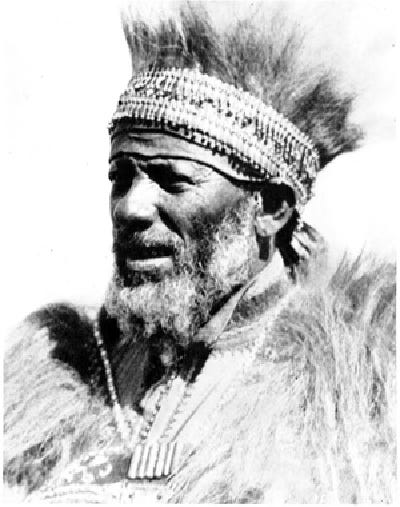
Among the chiefs was Nagash [a Patriot leader, but regarded by the British as having poor authority over his men] with his men designated as governor of Debra Markos by Haile Selassie, who arrived on 5 April. With this authority he demanded that Boustead should remove his troops from the fort. Having had no help from Nagash in the fighting Boustead and his officers dealt with him and his men fairly sharply. Boustead refused to remove his troops, and when Nagash’s men started looting the hospital, ‘Jock Maxwell shot one dead at 300 yards and scared off the others, making them drop their loot as they ran.’
Nott and Kabada went back to Dambacha in one of Ras Hailu’s trucks to report to Wingate and the Emperor. Although flying the Ethiopian flag, they were sniped at by Patriots. Nott stopped and ‘warned the various posts not to fire’ .
Nott returned in the truck with Wingate, and other arrivals at Debra Markos on 5 April were Lieutenant Colonel Geoffrey Benson OBE, Royal Ulster Rifles, to take command of the 2nd Ethiopian Battalion, and Sandford and Kabada to see Ras Hailu, assess the political situation, and prepare for the Emperor’s entry on 6 April.
When Sandford and Kabada, who, despite what Kabada wrote afterwards, were working together effectively and amicably, met Ras Hailu, the ras, who had a sense of humour, greeted Kabada with the words, ‘You will pursue me to my grave!’ Kabada, as court chamberlain, had been his gaoler under Haile Selassie. Sandford told him that the Emperor was pleased with his action in surrendering the town and maintaining law and order, and Hailu replied, as Sandford reported to the kaid in a letter of 8 April, with ‘a long story explanatory of his attitude over the last few years, and in particular detailing his manoeuvres over the last few weeks for hoodwinking the Italians so as to be able to come over when the time was ripe.’ He also said that the Emperor should defer his entry into Debra Markos for fear of aerial attack. Sandford saw through this last remark as a ploy by the ras to consolidate his position with Nagash’s fitauraris before the Emperor arrived.
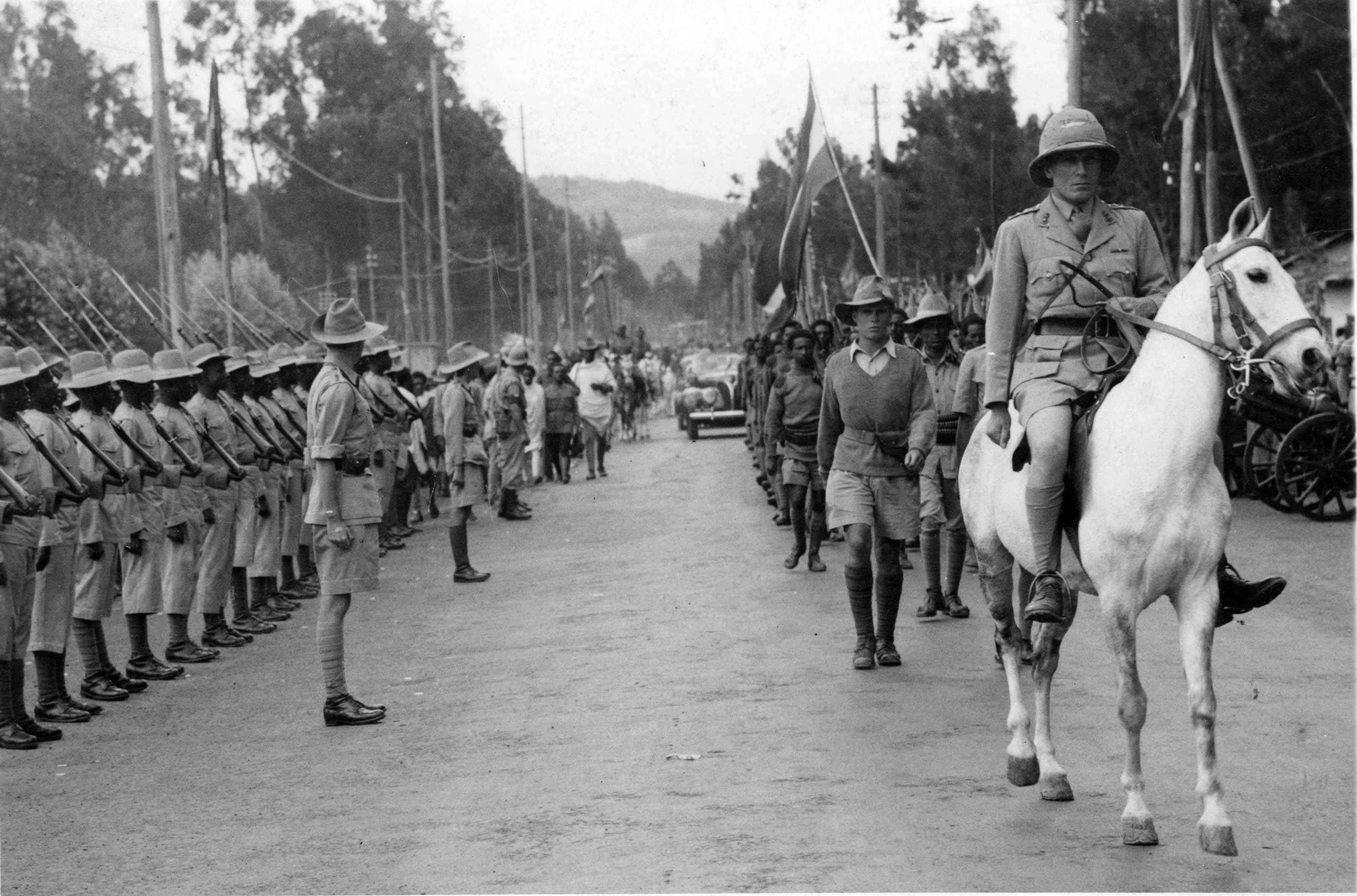
On 6 April 1941, the same day Cunningham’s forces entered Addis Ababa, Emperor Haile Selassie entered Debra Markos in a car driven by le Blanc in a convoy of six cars, which le Blanc had led up the Matakal escarpment on 2 April, the first vehicles to travel on the road he had been constructing. The date 6 April remains a significant one in Ethiopian history, the ‘Day of Liberation under the Mengistu regime (1974-91), the day on which British troops entered Addis Ababa and the day the Ethiopian flag first flew over a provincial capital.
But it had a more ominous significance at the time; it marked the recapture of Benghazi by Rommel and Axis troops, signalling the beginning of the reversal of Allied fortunes in North Africa.
Haile Selassie arrived at the fort at midday and was greeted by Wingate and a parade of the two battalions of Gideon Force commanded by Boustead. After Haile Selassie had taken the salute, Ras Hailu was to make his submission, but, awkward to the last, he kept the Emperor and the parade waiting for half an hour.
Then, as Tutton records, ‘he drove up in a motor car and got out. He bowed stiffly, a formal obeissance to the Emperor, and muttered something, and then stood upright.’ Nott was also watching the scene; ‘Haile Selassie then read an address in which he praised the Fr. Bn and 2nd Eth. Bn. He then sat on the Palace steps — which we had hastily cleaned as his dwelling — and held a reception of notables.’
HM received patriots who danced before him, reciting their prowess, mostly lies …
We can speculate how many of those notables who said goodbye to Maraventano with tears in their eyes on 3 April came to greet the Emperor on 6 April. In the evening, on hearing that Cunningham’s troops were in Addis Ababa, the Emperor invited all officers to a ‘champagne [captured] reception’.
So ended an eventful day. Next day Nott extracted petrol from Ras Hailu, who was still holding the petrol supplies - ‘He gave me a good reception and some inferior cognac before breakfast’ - and Haile Selassie held a review of patriot forces, eliciting a comment from Maxwell, which was unflattering but fair as far as the Debra Markos campaign was concerned: ‘HM received patriots who danced before him, reciting their prowess, mostly lies except for Azaj Kabada and his boys’.
© David Shirreff 1995, 2009, ‘Bare Feet and Bandoliers: Wingate, Sandford, the Patriots and the Liberation of Ethiopia. Reproduced courtesy of Pen & Sword Publishers Ltd. NB Not all of the above images are from this volume.

Affiliate Links
Recently on World War II Today ...

