Continuing a short series about Hitler, this week’s feature comes from Tim Heath’s Creating Hitler’s Germany - The Birth of Extremism. Heath specialises in German eyewitness accounts of life under the Nazis, publishing a series of books that give a candid insight into the lives of ordinary Germans under Nazism and after the war.
This excerpt comes from the very earliest days when the German public first encountered Hitler, when he began to make speeches in the Beer halls of Munich immediately after the First World War:
Munich was to become the spiritual home of the Nazis. It was in Munich, on 16 October 1919, that Hitler gave his first pre-arranged public speech. Hitler had joined the Deutsche Arbeiterpartei [German Workers Party] the previous month. Otto Rische lived in Munich with his wife and three children. He was another disgruntled soldier who had fought in the First World War and had witnessed the decline in Germany’s fortunes in the preceding years:
It was several friends of mine, who I had served with in the army, that persuaded me to go with them to listen to this new speaker. It was at the Hofbraukeller, a restaurant in Haidhausen owned by the Hofbrau brewery. I believe this was Hitler’s first official public speech and there were a hundred or so people in attendance. When we arrived, we bought ourselves beer and settled down to listen to what the man had to say. My initial thoughts when I first saw Hitler was that he didn’t look much. I was going to drink my glass of beer and go home, but my friends told me I must wait. I sat back down and as Hitler came in I waited to listen. There was some raucous applause and cheering from the crowd as he entered the room.
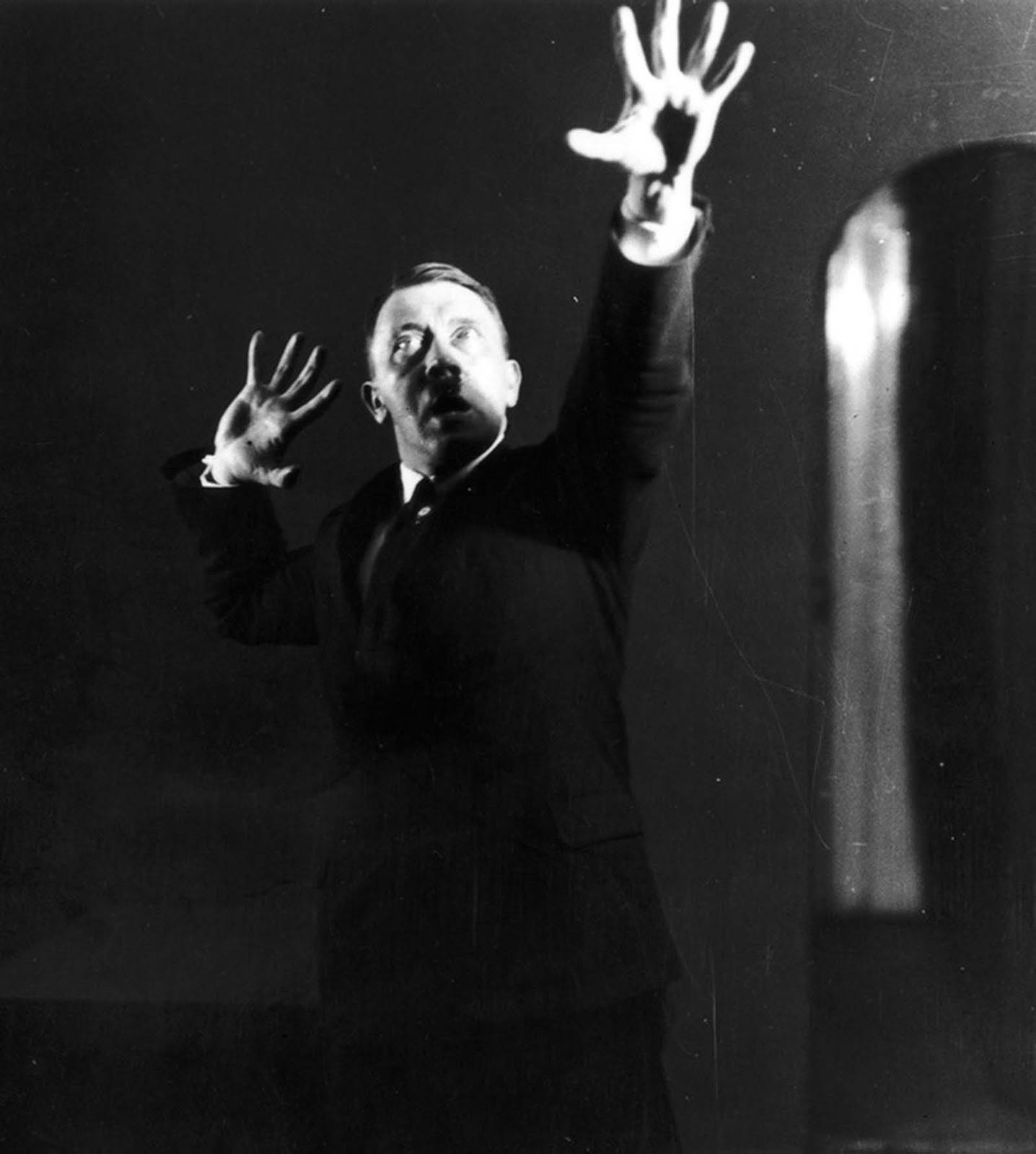
When he began to talk, it was like being hit on the head. This unassuming man with his small, black, well-trimmed moustache instantly grabbed your attention. He was very outspoken about the Weimar government. In a most skilled rhetoric, he poured scorn on Weimar, the Treaty of Versailles and the Communists.
Everything he said appealed to us, but here, in this place, were barely one hundred people. I can remember thinking to myself, what possible difference could he and this small workers party make in the current political state? It was a whirlpool of clashing ideologies rather than one defined one.
We were like sheep running in all directions from a wolf. I thought, what he was saying was right and he was certainly passionate about what he was saying. My friends just said we have to support Hitler, as the more of us who join him, the louder a voice and greater political influence we will have. I would say that’s how many joined in the political group that would become the Nazi Party. Just a hundred or so people, but then the hundreds grew to thousands.
Otto Rische was just the kind of German that Hitler had hoped to influence. He had been a shopkeeper before going to war in 1914, after which his parents took over the business. After 1918, the business began to struggle in the poor economic climate. The Rische family had to adapt in order for their business to survive the depression that followed and Hitler seemed like a light at the end of a dark tunnel. He offered hope and promised prosperity for all Germans. Otto wrote of the situation, ‘I hate nothing as much as I hate our government right at this moment!’
Once you heard him speak, that was it, you were captivated.
Another Munich resident, Albert Friest, who worked at a Munich bank, also succumbed to Hitler’s charisma:
After Hitler had spoken, people were left almost star struck by the man. He was surrounded by his supporters, some of whom would become familiar faces in the future Third Reich.
At these early meetings, it was quite easy to approach Hitler, shake his hand and congratulate him. Naturally, he wanted to court every piece of support from society as he could. He had a firm yet courteous nature, smiled and was happy to engage in conversation. Even in these early meetings, anti-Semitic language was prevalent. He had to find political scapegoats and Jews and Communists fitted this perfectly. He made no effort to hide his dislike of Jewry and Communists.
I felt that this was a man that hated a lot of things about Germany at that time. He hated the fact we lost the war, he hated the fact that Jews had thrived and prospered over what he termed indigenous Germans and he hated seeing the German people suffering man full of hatred, yet I had to admire his tenacity in getting from the consequences of Versailles. Yes, I would say he was a up in public and speaking out for Germans and Germany. It’s no surprise his popularity soared over the years. Once you heard him speak, that was it, you were captivated.
Ingrid Altmann worked as a secretary for a legal firm in Munich. She recalled accompanying her then boyfriend, Andreas Hoess, to hear Hitler speak, on 24 February 1920. This was one of his larger meetings, with around two thousand people in attendance. The venue was the Hofbrauhaus in Munich and this was also the date that the new National Socialist German Workers Party [NSDAP or Nazi Party] was officially founded.
The Sturmabteilung, or SA, were there. These men were often referred to as Braunhemden, or Brownshirts’, due to the colour of their uniform shirts. The SA became the paramilitary wing of the fledgling Nazi Party. Their role was to provide protection for Hitler, his staff and his supporters at the rallies. They were also employed to disrupt meetings of the opposing political parties. The SA soon became adept at using violence and intimidation, not just against political opponents, but also Germany’s Jewish population. The SA would later be dissolved after a bloody purge that saw many of its founding members murdered or imprisoned during the ‘Night of the Long Knives’.
Ingrid wrote of the event on 24 February 1920:
I was angry with Andreas. All men appear to have this political preoccupation. They read politics and discuss politics, even in the cinema. I would have rather been taken out to dinner than witness some war veteran tell us all the things we Germans already know: I could not have been more wrong. Contrary to being boring, this Adolf was quite some show!
I was hypnotized by this man and somewhat intrigued.
He whispered softly, like a man would do in his lover’s ear, then he would explode into fury, deriding the old German attitude, cowardice and betrayal of 1918. Shaking his fist in the air he grasped his audience and held them all by the throat before calming down and letting them gather their breath. I was hypnotized by this man and somewhat intrigued. His enemies called him the failed artist, the bastard, but he was actually very charming.
Andreas had associates who were friends of this Adolf and they introduced us after his speech. As I explained, he came across as the perfect gentleman. He took my hand and bowed his head and kissed my knuckles. At the end of the evening, I removed the white gloves I was wearing and never washed or wore them again. Why I did that, I’m not sure. It was strange; this Adolf was not exactly an attractive man, yet I felt an attraction of sorts towards him, which was quite inexplicable.
Andreas sensed this and I’m sure he was jealous. I was not the only woman to be granted an audience, but he made you feel like you were the only woman in the room. When he greeted you it was unconditional sincerity.
Ingrid Altmann would be among the first of thousands of German women and girls to fall under the Hitler spell.
The man is quite repulsive, supports racial theories, hates anything Jewish and incites violence …
Not everyone was spellbound, however, as Melitta Jorg wrote in a letter to her friend in Norway:
There is a thuggish air about the National Socialists. Their leader is a man named Adolf Hitler. He is not a German but Austrian, yet he is telling us that my father’s generation are traitors. He wants Germany to be great again and says he will rebuild her to her former glory. How will he accomplish this task? War? It makes me squirm when you see these high society darlings grovelling to him and how he stares them in the eyes. It would appear that he is making love to them with his eyes as he clasps their hands and kisses them graciously, as if a kind of statesman. The man is quite repulsive, supports racial theories, hates anything Jewish and incites violence in my opinion. My old friend Bernd loves the man and she goes to listen to him talk. She will have nothing said against the man. We argue, I say he is ugly inside and out and she protests to the contrary. Poor deluded darling, sigh!
Melitta Jorg, described by her great-granddaughter as a charming socialite, would later flee Germany after Hitler and the Nazis came to power. Her family was of Jewish ancestry and under no illusion as to what was going to happen to them. They packed up their belongings and left their home for France, only to move again as Hitler’s army spread across Europe. Melitta and her family were among the lucky ones, finally arriving in England sometime in the late 1930s. The word ‘war’ in Melitta’s letter was strangely prophetic.
© Tim Heath 2019, ‘Creating Hitler’s Germany - The Birth of Extremism.’. Reproduced courtesy of Pen & Sword Publishers Ltd.

Affiliate Links
Recently on World War II Today ...

Next week …