

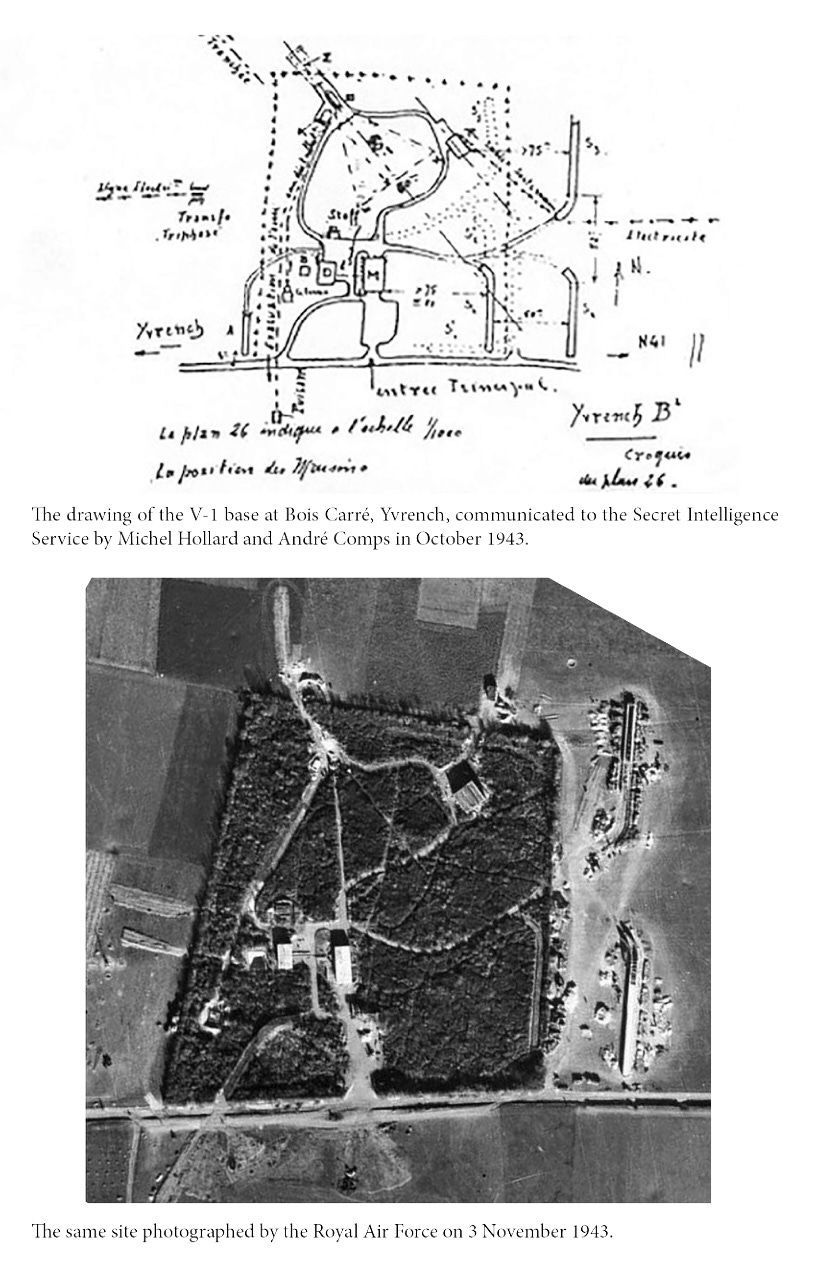
Sometimes one individual's determination, resourcefulness, and bravery can turn the course of history. A French hero, acting independently, was such a man. Michel Hollard’s name is little known in England. His biography, now available in translation, may change that. The Guardian Angel: Michel Hollard: The Resistance Leader who stopped Hitler’s Plans to destroy London is a tale of extraordinary adventures and tests of courage to rival any spy novel. The original preface by the great Simone Veil, holocaust survivor and so much more1, serves as an excellent introduction to why Michel Hollard deserves to be remembered:
We are learning more and more about the Resistance movements, but the story of Michel Hollard remains largely unknown. As leader of Agir, a network independent from the FFI (French Forces of the Interior), he discovered the secret weapon that the Nazis had designed to destroy London. He was later deported and shared the same terrible experiences as so many prisoners in Neuengamme concentration camp. The honours this man received after the war never besmirched the modesty and determination he was able to show, in such an exemplary manner, all throughout his life.
Engaged from the very beginning in the struggle for the freedom of his country, he ruled out even the simplest collusion with the enemy. In 1940, although managing a large firm making wood gas generators, whose technology replaced petrol which was in short supply in Western Europe, he refused to let the enemy benefit from his findings.
Subsequently, in all seasons, despite the infinite dangers he risked and the very real threat of arrest and sentencing, he crossed the Swiss border in both directions to bring strategic intelligence to the British and Swiss secret services in Bern: where troops were moving, where the main units were stationed and where the officers of the German Army were billeted.
Around him, in all parts of the country, first in the Occupied Zone, then in the former Free Zone after the Allied landings in North Africa, patriotic men and women were unceasingly noting down information about an invader everybody considered as the enemy to be defeated, contrary to France’s official position.
And yet, despite the discovery – vital for the course of the war – of the secret ramps the Germans set up to launch the infamous V-1 missiles at London from the coasts of Western Europe, Michel Hollard never wanted to believe he had done anything other than his duty. Despite his family’s Christian obedience, which can be read in every line of this book, he refused to stop after his discovery which forever established his importance in the eyes of the English.
His story intertwines with those of other men, Swiss and English, all those to whom he brought vital information for the conduct of the war, and also a host of other more or less anonymous French people. These include railway workers, hotel owners, farmers – a ‘morally committed’ France that he inspired by his charisma to struggle against the occupier, that oft-forgotten face of France which, despite the dangers and the difficulties, did not yield totally under the German yoke.
After his betrayal and subsequent arrest at the Café des Chasseurs near the Gare du Nord, he was tortured by the Gestapo, but he showed selflessness despite the torture and did not denounce any of his own agents. He was then deported to Neuengamme concentration camp in 1944, where he suffered the hell of privations, abuse and forced labour. Yet he never gave up. Rather, he continued to gather men around his faith and optimism, giving them the courage to await the Liberation.
Beyond Michel Hollard’s impressive series of heroic acts, told fervently by his son, I have retained the profound modesty of this man who said the following words to his former companions in the Resistance a few years after the war: ‘You were all filled with patriotic zeal. All I did was awaken your indignation against the tyranny you were putting up with in silence.’
There are men whose lives are exemplary, not only for their heroism but equally for their humanity; a quality which in troubled times was lacking in so many others. Reading his story, it is easy to understand why Michel Hollard has left such a strong impression of respect and admiration. This man, driven by such rare faith, energy and sensitivity, deserves an eternal place of honour in the annals of history.
The biography opens with a description of the events surrounding Hollard’s great discovery:
In the summer of 1943, an agent in Michel Hollard’s network named Jean-Henri Daudemard, who worked as an engineer with SNCF (Société Nationale des Chemins de Fer Français), France’s national railway company, drew Hollard’s attention to the appearance of strange constructions the Germans were building in north-western France.
Daudemard was lunching in one of Rouen’s brasseries when a conversation at a neighbouring table caught his attention. The two speakers were public works contractors obliged by the occupying army to supply it with large quantities of building materials. ‘Our clients,’ said one of the men, ‘want their strange buildings finished as soon as possible and to do this they have drafted in a huge number of labourers from both here and abroad. What’s more, the technical demands specified by their engineers are very stringent…’
For some time now, Nazi propaganda had been stirring fears of a forthcoming deployment of mysterious machines of destruction the Reich claimed it possessed. Despite its scantiness, Michel Hollard thought the information was clear enough for him to believe the Germans were up to something on a large scale. He got ready at once to carry out his own investigation.
How was he going to find out where these mysterious construction sites were? He thought up a crafty ploy. Carrying an assortment of religious brochures and tracts exalting moral values, he took the train to Rouen. His luggage contained his little scout’s compass, which was often very useful when exploring.
Pretending to be a representative from a charity, he went to the local labour office in the Norman administrative capital and knocked at the door of the social services. There, he spread out his collection of righteous literature, declaring he ‘wanted to get in touch with the young people working on those large projects, since the uprooted workers were most certainly exposed to the most frightful temptations because of the easy money they were making’!
The civil servant seemed to be taken in by his explanation, or at least he acted like he was. Perhaps he guessed it was a stratagem and, cooperating without saying anything, he pretended to believe him. The main thing was that he agreed to give him a list of where these ‘special constructions’ were situated in the neighbourhood.
Back at Rouen station, Michel Hollard went to the public conveniences, came out wearing worker’s overalls and put his suitcase containing his town clothes in the left luggage. After a thirty-minute trip he got off the train at Auffay, his haversack slung over his shoulder, and made enquiries among the locals. Either they didn’t know or they didn’t trust him; none of them said anything about the supposedly secret building work. He was convinced, however, that the official back in the labour office had not given him the information for nothing. As his perseverance sometimes amounted to stubbornness, he made a point of going around the neighbouring countryside methodically.
As Auffay was at the junction of a network of roads, he set off down one road for forty minutes, looking over the landscape carefully, without result. Coming back to where he’d started from, he did the same in another direction, but again in vain. The third road he tried led him to the hamlet of Bonnetot-le-Faubourg. After walking for almost 2.5 miles in that direction, he was about to turn back when he heard a distant rumbling noise. He carried on even more keenly, with the dull rustling sound accompanying his steps getting louder and louder.
He was soon able to make out a crowd of workers wielding spades and pickaxes within a vast enclosure. The rumbling sound of the concrete mixers echoed their blows, together with the din of an endless merry-go- round of backfiring motor vehicles. The rectangular-shaped construction site, measuring about 400 yards along its longest side, already had a maze of concrete paths, probably for serving a series of buildings under construction. German soldiers walked back and forth across the site and there were a lot of sentries on guard everywhere.
Trying to get into such a heavily protected area without a pass was wishful thinking. It was impossible to be the slightest bit curious and even just turning back would arouse suspicion, so he just had to carry straight on. Opportunity provided him with a wheelbarrow, abandoned by the side of the road. After hurriedly hiding his haversack in the nearby undergrowth, he grabbed the barrow and pushed it calmly onto the construction site. The guards saw him but did nothing.
Walking along a complicated network of concrete paths and cemented areas, he noted the beginnings of several forts and casemates of varying sizes. He went up to a group of labourers carrying breeze blocks and helped them without this seeming to surprise them. Speaking to one of them, he tried a question, asking him if he knew what it was they were building.
‘According to the vert-de-gris [Vert-de-gris (grey-green colour called field grey or Feldgrau) was one of the French nicknames given to the soldiers of the Wehrmacht, referring to the colour of their uniforms.], they are building garages for lorries,’ the man answered evasively, revealing his own disbelief. For everybody, the work in progress was more than just questionable, but nobody knew what it was for.
Michel Hollard was quick to take in that the maze pathways all converged on an area set out with special care. A string was stretched out over 50 or so yards between two rows of perfectly parallel markers; it sloped gently upwards to the far end of the construction site. ‘String stretched out in this manner could obviously only be used as a guide,’ thought the exploring engineer. ‘That particular implement is essential for doing well-calculated line-ups, or making rigorous settings.’
Keeping an eye on a group of masons working nearby, the undercover visitor ventured closer to the layout, despite the presence of several German guards watching from a distance. Observing what they were doing and how they were all getting on, he took advantage of a moment of inattention to go and stand along the construction’s alignment, facing where the string started. Following a sudden intuition, he took one of his most foolhardy initiatives: crouching down as if to tie-up his bootlaces, he remained in that position for a good ten seconds, time enough to take a compass reading of the layout’s bearing.
© Florian Hollard 2025, ‘The Guardian Angel: Michel Hollard: The Resistance Leader who stopped Hitler’s Plans to destroy London. Reproduced courtesy of Pen & Sword Publishers Ltd.

Affiliate Links
Recently on World War II Today ...


Simone Veil (1927-2017): a French magistrate, Holocaust survivor, and politician. Deported as a teenager to Auschwitz-Birkenau and later Bergen-Belsen, she became a prominent advocate for human dignity and European reconciliation. First Female President of the European Parliament; former French Minister of State and Member of the Constitutional Council; member of the Académie Française; President of the Foundation for the Memory of the Shoah.