

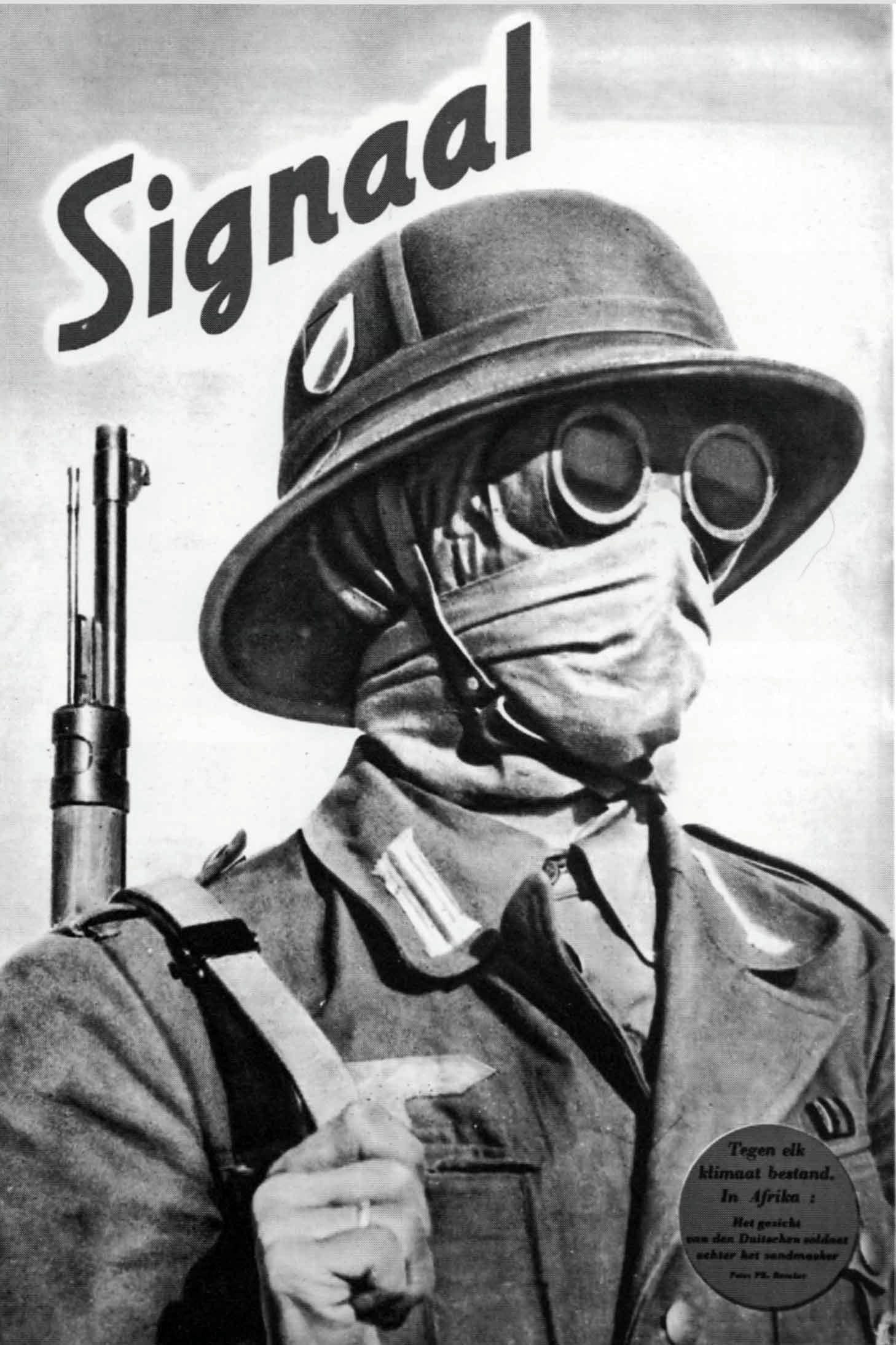
Erwin Rommel arrived in Libya in February 1941, where British forces had won a stunning victory over the Italians, who outnumbered them five to one. Fresh British troops were arriving on the battlefield, soon to meet the Deutsche Afrika Korps.
With so many titles already published about the war in North Africa, what scope is there for another? David Michelhill-Green had written several photographic collections of Rommel and the desert war (available in the ‘Images of War’ series) when he turned to a narrative account. ‘Hitler’s War in Africa 1941-1942, The Road to Cairo’ makes extensive use of personal accounts from wide research to build an accomplished, fresh perspective in a single volume.
Rommel’s ‘Sideshow in Africa’ was a minor affair compared with the titanic struggle on the Eastern Front. But it became a central preoccupation of the Allies, for a long time it was the only land theatre in which they faced the Germans. The see-sawing battles became a testing ground for men and machines, for tactics, logistics and strategy - and for a succession of Generals. It will always be of fascination to military historians - this volume includes a series of explanatory maps and relevant photographs - but here is an engaging account that brings the human story to the fore.
The following excerpt describes the general conditions encountered by German troops when they arrived in Libya:
‘Not a war in a palm grove’
Africa held the promise of adventure, at least at first. Siegfried Westphal recalled how the ‘number of volunteers for this theatre was understandably large, as the magic of the Orient has always attracted youth.’ Leutnant Ralph Ringler (104th Panzer Grenadier Regiment) welcomed news of his assignment. ‘Like madmen we jumped and hugged each other... We became a separate caste in the barracks - “The Africans”...our young comrades envied us, the old ones were amused by our enthusiasm ...in Africa there awaited great adventure.’
Hans Schmitz’s first impressions were ‘yellow and sandy ...Palms and small trees...Solitary settlements, mud huts and mats, tents, caravan roads, dried-out riverbeds. Everything disappeared against the sandy horizon.’
A German officer in the 21st Panzer Division enthused:
‘Fantasy has had a free rein - Africa - that’s tropical nights, palm trees, sea breezes, native oases and tropical helmets. Also a little war, but how can we be anything but victorious?’
Even the privations of thirst, heat and cold were to be braved in this ‘wonderful of theatre of war’ , a captured letter championed: ‘One might almost envy you [in] all these hardships.’
The largely featureless Western Desert - a title bestowed by the British during the First World War to the desert region west of the Nile River - was an ancient battlefield where decaying ruins attested to earlier occupations by the Greeks, Romans, and Ottoman Turks. These latest combatants too discovered an arid expanse capped by natural geographical barriers at either end.
The narrow point in Libya was at El Agheila on the border of Cyrenaica and Tripolitania (Libya’s east and west provinces respectively); the eastern bottleneck, as we will see, lay six hundred miles to the east at El Alamein. The Germans were novices in this setting, the distances unprecedented. Rommel’s 7th Panzer Division in France, for example, had traversed 268 miles to reach the English Channel in 1940. He now faced a march of 1,415 miles to reach the Egyptian city of Alexandria.
In stark contrast to a rumoured corps d’elite, Hitler’s army in Africa was a hastily assembled formation devoid of experience, specialised acclimatisation or training. Measures before leaving Europe were little more than briefings by officers who had visited Africa and lectures on tropical medicine. Not surprisingly, the DAK faced myriad problems. While the pitiless desert heat may have been expected, the cold nights were an unexpected misery. ‘Night and morning [were] really lousy cold,’ Hauptman Wolfgang Everth complained. Even with three blankets one is frozen like a naked ski instructor. One’s feet aren’t warm until midday.’
German troops were hurriedly outfitted for their new posting. The basic tropical uniform was cut in a style reminiscent of the Kaiser’s colonial forces. ‘What we were “fitted” out with defies description,’ Major Hans von Luck (who served with Rommel in France in 1940) wrote after receiving his tropical uniform. ‘One could see that Germany had no longer any colonies since 1918, and so had no idea of what was suitable for the tropics. We need only to have asked our allies, the Italians, but no, the commissariat had designed the tropical equipment strictly in the Prussian mode.’ The stiff, tight-fitting uniform linen material provided little protection against the summer heat or insulation against the penetrating cold. Further accoutrements included a linen belt, high lace-up boots and a pith helmet, which, supposedly, ‘was essential wear in the tropics’ and shirts ‘impermeable to air’ .
As von Luck writes,
Wounded men from North Africa, waiting there for reposting, told us how they, like many others, had carried on a lively trade with the Italians in order to exchange at least some of their equipment for the more appropriate Italian uniforms.
British tropical uniforms made of pure wool were also found to be much more practical in the desert arena.
Shipped in haste, the first Geiman vehicles unloaded at Tripoli’s Spanish Quay still sported a dark grey European camouflage. Conceived to fight a war on the Continent, the Panzers suffered enormously in desert conditions. The average life of a tank engine, for example, was halved without appropriate air filters and operating in a low gear for extended periods over long distances. Frustration features in Leutnant Schorm’s diary (6 April), shortly after setting off early in the morning:
Every vehicle loses its way. When we reach the Via Balbia again - who will? - our Panzers, or at least their engines, will be ruined. According to instructions, the engines must be changed at 2,000 km. Their life is given by the firm at 2,500 km. They have already done 500 km in Germany. We have come 1,000 km along the Via Balbia. By the time we reach Derna, every Panzer will easily have passed the limit of 2,000 km. 600 km will have been carried out across the desert - in dust and heat, and that counts for more than treble [the normal strain].
Though trucks could traverse much of the terrain, broken springs and shock absorbers engendered frequent breakdowns. Leutnant Dr Kurt Wolff Tank (5th Panze Regiment) watched as repair groups came to life at dusk, industriously repairing engines and cleaning carburettors. Springs, track rollers and track links have to be seen to and fixed. Guns and machine guns have to be checked. You can hear the swearing of hard-working men, the clanging of hammers in the wet and cold night. As soon as the sun rises through the morning mist, the Regiment starts to roll forward.
With spare parts not readily available, Rommel’s formations would rely heavily upon captured enemy transport. ‘If you want vehicles, then go out into the desert and get them’ , he directed. ‘Our destroyed vehicles are being replaced by excellent British cars,’ Schraepler noticed, so much so that ‘some German units will not be recognised as German, and one might think that there are English here. Besides, our men can barely be identified, covered by dirt and dust.’
Diet was another problem for the German soldier. A DAK Feldwebel vented his frustration in an October 1941 diary entry:
‘Isn’t it perfect mockery what they offer us here for food? Here of all places where you need more to keep your health than elsewhere. It doesn’t matter a damn if we go to the dogs: what matters is that Germany saves foreign exchange and will win the war.’
Schraepler dismissed the Italian catering as ‘more than poor...dry mouldy bread, for dipping into edible oil, butter substitute, plus canned meat. That was our lunch.’
As Schmidt explained to General Paulus during his visit to Tobruk in May 1941: ‘fruit and vegetables are unknown to the soldier. They miss their potatoes especially. The usual rations consist of sardines in oil, bulky tinned-meat sausages (Bierwurst)’ and Italian tinned beef, stamped AM (for Administrazione Militare, Military Adminstration) - a staple derided as Alter Mann (Old Man) because of the letters embossed on the can. Worse still, the Italian rations, rich in pulses (leguminous plants) and conserved meat with a high fat content, often led to jaundice.
Disease debilitated both sides. An Australian soldier poeticised the scourge, writing of a
‘Land of filth, of flies and fleas; home to every known disease...
So we may when then battle’s won give Libya to the greedy Hun;
For never could worse existence be, than to live in Libyan misery.’
Rommel, for all his vitality, was stricken with jaundice and other chronic illnesses during his time in Africa. He was ‘a sick man’ , Schmidt wrote.
In the period from March to June 1941 alone, the DAK lost 12,203 men - 3,512 as battlefield casualties, the rest through sickness. Rommel’s adjutant recorded the extent of the problem as early as May 1941, noting ‘scores of soldiers are sick. This number is increasing every day.’
Another officer complained,
‘sometimes as many as sixty per cent of us suffer from dysentery-like diarrhoea at the same time. No one is spared. When you have it, you don’t know whether you want to live or die.’
© David Michelhill-Green 2020, ‘Hitler’s War In Africa 1941-1942’. Reproduced courtesy of Pen & Sword Publishers Ltd. An Amazon link is currently unavailable.

Recently on World War II Today ...

