

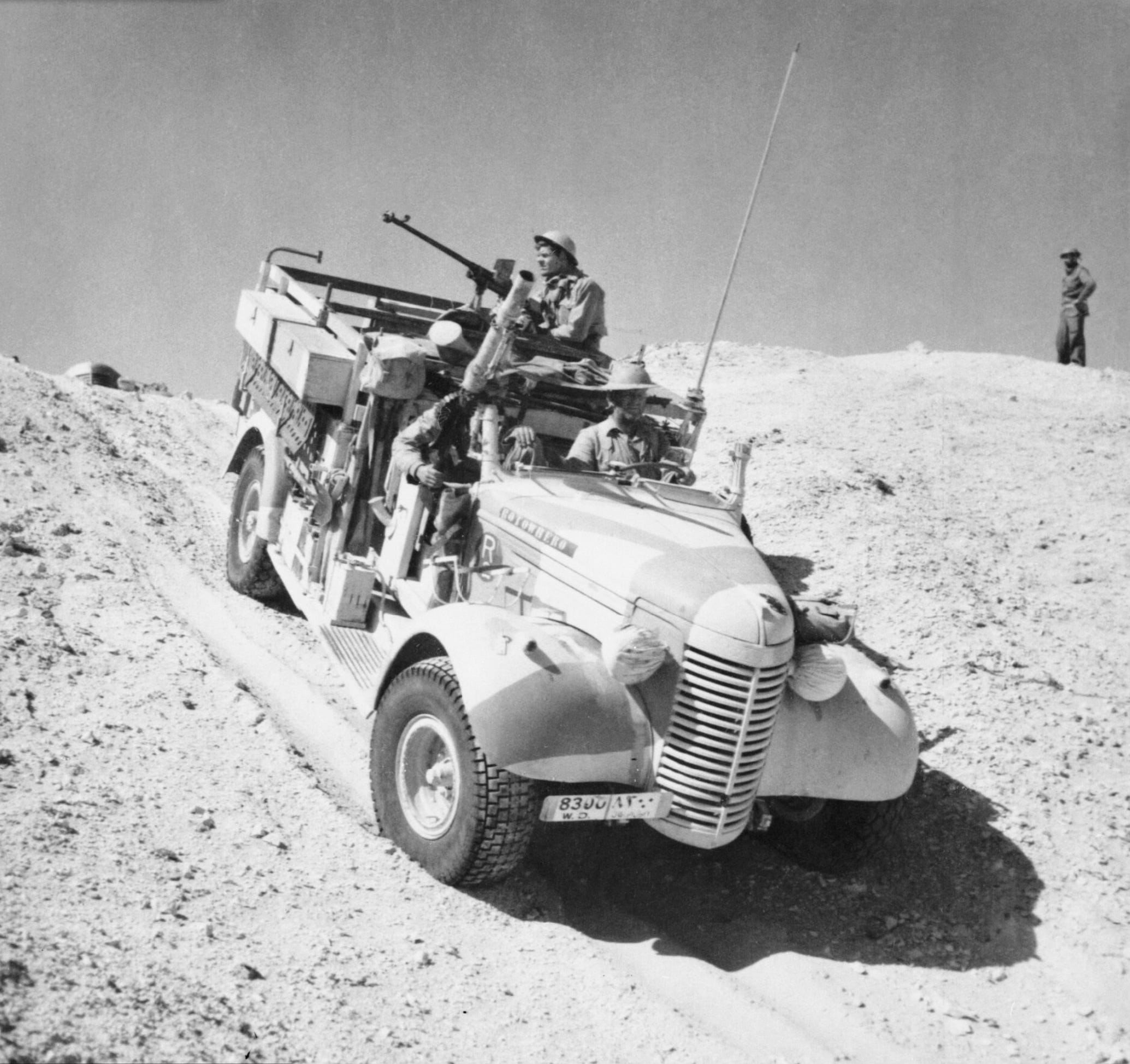
W. B. Kennedy Shaw was one of the pioneers of desert exploration before the war; one of his expeditions took him a thousand miles into uncharted wilderness on a small camel train. His navigational expertise was invaluable to the LRDG, established by his fellow explorer, Ralph Bagnold, in June 1940. Kennedy Shaw was to write up his experiences in 1943, simply entitled Long Range Desert Group: Behind Enemy Lines in North Africa, at the conclusion of the Desert campaign. In 1945, it was one of the first memoirs ever published about the behind-the-lines exploits that became the foundational experiences for the establishment of Special Forces.
January 1941 was still the early days for the LRDG; not all of the different patrols had yet been in action. The Italians at the airfield at Murzuk could not reasonably expect to be disturbed by a raiding party:
Lunch over, we set off to finish the last two miles of the journey which had begun in Cairo eighteen days and 1500 miles before. Clayton led in his 15-cwt., then Hewson with one troop of ‘T ‘ patrol, and then the rest - a quiet procession of cars, down the scarp on which we had halted, through some broken ground, over a low ridge and into the outskirts of the town, I wondered if the Italians had. had the foresight to put even one, machine-gun post on the Sebha road. Luckily they had not, and we had achieved the advice of their own Machiavelli :
“ Those enterprises are best which can be concealed up to the moment of their fulfilment.”
The road seemed to lead to the fort so Clayton followed it. At a well by the roadside a group of natives gave the Fascist salute and cried “ Bon giorno.” A little farther Clayton overtook Signor Colicchia, the postmaster, bicycling towards the fort, and hustled the terrified official on to his car as a guide. Ahead I could now see the fort, partly hidden by trees and with some after-lunch strollers around it. The surprise was complete.
Then things began to happen. Hewson swung off the road to the left and opened fire on the strollers ; the Guards turned to the right and started to engage the fort. I was with Bruce Ballantyne with the other half of T patrol who were to tackle the airfield. The hangar was now out of sight, so from a group of natives outside a hut I seized a Sudani for a guide and pushed him on to the truck. No doubt he thought he was going to be murdered and he was paler than I should have thought a black man could be. He was too scared to speak and soon fell off, but by now we could see the hangar and were racing to beat the landing ground guards to their machine-gun posts. Bruce with two trucks got there first and most of them surrendered without firing, but he killed the last man, still fumbling with his rifle, with a quick shot through the head.
Out of the corner of my eye during this confusion I had seen Clayton’s car crossing the aerodrome and wondered how he had got there. A few minutes later he joined us with his car full of bullet holes and d’Ornano’s body in the back. Round the corner of the hangar he had run into a machine-gun post which one of he bolder Italians had manned. Beside him, in the front- seat, Adams’s Vickers gun had jammed, and before Clayton could slam the gears into reverse d’Ornano on the back had been killed with a bullet through the throat and also an Italian Air Force sergeant whom Clayton, having handed over the postmaster, had roped in as another guide. No doubt the Italians thought we had shot him in cold blood, but this is the truth about his death.
We got the Bofors going on to the gun post and the hangar and before long the twenty odd Italians had had enough of it and one of them appeared on the roof waving a white flag. Three dead or dying Libyans and one wounded Italian were their casualties. In the middle of it all I remember seeing, shuffling with half-bent knees across the landing ground, that so familiar African sight, a string of old women carrying firewood bundles on their heads.
Meanwhile at the fort, where Hewson had been killed and Wilson and three other men wounded, the patrols were successfully containing the garrison and a lucky mortar bomb had set the tower ablaze and burnt the flag and flagstaff. In the middle of the attack a touring car drove up to the gate. In it was the Italian commander who had probably been out to lunch and also, as some said afterwards, a woman and child. One shell from the Guards Bofors put an end to them ; it was unfortunate about the woman and the child but people should arrange their lunch parties more carefully.
… for lack of transport space and rations, we let the rest go, to the disgust of the French who would happily have cut their throats.
In the hangar were three Ghiblis (Colonial bombers) and finding a portable re-fuelling tank which was full I set the Libyan prisoners to pump petrol over the aircraft. I remember being surprised to find them fitted with Lewis guns ; such are the mysteries of the international armaments business. As we were finishing Clayton came back from the fort saying that the garrison continued to hold out and that as the main objective, the destruction of the aircraft and hangar, would be achieved he proposed to withdraw. From what we heard afterwards the fort was probably on the point of surrendering, for that evening the French ative troops said that they had heard cries of “ Nitla burra. Nitla burra ” (“ Let’s get out ”) from the Libyans. They may have been insisting on an offensive sortie, but it seems more likely that they had had enough.
Ballantyne had moved his trucks and prisoners away from the hangar and we laid a trail of petrol to the door. One match struck and before we were off the landing ground the hangar was ablaze and the bombs and ammunition exploding. As we moved out of the town a few minutes later I looked back to see the roof collapsing on to the aircraft within. Of the twenty odd Italian prisoners sitting downcast on the edge of the landing ground we kept four of the most intelligent-looking and, for lack of transport space and rations, let the rest go, to the disgust of the French who would happily have cut their throats.
We left the town by the same road. In the ditch lay the postmaster’s bicycle which I picked up and tied to the back of Beech’s truck, thinking it would be useful for riding to the office in Cairo, but though Beech carried it for three weeks it was finally lost to me, burnt with its former owner in the action at Gebel Sherif.
A cold sandstorm was blowing when we buried Hewson and d’Ornano by the roadside just outside the town, with the shivering Italian prisoners standing dejectedly by and wondering, I expect, if graves would soon be dug for them. Their countrymen in Murzuk showed no signs of pursuit and we camped that night at Diem, where the villagers turned out and received ’Abd el Galil with enthusiasm. In the base wireless room in the Citadel in Cairo the faintly-heard dots and dashes of our No. n set were giving Bagnold the news, good and bad. This range - it is a thousand miles from Murzuk to Cairo - taxed the abilities of the signalmen to the uttermost.
© WB Kennedy Shaw 1945 & 1989, ‘Long Range Desert Group: Behind Enemy Lines in North Africa. Reproduced courtesy of Pen & Sword Publishers Ltd.

Affiliate Links
Recently on World War II Today ...

