

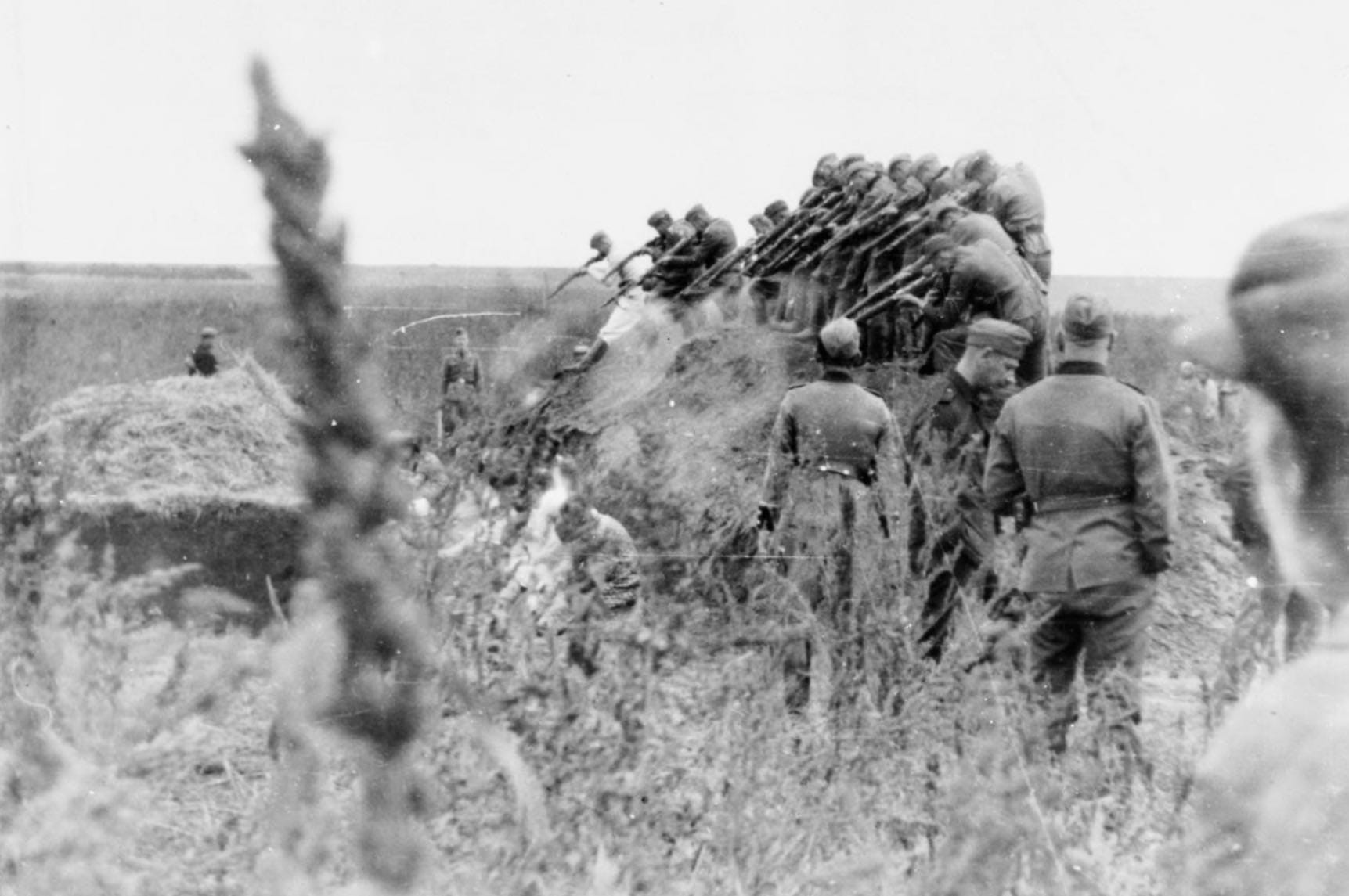
Around half the population of the Lithuanian capital Vilnius was Jewish at the beginning of the war, some 70,000 people. At the beginning of September, the process of herding the Jews into two small ghettos had begun, organised by the Reichskommissar for the Ostland, the new Nazi authority in the east.
There was an ongoing dispute between the Reichskommissar - the ‘civilian authority’ - who wanted to restore industrial production and the Einsatzgruppen leader who wanted ‘ a radical treatment of the Jewish question’.
The Nazis soon realised that there was insufficient room in the old Jewish quarter of the city to accommodate half the city’s population. On the 2nd September, a proportion of the Jews were marched off to the Lukiszki prison and then taken in the direction of Ponary, where there was a railway station.
Then around 7,000 Jews - men, women, and children - were marched off to Lukiszki prison under brutal conditions. Here a proportion of men - doctors, engineers and skilled workers - were separated out and sent back to the ghetto.
The remainder remained in the prison. Sima Katz and her three children were amongst them:
At Lukiszki we were kept outside for two days and then put into cells. We learned that the previous inmates had been sent to Ponary, but no one thought that all of them had been killed.
We remained there until Thursday [11th September 1941]. At two a.m. the prison square was suddenly illuminated with floodlights. We were put aboard trucks, fifty to sixty women in a truck. In each vehicle there were armed Lithuanian sentries. The trucks headed for Ponary. We came to an area of wooded hillocks and were dumped among them.
Suddenly the truth hit us like an electric shock.
Still, the mind would not keep pace with reality. We were arranged in rows of ten and prodded toward some spot, from which came the sound of shooting. The Lithuanians then went back for more batches of people.
Suddenly the truth hit us like an electric shock. The women broke out in piteous pleas to the sentries, offering them rings and watches. Some fell to the ground and kissed the sentries’ boots, others tore their hair and clothes to no avail.
The Lithuanians pushed one group after another to the site of the slaughter. By noon, when it became clear that there was no escaping this fate, the women fell into a kind of stupor, without any pleading or resistance. When their turn came, they went hopelessly to their death.
‘I held my breath and strained my ears. Moans and sounds of dying people, and from above came the amused laughter of the Lithuanians. I wished myself dead so that I would not have to hear the sounds. Nothing mattered. It did not dawn on me that I was unhurt.’
Suddenly we saw a group of men. At their head was an aged rabbi, wrapped in his prayer shawl; passing us he called out "Comfort ye, comfort ye my people." We were seized with trembling. The women broke into moans, and even the Lithuanians took notice. One of the guards ran up and hit the rabbi with the butt of his rifle.
My daughters and I were on the ground. Other women did not wait to be led away but broke from the rows and went on. The rows were broken. The women sat down and waited for a miracle to halt the massacre. I had one thought in mind: to be among the last.
Our turn came at five-thirty. The guards rounded up the remaining women. I felt my older daughter's hand in my own... .
When I came to, I felt myself crushed by many bodies. Feet were treading on me, and the acrid smell of some chemical filled the air. I opened my eyes; a young man was sprinkling us with quicklime. I was lying in a huge common grave.
I held my breath and strained my ears. Moans and sounds of dying people, and from above came the amused laughter of the Lithuanians. I wished myself dead so that I would not have to hear the sounds. Nothing mattered. It did not dawn on me that I was unhurt.
A child was whimpering a short distance away. Nothing came from above. The Lithuanians were gone. The whimper aroused me from my stupor. I crawled toward the sound. I found a three-year-old girl, unharmed. I knew that if I survived, it would be thanks to her.
I waited for darkness to fall; then, holding the child in my arms, I wriggled up to the surface and headed for the forest. Not far in the interior, I came upon five other women who had managed to survive. Our clothes were smeared with blood and burnt from the quicklime. Some of us had nothing but our underclothes on our skin.1
Katz joined the five other women who had survived. After hiding for two days in the forest, a local peasant eventually helped them.
The SS reported that they killed “993 Jews, 1,670 Jewesses and 771 Jewish children” in this action.
Masters of Death: The SS-Einsatzgruppen and the Invention of the Holocaust
A slightly different translation appeared in Ghetto in Flames. The Struggle and Destruction of the Jews in Vilna in the Holocaust.