Many aspects of Operation Barbarossa remain opaque to this day. German military operations were conceived on an unprecedented scale and unfolded over a vast area, causing immense casualties to the Red Army and the ordinary people of the Soviet Union. The scale of the barbarism is beyond comprehension.
But the Russian first-person accounts that survive give us only a brief glimpse of what happened. Many reasons explain why the Soviet perspective is limited: most participants did not survive the battles of annihilation of this period. The Soviet system also permitted only an authorised narrative of events to survive until long after the war.
There are also huge gaps in the German account of events - because most of the German participants were also killed - eventually. Over 3 million Germans were involved in the initial invasion. Over 5 million Germans would die on the Eastern Front during the course of the war. So the accounts that the survivors left behind are only a small part of the story.
These reservations especially apply to naval operations. While naval battles in the West of equivalent size and significance are now well documented, many details of what unfolded in the East are probably lost for all time. Danish Naval officer Poul Grooss, a Russian-speaking intelligence officer and veteran of NATO operations in the region during the Cold War, managed to fill in many of the gaps during his research for The Naval War in the Baltic, 1939-1945, an impressive accomplishment. So at least we now have a one-volume overview of events, including the ‘Soviet Dunkirk’:
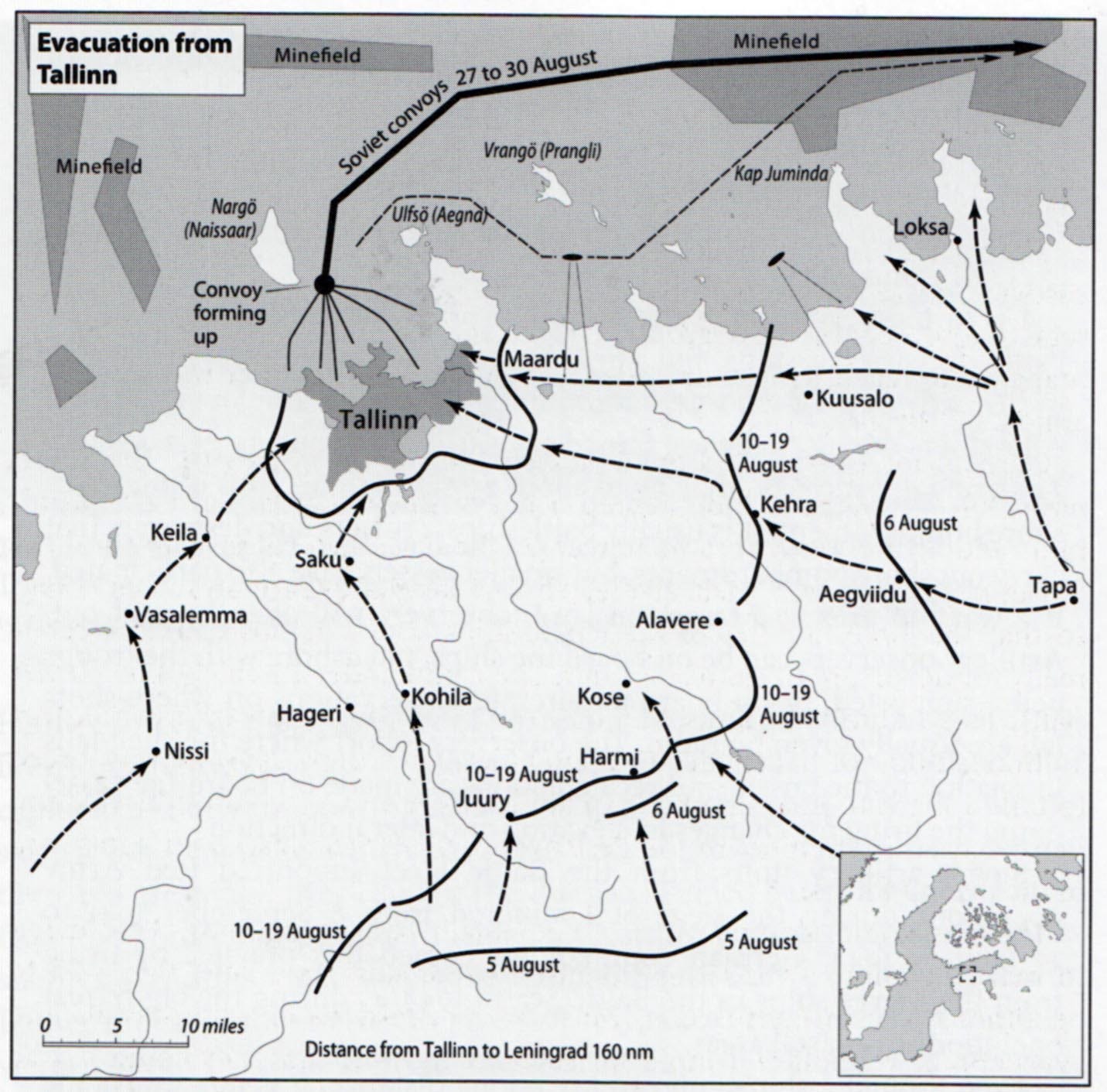
The evacuation of Tallinn: the ‘Soviet Dunkirk, or the mine battle at Tallinn
On 7 August, German troops reached the city of Kunda on the Estonian north coast, 50 miles/8okm east of Tallinn. This meant that Soviet units in Tallinn were then unable to retreat over land. They could now only be evacuated by sea. This applied to those remaining from three divisions, the 1oth Division, the 16th Division and the 22nd Division, and units from the Marine Corps. The attackers knew immediately how to exploit the situation.
During the next fourteen days, German and Finnish forces laid a large number of mines in the Juminda minefield, which in reality consisted of nineteen separate minefields. Cape Juminda is one of the northernmost points on the Estonian coast and the German army set up a 6.5in/170mm coastal battery here.
Initially, the minefield consisted of 1,370 mines and a similar number of explosive buoys laid as minesweeping obstacles, but in the following days, further mines were laid. The minefield went across the Gulf of Finland from the Estonian coast to Söderskär, off the Finnish coast. The operation was intended to prevent the Soviet units in Tallinn harbour from escaping back to Leningrad. The Soviet Union decided to evacuate Tallinn, and sent two hospital ships eastward on 10 August with the injured from previous battles. There were a total of 6,500 people on board the two ships. One of the ships hit a mine, but managed to reach Kronstadt under its own power. The other was sunk with almost no survivors.
German forces launched the attack on the city on 19 August. The Soviet naval forces sought to hide behind a heavy smokescreen, but German air raids and artillery fire became fiercer by the day. The cruiser Kirov and the Soviet destroyers used their artillery fire to keep the German forces at bay, so that the large number of merchant ships and warships could be made ready for departure from the harbour. The commander-in-chief of the Soviet Baltic Fleet, Admiral Tributs, had informed Stalin just a few days earlier that Tallinn would not fall to the advancing German troops. Now he was forced to take a flight to Leningrad to explain himself, and Vice-Admiral Valentin Petrovich Drozd on board the destroyer Stoikiy (Steadfast) took command of the overall forces.
Vice-Admiral Valentin Petrovich Drozd’s fate has been quite difficult to investigate. One source said that he died in a car crash, and it is always necessary to be sceptical when people are reported dead in traffic accidents under Stalin’s regime. Another source said that he had fallen in battle. After numerous investigations, it was discovered that both sources were correct. On 29 January 1943, Vice-Admiral Drozd was on his way across the ice in a staff car from Kronstadt to Leningrad, when German forces opened fire with artillery from the coast near Petrodvorets. The car fell into a hole in the ice caused by a shell falling in front of it and everyone in the car died.
The decision-making process under Stalin was dangerous. Few dared to make decisions themselves because of reprisals. As a rule, they had to be either taken or approved in Moscow, so decisions on withdrawals and evacuations were often delayed for such a long time that they could not be implemented as originally proposed. Local commanders often had a better understanding of the situation, but the Soviet leadership was racked with suspicion and indecision. Furthermore, the local commanders sometimes had to embellish the situation a little, in order not to fall out of favour.
On 27 August, the Soviet units were finally ready to evacuate Tallinn in about 170 ships divided into four convoys, of which twenty-nine ships were over 6,000 tonnes. The relatively concentrated air defence on the ships in the harbour area could keep the German aircraft at a distance, but as soon as the convoys were formed up out to sea, they were subjected to threats from mines, submarines, aircraft, torpedo boats and shore batteries. The distance to Leningrad was about 160 nautical miles (300km). The weather was bad and the minesweepers in the force could not immediately set out their minesweeping equipment because of the heavy seas.
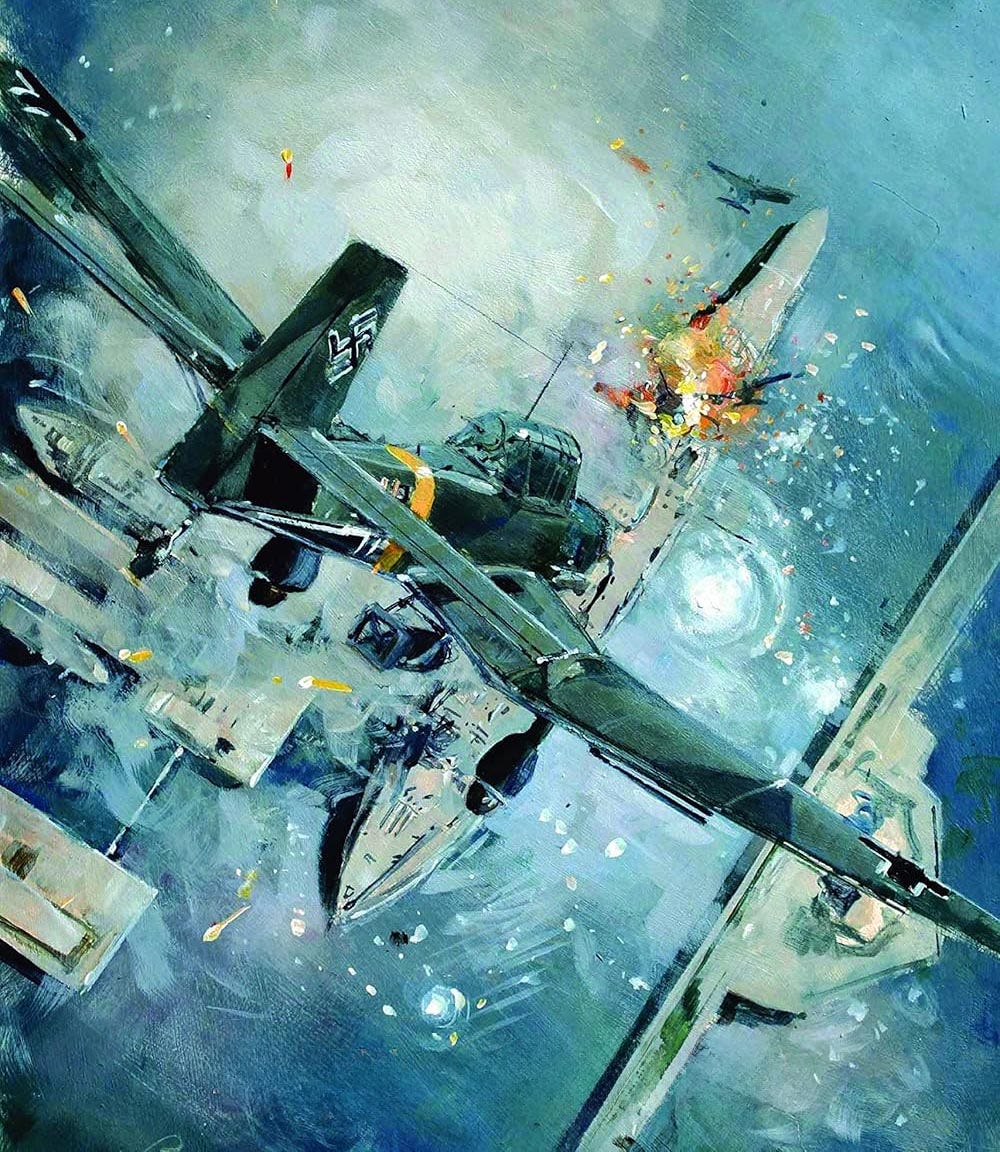
When the convoys reached Cape Juminda, the fighting began in earnest. When the first mine detonated, the progress of the entire Soviet force was stopped. At the same time, the German coastal battery opened fire and seven Junkers Ju 88s launched a bombing raid. The cruiser Kirov fired some very precise counter-battery shelling with her 7in/18omm guns at the German coastal battery on Cape Juminda, which was destroyed.
Some ships in the convoy tried to force their way through the minefields, while others dropped anchor for the night and prepared themselves to continue the next morning. Five of the nine Soviet destroyers were sunk. Four of them were older Soviet destroyers from 1915, now named after political VIPs (Yakov Sverdlov, Kalinin, Artem and Volodarsky). The fifth was the brand new Skoryi (Rapid), built in 1941. In addition, two of the three frigates, Sneg and Tsiklon (Cyclone), were sunk. Of the twelve submarines, S-5 and Shch-301 were sunk. Twenty-five of the twenty-nine larger merchant ships were sunk, three were put aground, and only one of them reached Leningrad.
Approximately two-thirds of the convoy’s ships reached Leningrad, but it was mainly the small vessels that successfully negotiated the voyage. The two largest of the sunken merchant ships, Ivan Papanin and Vtoraya Pyatiletka (Second Five-year Plan), each had more than three thousand soldiers on board. In the Stalinist system, the rule was that in the case of failure, some scapegoats were required. Among the few rescued persons were individual ship’s captains who had been fished out of the water and brought to Leningrad. Most of them had behaved very heroically in the situation, but they were nevertheless put on trial and executed. They were rehabilitated in 1962.
Germany called the subsequent battle Die Minenschlacht von Reval (the mine battle at Tallinn), and regards this as the most successful mining operation in the history of naval warfare. Altogether, 2,828 mines and 1,487 explosive buoys were laid. The official number of Soviet casualties during the voyage of the convoy from Tallinn to Leningrad was set at 10,000 immediately after the war, but is now estimated to be 14,000 people. Sixty-five ships went down, but about 28,000 people and 60,000 tonnes of equipment reached their destination.
The Soviet defence was not very well organised in 1941, but the forces, and not least the Baltic Fleet, fought fiercely and succeeded in inflicting a number of losses on the German forces. Their inferiority in equipment was often offset by personal heroism, patriotism, fighting spirit and tenacity. The regime had also ensured, primarily with the help of Communist Party functionaries and NKVD units (the secret police, which also included border troops), a reduction in the possibilities for desertion, speaking out in defeatist terms, and similar.
Soviet historiography during and just after the war painted a rosy picture of a united people who were behind all the decisions of the Party and fought against hunger, cold and superior power. A somewhat more nuanced picture of the abuses of the system against its own citizens, criminality, cannibalism, and much more, is slowly becoming available to historians, but a number of Soviet archives are still inaccessible.
The more recent statistics show, for example, that starvation did not take nearly as many victims among members of the Communist Party elite, NKVD personnel and employees of the food industry as in the general population. The general picture of the city’s leadership, like so many other places in the Soviet Union at that time, is characterised by incredibly bad leadership, lack of sense of responsibility, poor, slow planning, corruption and nepotism. For example, there is anecdotal evidence that Party Secretary Zhdanov, in the middle of the worst of the famine in 1942, had fresh peaches flown in by courier plane.
© Poul Grooss 2014 & Seaforth Publishing 2017, ‘The Naval War in the Baltic, 1939-1945’. Reproduced courtesy of Pen & Sword Publishers Ltd.

Affiliate Links
Recently on World War II Today ...