

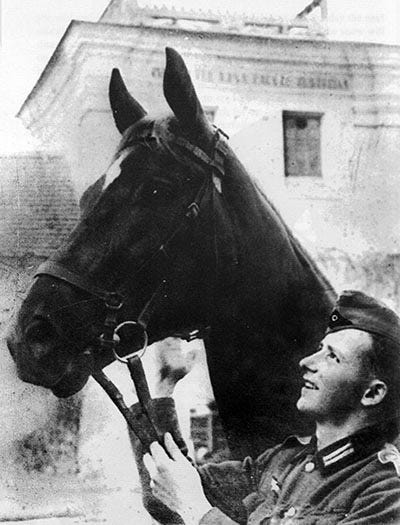
Max Kuhnert (1917-1990) was a very experienced cavalryman in 1941, having served in Belgium and France in the mounted reconnaissance troops of an Infantry Division during the invasion of 1940. As a senior NCO in 1941, he had a hugely responsible role, often right out in front for the whole Division.
‘Will We See Tomorrow’ has a graphic description of the conditions in Russia in early August 1941. Kuhnert was not involved in the fighting for Gomel, which was the site of a terrible battle and much suffering, its population reduced from 144,000 to 15,000 during 1941-1943. But an incident in the woods and swamps of Russia was burnt onto his memory. Kuhnert found himself nursemaiding a young officer, who was not only a very inexperienced horse rider but had much to learn about the skill and craft of mounted scouting …
Our destination was ‘Gomel’, though this was only the plan. On the way, we were to meet stiff resistance, and also have to make our way through the treacherous Rekidnov swamps, which occupied the whole area in between. The main objective was to go as fast as possible south - perhaps our division was needed to strengthen or at least to help out with some encirclement.
Relentlessly we marched on, and now we, the ‘lot on horseback’, really came into our own. Not only had we to scout to find the enemy, but we also had to look for a comparatively safe route for all vehicles, including tanks. You can imagine what it would be like for a heavy vehicle to get caught in a swamp. It was not just a matter of riding ahead now, but of riding ahead of the infantry point, with their scouts on foot. We, on horseback, had such advantages as having four rather than two legs, and of being able to see further; on the other hand we could also be seen more easily, and we presented a larger target. There were scout cars, but in a swampy area they were hardly a first choice.
This was no small order for us and I could see right away that we would have to work hand-in-hand with Lieutenant Weigert’s troop. Since the Lieutenant had no experience whatsoever I suggested that he might follow me. .
‘That would hardly be fair,’ Sergeant Helm said. It would sap his confidence, or at least hurt his pride. Why not take two of each of the squad of my rider troop and him. It would look much better. My five members, including Corporal Krizock, would go along with Erich Helm to the Battalion.
‘Well... all right, then,’ I said, not really agreeing, but seeing the sense. After all, I hardly knew his men, and having such a greenhorn to drag along on an important mission like this went strictly against the grain. However, just for the sake of peace, I agreed and went to Lieutenant Becker to be briefed.
Confounded bloody war, I thought. I really was worried. We parted and set off on our respective routes. The maps were not much help at all; the compass was most important now.
There were eight of us. I didn’t even know the names of Erich’s boys, so I just pointed to a young corporal to take the first stretch as front scout. Then I followed with Lieutenant Weigart, at a distance but so that we could still see one another, as we usually did in the daytime, and the rest did exactly the same behind us.
Lieutenant Weigert was like a kid, asking question after question, and really took my concentration away, for I had to keep a very watchful eye on the front scout for any signal. In the end, I asked him to keep quiet and told him that I would tell him in my own way, if necessary, what was required and when. After all, this was not a training exercise, but in deadly earnest. At most of the forest corners or any bends or groups of houses, I cantered ahead to join the front scout whose name, I learnt, was Ebert. We called it observation halt; I always consulted the Lieutenant first, out of courtesy, blast it. Several times Ebert used the drawing manoeuvre described earlier.
After one hour’s march nothing had happened, and I again called a halt. I exchanged Ebert with a rider from the rear, by the name of Henkel, a shortish blond chap, a bit scared. It was his first time at the front, and it was showing.
‘Well’, I said, ‘you have got something to look forward to,’ but then I briefed him by telling him exactly what to do. One person was learning fast, and that was Lieutenant Weigart.
It was a highly organised operation. Everyone was connected with the essential units, such as anti-tank guns, two of them from 14 Company. Our men in the rear were in touch by sight with the infantry scouts and they in turn with their company commander. The only difficulties were the flanks.
The terrain was changing constantly, and many times we were unable to keep exactly to the strait and narrow, so to speak, as the compass told us. Our orders were to stop only when absolutely necessary, and a complete halt for a rest or for the night could be made only when it was ordered from the rear, and then only if it was a safe position, whatever that meant.
We were getting rather tired after two or three hours on the march under constant tension. Plenty of wooded countryside was in front of us, but so far we had had no contact with anyone -we hadn’t even spotted a plane from either side. The countryside was beginning to turn swampy; we could see, here and there, greener patches of grass with smaller patches of reeds in between. I pointed them out to Lieutenant Weigert and suggested that we send a man back to report it to the company commander behind us. Henkel, out front, had done very well so far, until we heard rifle and machine-gun fire out front, to our right, a long way away yet, at which he came galloping back.
Siegfried’s … ears were telling me everything, twitching and turning at the slightest sound.
‘Go back,’ I shouted, ‘and keep going; they have nothing to do with us, but be very observant,’ but then I changed my mind. ‘Would you mind if I went myself to the front, and you take over here, Lieutenant?’ ‘No, not at all,’ he answered, his voice very throaty. So off I went, hoping that the time lost, about three or four minutes, had not changed anything out front. I felt a great deal better now, not having to rely on someone else. Siegfried [his horse] also seemed much more alert and his ears were telling me everything, twitching and turning at the slightest sound.
The firing had stopped and I approached smaller squarish pieces of woodland, mostly pines and very dense at that. As I stopped for a moment to skim the edges of them with the glasses, I thought I saw something, but I was not sure at first; only when I scanned the area again could I see quite clearly movements among some pines, while the other trees were quite still and there was no wind about. I signalled back to the others to stop and went on till I was in rifle range.
Observing the flank where there were also some pine patches, I signalled for an observer to be sent to the left and scout the small woods, and then galloped back to the comparative safety of the trees. Lieutenant Weigert had already gone. But I had not asked him to go, but to send someone. He had left with Ebert and Henkel to explore the woods, trotting, if you please, as if we were on Luneburg Heath, right across the plain, virtually holding hands with each other.
Well, there they go, I thought, mad with myself for having allowed such a stupid thing. What if the Russians were just waiting for them in those woods? After all, I had observed movements out front, and shooting had been going on on the right, so why shouldn’t there be any on the left?
I decided to go after them, telling the others to stop and spread. I circled first to the left to try to get a better look around the wooded edges, but could see no one and eventually went straight for the opening between the two forest islands. No sooner had I reached the first corner, than I saw them, about two hundred metres away, still together as if they were inspecting the birds. I knew I had told them to look up into the treetops from time to time, but this was ridiculous.
… the only screams I could hear were from their horses.
I observed that they had ridden along the edge of the wood, which was all right, and then had turned in the middle, towards the nice green grass, in the tell-tale reeds. Too late for me to do anything, though - fire was spitting at them from the right; instead of riding into the wood on the right, they panicked and turned, galloping like mad, straight into the green that I knew was swamp. They all went down, and the only screams I could hear were from their horses.
I froze completely, not believing what I saw. There was nothing I could do. I just stood there until they had practically disappeared. I realised that the Russians had not seen me yet because they were concentrating on those poor devils. Oh, how I hated myself.
I galloped along the edge and raced back till I was in touch with the first infantry scout. I told him what had happened and turned to signal to my men, the remainder of them, calling them in, still shaking at the knees. I dismounted then and tried very hard to control myself and not to scream.
Colonel von Gratz called me to his tent, or rather he was waiting for me outside it. What was I going to tell him? Here we go, I thought, I am really for it. Major Mauve and Lieutenant Becker were also there, with several young officers. ‘Well, all right, Kuhnert, let’s hear all about it. We haven’t got much time. By the way, we are all very sorry. Bloody bad luck.’
I told him everything and he said in a whisper, ‘I should have known better.... He was too damn young, with no sense, and the other two just lads as well. All so unnecessary. What a waste....
© Estate of Max Kuhnert 1993, ‘‘Will We See Tomorrow, A German Cavalryman at War 1939-1942’. Reproduced courtesy of Pen & Sword Publishers Ltd.

Affiliate Links
Recently on World War II Today ...

