

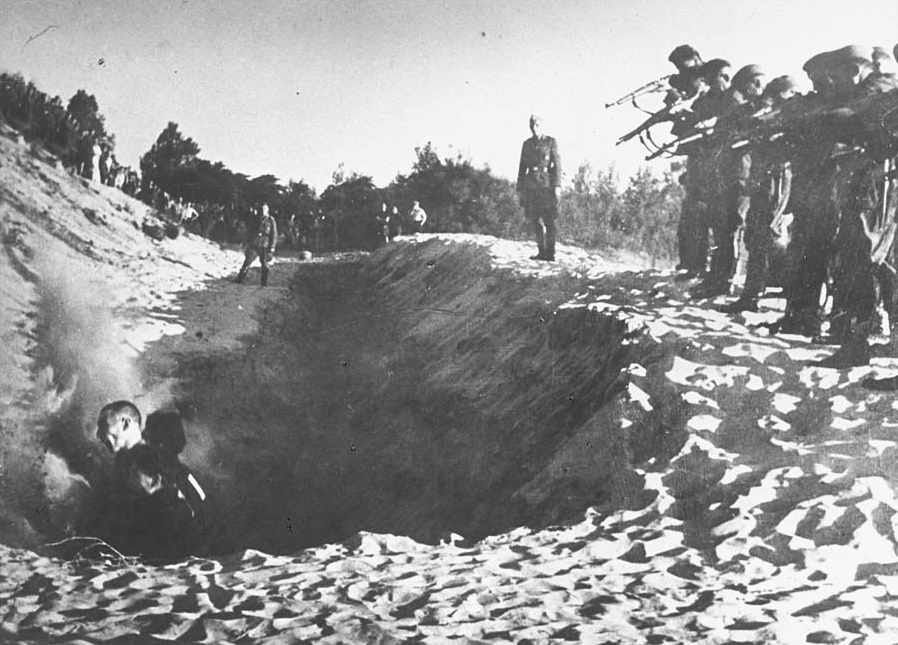
As a member of the Austrian SS, Felix Landau had been involved in the murder of the Austrian Chancellor Engelbert Dollfuss in 1934. After 3 years in jail, he became a naturalised German citizen and joined the SS Security Police. In 1940, he was awarded the Nazi Blutorden, the ‘Blood Order’1 for his part in the failed coup.
Isn’t it strange, you love battle and then have to shoot defenceless people.
At the end of June 1941, he volunteered to work in the Einsatzgruppen (special action groups). He was part of the killing squad that followed the German invasion of eastern Poland and then Russia. It seems that he partly volunteered because of a difficult relationship with his girlfriend. His diary is full of references to missing her and to waiting for a letter from her.
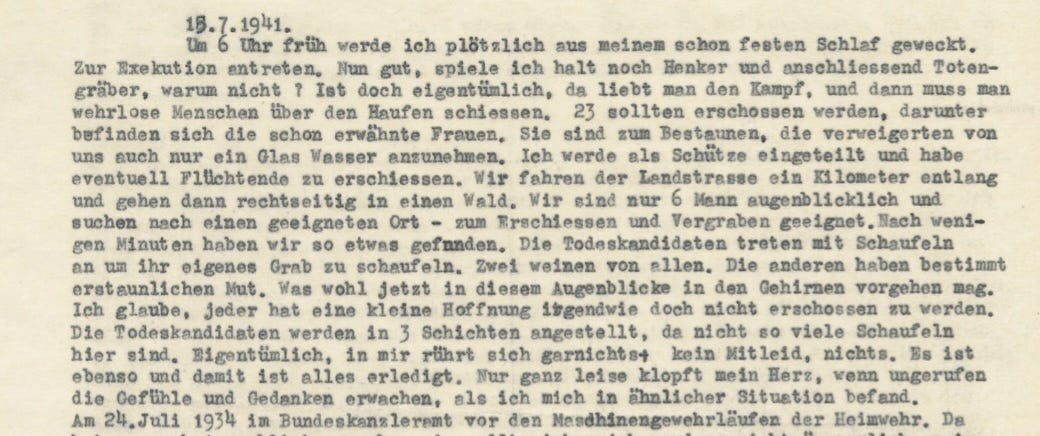
The diary2 is also completely open about his new line of work - shooting Jews.
12 July 1941
At 6.00 in the morning I was suddenly awoken from a deep sleep.
Report for an execution. Fine, so I’ll just play executioner and then gravedigger, why not? Isn’t it strange, you love battle and then have to shoot defenceless people. Twenty-three had to be shot, amongst them the two above-mentioned women. They are unbelievable. They even refused to accept a glass of water from us.
I was detailed as marksman and had to shoot any runaways. We drove one kilometre along the road out of town and then turned right into a wood. There were only six of us at that point and we had to find a suitable spot to shoot and bury them. After a few minutes we found a place.
The death candidates assembled with shovels to dig their own graves. Two of them were weeping. The others certainly have incredible courage. What on earth is running through their minds during those moments? I think that each of them harbours a small hope that somehow he won’t be shot.
The death candidates are organized into three shifts as there are not many shovels. Strange, I am completely unmoved. No pity, nothing. That’s the way it is and then it’s all over.
My heart beats just a little faster when involuntarily I recall the feelings and thoughts I had when I was in a similar situation. On 24 July 1934 in the Bundeskanzleramt [Chancellery] when I was confronted with the machine-gun barrels of the Heimwehr [Austrian militia, 1919-38]. Then there were moments when I came close to weakening. I would not have allowed it to show, no, that would have been out of the question with my character. ‘So young and now it’s all over.’ Those were my thoughts, then I pushed these feelings aside and in their place came a sense of defiance and the realization that my death would not have been in vain.
‘And here I am today, a survivor standing in front of others in order to shoot them. Slowly the hole gets bigger and bigger; two of them are crying continuously. I keep them digging longer and longer; they don’t think so much when they’re digging. While they’re working they are in fact calmer.’
And here I am today, a survivor standing in front of others in order to shoot them. Slowly the hole gets bigger and bigger; two of them are crying continuously. I keep them digging longer and longer; they don’t think so much when they’re digging. While they’re working they are in fact calmer. Valuables, watches and money, are put into a pile. When all of them have been brought to stand next to one another on a stretch of open ground, the two women are lined up at one end of the grave ready to be shot first.
Two men had already been shot in the bushes by our KK. [Kriminalkommissar] ... I did not see this as I had to keep my eyes on the others. As the women walked to the grave they were completely composed. They turned round.
Six of us had to shoot them. The job was assigned thus: three at the heart, three at the head. I took the heart. The shots were fired and the brains whizzed through the air. Two in the head is too much. They almost tear it off. Almost all of them fell to the ground without a sound. Only with two of them it didn’t work. They screamed and whimpered for a long time. Revolvers were no use. The two of us who were shooting together had no failures.
The penultimate group had to throw those who had already been shot into the mass grave then line up and fall in themselves. The last two had to place themselves at the front edge of the grave so that they would fall in at just the right spot. Then a few bodies were rearranged with a pickaxe and after that then we began the gravedigging work.
I came back dog tired but the work went on. Everything in the building had to be straightened up. And so it went on without respite.
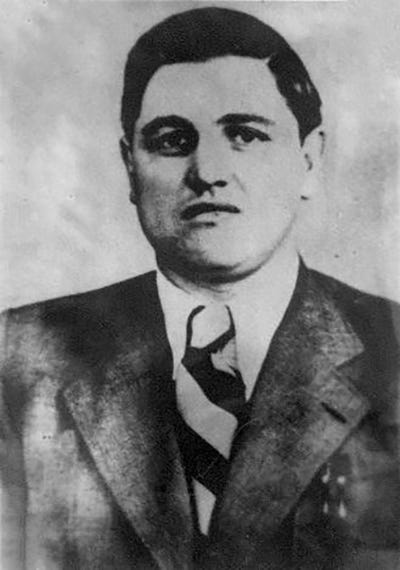
The Nazi Blood Order (Blutorden) was one of the most prestigious and exclusive decorations in the Nazi Party. Officially instituted by Adolf Hitler in March 1934, it commemorated the failed 1923 Beer Hall Putsch in Munich and subsequent Nazi attacks.
The Good Old Days: The Holocaust as Seen by Its Perpetrators and Bystanders
For the original typescript, see
“Wartime Diary of Felix Landau (1910-1983)” (1941). Bulmash Family Holocaust Collection. 2022.1.30a-o. https://digital.kenyon.edu/bulmash/1877
These events took place near Drohobycz, now in western Ukraine.
At least two executions of Jews took place soon after the arrival in the city of the SD-Einsatztrupp. On July 12, that unit murdered 23 Jews, including two women, in the woods near the city, and on July 22, 20 more Jews were killed.
Project Muse at the USHMMM
Marcel Drimer was seven years old when the Nazis arrived in Drohobycz. His recollections were recorded on video in 2022 and are available at the United States Holocaust Memorial Museum.
I was seven years old when the German army entered our town, Drohobycz, in Soviet Ukraine on July 1, 1941. Immediately they started persecuting Jews by indiscriminately robbing and killing us, forcing us to wear armbands with the Star of David, and confiscating our arms, radios, gold, etc. They encouraged Ukrainian thugs to enter Jewish homes, beat up the inhabitants, and take whatever they wanted. In fact, it did not take much encouragement. My maternal grandfather was one of the victims of the beatings and died a few days later.