

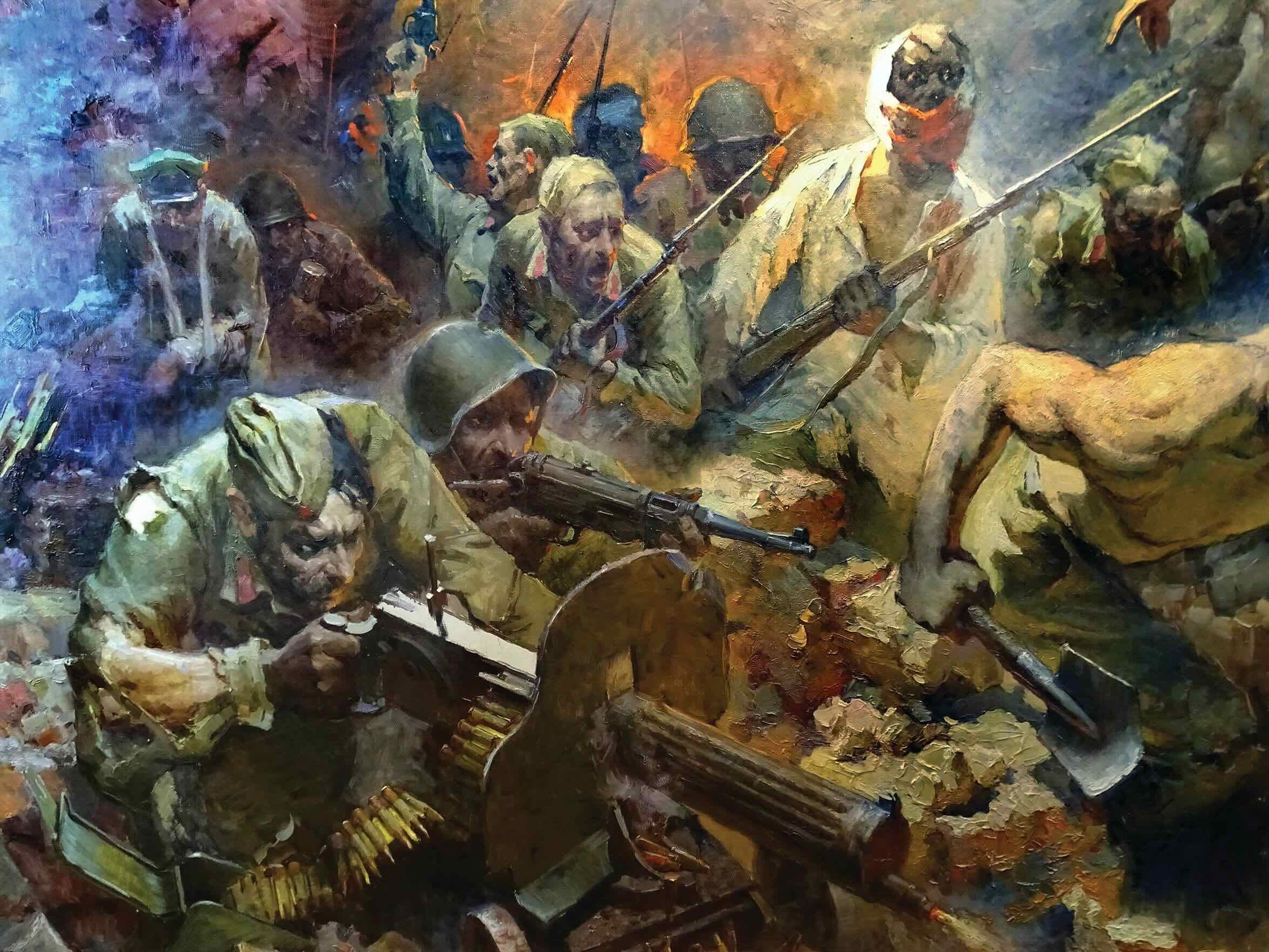
The Germans invading the Soviet Union quickly discovered that it would be a conflict unlike anything they had previously encountered. Although Nazi propaganda characterised ‘the Slavs’ as Untermenschen, sub-humans, they put up a determined resistance, resolute even in the most suicidal circumstances. Nowhere was this more evident than in the fortress of Brest-Litovsk.
Located right on the border, on the eastern side of the River Bug, the fortress was a 19th-century construction begun in 1833. By 1941, the star-shaped fortress area with a central citadel and several separate strongpoints, surrounded by barracks housing 12,000 men and some of their families, was not intended as a key defensive position. With the surprise attack in the early hours of the 22nd June, it became a blocking position by default.
The Wehrmacht planned to take Brest within 12 hours. It would take over a week before the main body of besieged Soviet troops surrendered. Pockets of resistance continued for another month. Rostislav Aliev pieced together The Siege of Brest 1941: A Legend of Red Army Resistance on the Eastern Front, from sources on both sides, a difficult task since so many of the participants were dead.
The following excerpt looks at hours soon before the siege ended, when the East Fort was the only remaining site of organised resistance within the complex:
By the evening of 27 June, there was bustling in the stable below the inner wall — although the wall was shaking from shell explosions, yet another attempt to break out was being prepared here. Understanding that an escape across the grounds of the fort was impossible, the defenders decided to make an unexpected attempt — having broken through the casemates’ ceilings or walls, they intended to burrow through the earth covering the wall and, catching the enemy by surprise, to make a break for it in the darkness and smash through the German cordon. Approximately 200 people were ready to take part in this attempt. However, the soil proved to be sandy - sand kept refilling the tunnels.
Nevertheless, in several places they were able to break through the ceiling, erect ladders and dig their way up to the surface. One soldier after another clambered up the ladder and emerged on the surface. However, they were spotted - machine-gun bursts and shell explosions forced them to drop prone or try to seek shelter in the tunnels again. Many failed in the attempt - one of the tunnel exits caved in when a shell landed on it just as the first soldier emerged from it.
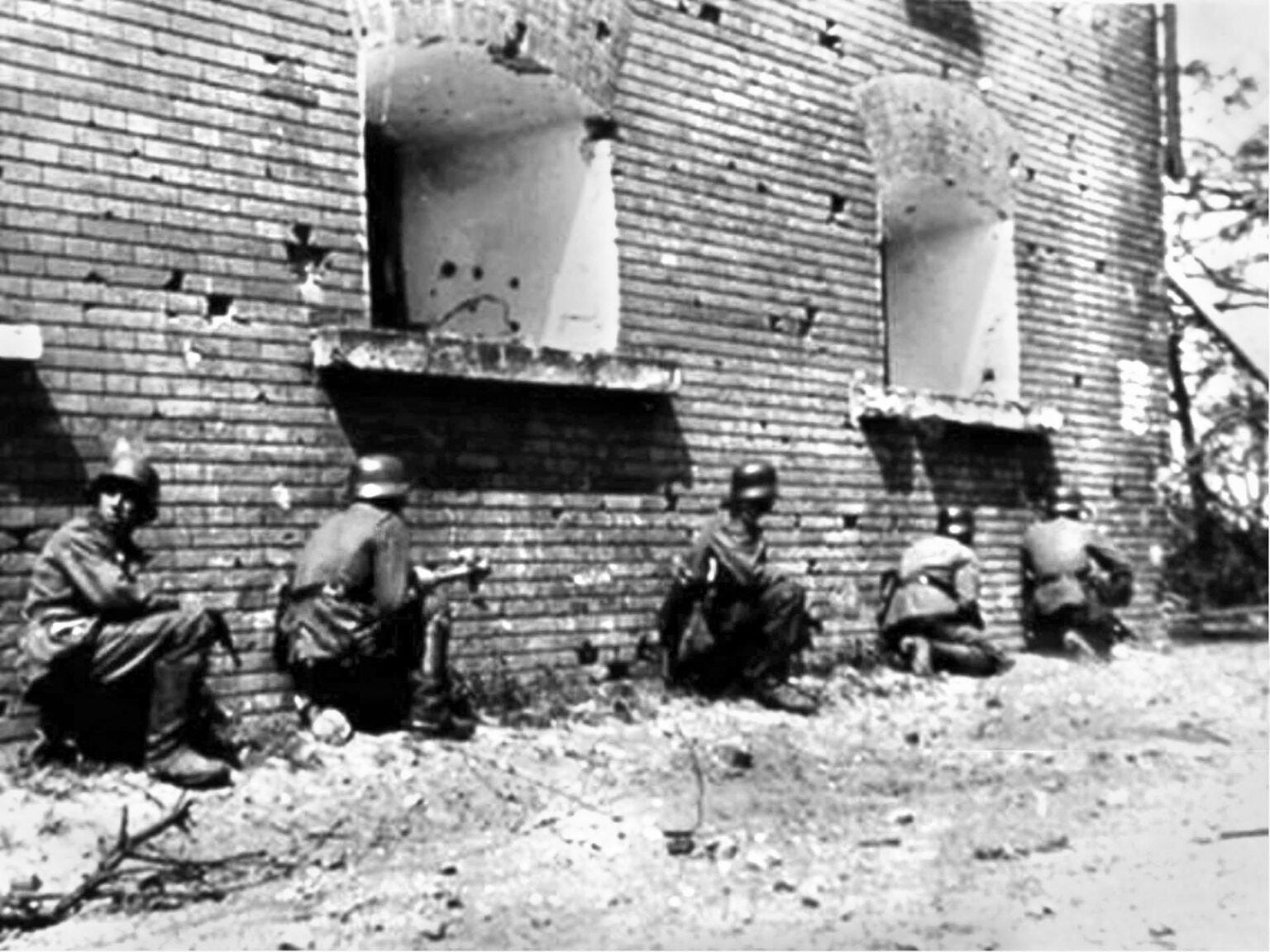
Machine-gun bursts that now and then struck the wall forced other soldiers to forego the digging of more tunnels. Altogether, approximately fifty men were killed or wounded during this break-out attempt. Soldiers gloomily dug fresh graves directly in the stable, while Abakumova and her assistants sought to tend to the wounded as far as they were able to do so. Now they also had nothing left to do but wait. By this time, Dar’ia Prokhorenko’s and Lidiia Krupina’s year-old daughters had both died.
On the morning of 28 June, an assault gun now joined the tanks that were shooting up the East Fort. An 88mm anti-aircraft gun - the largest calibre that the artillery could now contribute - was also employed against the fort. However, it seems that the additional weapons weren’t bringing about the desired result, so Oberst John drove off to the airfield at Terespol in order to seek air support. The former chief of staff of the II Fliegerkorps (Air Corps) Paul Deutschman (who was a colonel in 1941), recalled:
The commander of one of the regiments of the 45th Division arrived at the air corps’ command post in Biala Podlaska and asked for assistance in taking a Red Armv commissar school in Brest (it was steadfastly resisting and preventing an advance) that his elements had encircled, in order to support Panzer Group 2. Of course, the defenders within the gorge casemates of East Fort had no way of preventing forward movement along the rollbahns. However, some sort of weighty reason was needed in order to get the Lufttvaffe s commitment and employ such powerful bombs.
John learned that he could get air support, but for this it would be necessary to pull his own units back to West Fort. He was able to reach an agreement with a bomber unit (according to some sources, 6 Staffel [flight]/KG [Kampfgeschwader, or Combat wing] 3, which was equipped with Ju-88 bombers) staging from the Terespol airfield, to bomb East Fort that evening.
At 1145, a discussion took place between Armin Dettmer and the la of the LIII Army Corps headquarters regarding the order governing the division’s departure, which still hadn’t been put into effect. Losing patience, Dettmer sent a radio message to the LIII Corps headquarters, requesting authorization to move out in trail behind the 52nd and 167th divisions in the event of a departure in march column. He stressed, ‘We request a prompt decision.’ However, the corps headquarters was initially silent. Eventually, a reply came: the 45th Infantry Division’s departure from Brest was cancelled. Weighing all the circumstances and realizing that the 45th Division was still needed in Brest, Weisenberger decided to part with it.
The 45th Division left the roster of the LIII Corps and was made subordinate to a temporary command, Hdh.Kdo.z.b.V. XXXV. That evening a Fourth Army order arrived, according to which the division was presumably supposed to become part of the OKH reserve and be directly subordinate to Fourth Army headquarters. However, the dispatch of a reinforced regiment to Kobrin that was indicated in the order was cancelled — probably because by this time units of the division had already been diverted to guarding airfields.
The renewed firing on the East Fort by tanks and the assault gun failed to bring results. In the course of the afternoon of 28 June, the withdrawal of the committed elements from East Fort to the cordon line began. It was conducted with intensive fire cover, so that the defenders would not use the withdrawal to make another break-out attempt. Elements of III/I.R. 135 and the 45th Reconnaissance Battalion pulled out of the fortress entirely — for them, the fighting was over.
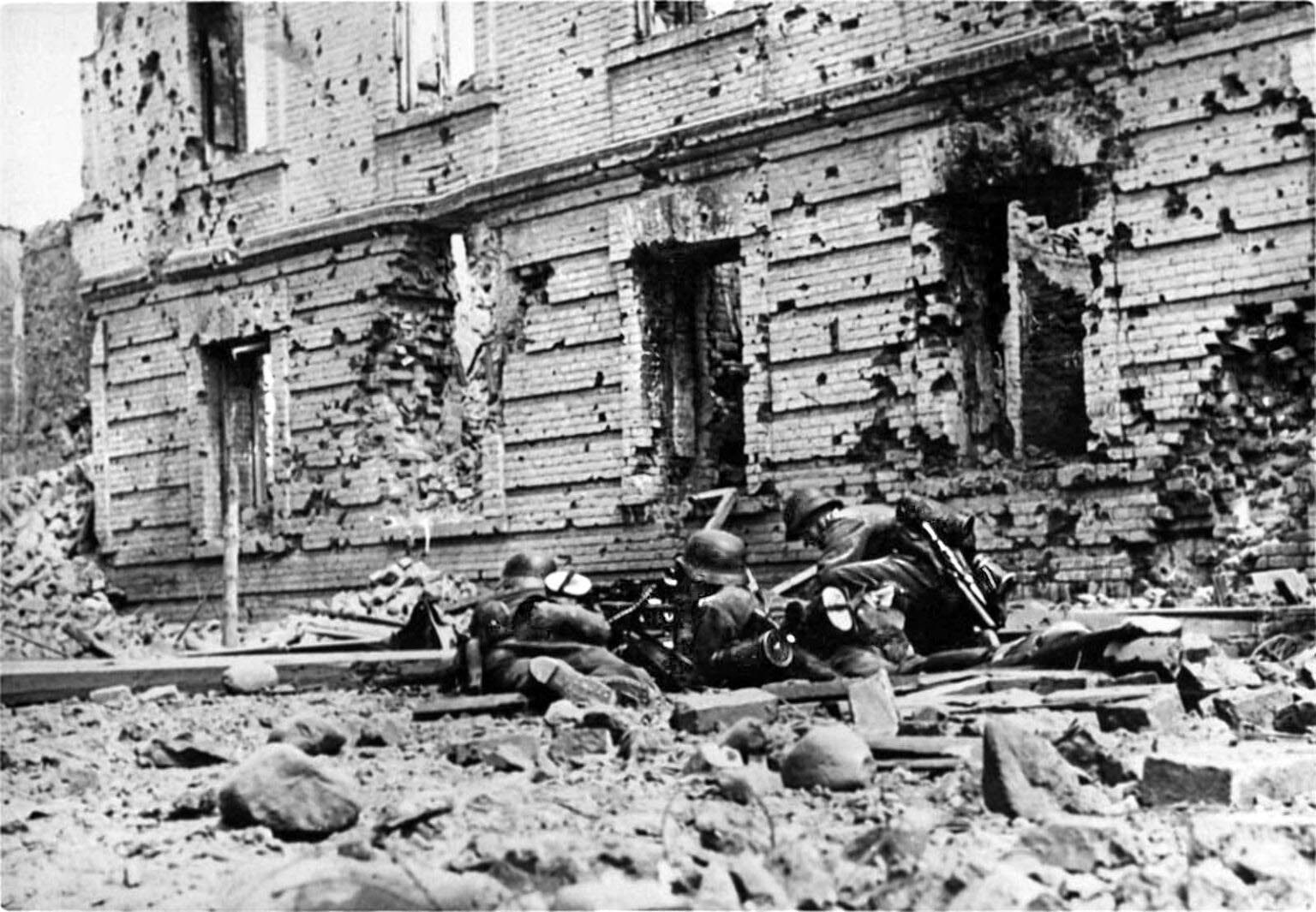
Only 5/1.R. 135 and Hartnack’s II/I.R. 130 remained on North Island. Everything was now ready for the bombing of East Fort — in order to mark the target, white sheets were laid down on the outer edge of the ditch. However, approaching heavy cloud cover forced a cancellation of the mission. It was revealed at 1915, though, that the regiment still didn’t know about the reason for the air-raid’s cancellation. Now Hartnack s battalion was forced to re-establish the tight cordon around East Fort quickly.
With the dawn on 29 June, Hartnack’s companies were again pulled back from East Fort. The weather promised to be fine, and by 0800, the drone of aircraft engines approached from the west. A white signal flare soared into the sky, and five Ju-88s dove on the target with a howl, releasing high-explosive fragmentation SD-500 bombs. Six direct hits were obtained, two missed the target, and two bombs failed to explode (one of them fell inside the Citadel, near one of the gates).
The effects of one of the hits are still visible today on the western side of East Fort’s outer wall. The casemates didn’t suffer - even Oberst John wrote about this, and any visitor today who desires to do so can go for a walk around them and not see any traces of collapsed walls or debris. Then once again, gunshots rang out from the windows and embrasures during an attempt to attack: its defenders were not contemplating surrender.
John obtained an agreement for another bombing mission that afternoon. The II Fliegerkorps command opted again to use medium bombers, one of which would be flown by a select crew, which was to drop the single 1,800 kilogram bomb (the SC-1800) available at the airfield on the fort. In addition, if the enemy still didn’t surrender after the second bombing mission, a new approach was being prepared for 30 June - the attackers would roll numerous fuel barrels up the slope of the glacis in front of the three inner gates and windows, before igniting them all.
Since the windows of the gorge barracks of the inner wall faced the ditch (the interval of space between the inner and outer walls), it was fully conceivable to drive out its defenders by this method. The goal was just the same as it had been now for several days: to destroy the garrison without taking excess casualties. For this operation, Harmack requested 8,000 liters of an enriched fuel mixture (petrol and oil from captured stockpiles).
Immediately after 12:00 noon, the defenders said farewell to the members of the command staffs families that were still taking cover in the casemates of East Fort. Dar’ia Prokhorenko recalls:
All the cellars were smashed; only ours remained intact, where the children were located. Then someone spoke up for the women and children to leave, or else the children would starve to death. We all got ready to leave, and there was now nowhere to fight; everything was demolished.
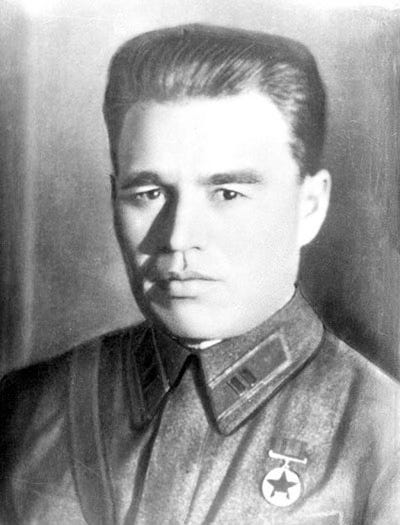
Major Gavrilov remembers, ‘I’ll never forget the tears of my combat comrades as they escorted the women and children out of the fort.’
© Rostislav Aliev 2013, ‘The Siege of Brest 1941: A Legend of Red Army Resistance on the Eastern Front’. Reproduced courtesy of Pen & Sword Publishers Ltd. NB Not all of the images above are from this volume.

Affiliate Links
Recently on World War II Today ...

