

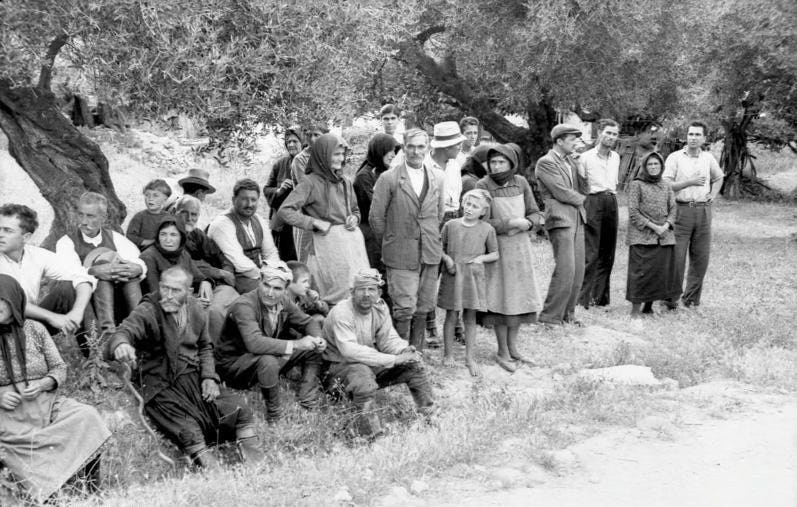
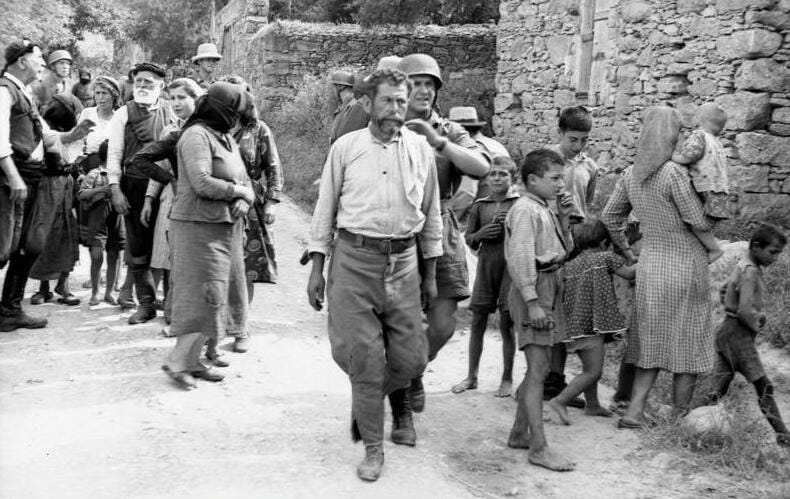
The civilian population of Crete had joined in the defence of their island alongside Greek and British armed forces. Some might regard this as a matter of self-defence, but the Germans interpreted it as “partisan” activity because they were not wearing uniforms and, in their eyes, were outside the rules of warfare. There were also rumours that bodies had been mutilated or that even some parachutists had been tortured - although a much more likely explanation was that bodies, necessarily left on the landing grounds, very rapidly decomposed in the heat.
As a result, Hermann Goering, in charge of the Luftwaffe and airborne forces, ordered reprisal measures.
Shooting groups of civilian ‘hostages’ as reprisals for any action against the occupying forces was a very common German practice - especially in Poland and on the eastern front. This was a rare instance in which there remains fairly comprehensive photographic and written evidence of the circumstances. German war correspondent Peter Weixler took a series of images and later made a statement to the Allies1 for the trial of Goering after the war:
The punitive expedition consisted of Trebes, another lieutenant, an interpreter, two sergeants and about twenty five parachutists of the Second Battalion. As a photographer assigned to my division I was permitted to accompany this commando. Near the village of Malemes, we stopped and Trebes showed us the corpses of several soldiers, obviously in the process of decay. He incited the men against the civilian population. We continued our drive to the village of Kondomari.
