

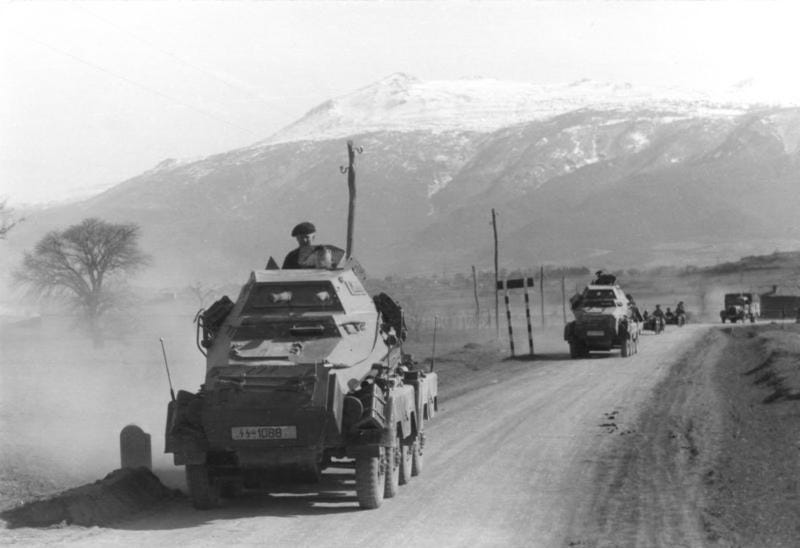
At the beginning of April 1941, Churchill sent Allied forces to support the Greeks against the Italians. The possibility, even probability, of German intervention was recognised, but the full implications of facing German panzers and a dominant Luftwaffe were never given proper consideration. The recently arrived British, Australian, and New Zealand troops immediately found themselves outflanked when Hitler broke through Yugoslavia.
In Greece 1941: The Death Throes of Blitzkrieg, Jeffery Plowman claims that the one-month-long campaign in Greece marked the end of German ‘lightning war’. Yet he does little to explain or justify this thesis, even by comparison with the immediately preceding or following campaigns. Neverthess this is a detailed history of the succession of battles over the mountains of Greece, combining accounts from both German and Allied sources.
The following excerpt describes the assault of Panzer Division Leibstandarte SS Adolf Hitler (LSSAH) and 9 Panzer Division against a combination of British, Australian and New Zealand troops high in the mountains of Greece in April 1941. The Allied infantry were virtually defenceless when facing the Panzers and assault Guns, yet still fought a valiant rear-guard action, making the best use of the terrain they could:
... on the morning of 12 April, LSSAH began to move forward again under intense mortar and machine gun fire. Their thrust initially fell onto the east of the road against the Rangers [9th Battalion, King's Royal Rifle Corps (The Rangers)], while on 2/8 Australian Battalion’s left flank, 11 Platoon started to come in for attention from the advancing Germans and then under light mortar fire as well. The Australians were also briefly shelled by their own 25-pounders, though fortunately to no effect. Shortly after this, 17 Platoon, in the centre, came under heavy mortar fire.
An attempt to deal with the German mortars was made by bringing forward an artillery observer, but came to naught because of a breakdown in communication to the rear. Mitchell then ordered 18 Platoon forward, but on moving up they ran into some German troops pushing around to the rear of C Company. In the end there was little 18 Platoon could do to help and around mid-morning 14 platoon was overrun.
At this point communication was restored with their artillery, allowing accurate fire to be brought down on the Germans. Aided by this and fire from some nearby infantry, the party of Germans, some 350 strong, was driven back, but only to the forward slope of the ridge.
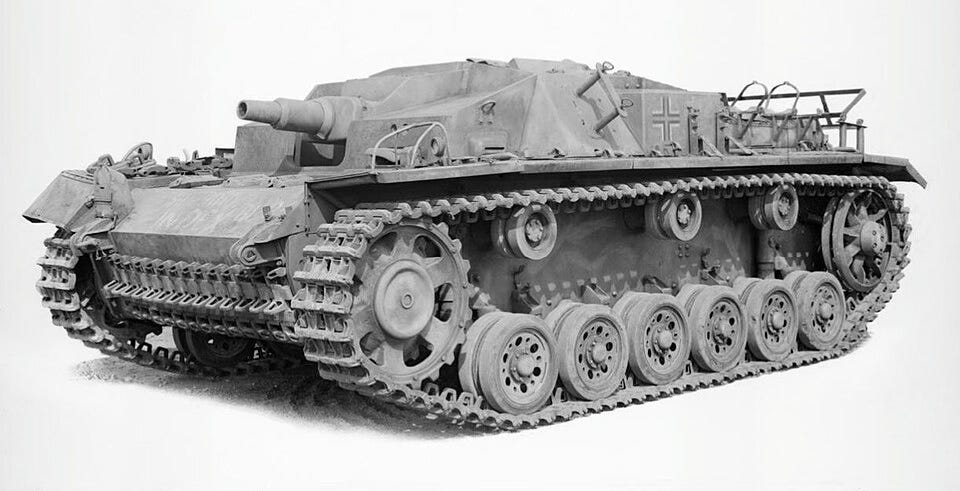
Concentrated artillery fire from LSSAH then started to fall on the Rangers’ positions. To add to the Rangers’ problems a StuG III took up a position in the dead ground in front of C Company, 2/8 Australian Battalion, and started shelling the Rangers. This forced the Rangers out of their slit trenches, some of whom surrendered. Faced with this assault C Company and part of B Company pulled back further up the slope. In the process they managed to rescue two New Zealand machine-gun teams, loading their guns and ammunition onto some packhorses they had found.
Later that morning advance elements of 9. Panzer-Division reached Vevi, but there was little the Australians could do other than watch as they began to move their troops forward.
A number of their tanks made for the dead ground below 2/8 Australian Battalion, while trucks started disgorging German infantry who formed up with the tanks. Further back the Germans began setting up artillery in a depression, but with the weather deteriorating no attack developed for several hours. Around 11 am the Rangers began to pull out from the pass to another position astride the road two miles further back. This exposed six 2-pounders of 2/1 Australian Anti-Tank Regiment and all but one had to be abandoned. Meanwhile, 2/8 Australian Battalion found themselves in the unfortunate position of holding a rather exposed salient along the ridge, so a platoon from A Company, under supporting fire from D Company, put in a counter-attack and managed to regain some of the ground lost by C Company earlier in the day.
With LSSAH heavily committed along the Vevi road it was not until 2pm that 9.Panzer-Division was able to link up with them and launch a combined attack. By now the Rangers were well on their way back to their pre-arranged rearguard position at Rodona, resulting in the attack falling on 2/8 Australian Battalion. Some 200 infantrymen from LSSAH thrust up a gully towards C and D Company, and for the next hour the Australians managed to contain this, but only until the last of the Dodecanese Regiment had gone.
Then 2/8 Australian Battalion found itself in the invidious position of being under attack from the left and under fire from the right. Some support did come in the form of the crews of the Rangers’ carrier platoon, but six of their carriers had to be abandoned and destroyed when they became bogged down forward of Kliedi. To make matters worse, around 4.30pm a German tank drove up the re-entrant between the two companies and opened up on them. Shortly afterwards, the tank was joined by three more, all of which set about destroying the Australian sangars and weapons pits. With fire from their Boyes anti-tank rifles ineffective, and with more German infantry moving up, the Australians had no choice but to pull back to the reverse slope.
Around 4 pm, with signs of the Australians pulling back, LSSAH began to take up the pursuit. Hauptsturmfuhrer Schulze, the commander of 2. Kompanie, later reported:
Abandoned or destroyed British trucks lay to the left and right of the road. As we ran past one, we saw a dead driver at the wheel. After we had run another 20 metres we saw the truck suddenly start driving, the driver had only pretended to be dead and was now trying to break through at high speed. About fifty metres in front of us there was a gigantic explosion as the road was blown up by remote control detonation. The escaping truck and its driver flew into the air and a deep crater blocked the road.
At that point 3 Kompanie, LSSAH also took up the pursuit around 4.30pm:
With our bayonets on our rifles we rushed forward. The Pioniere had taken advantage of the fog and cleared paths for us through the s minefields. Two Sturmgeschiitzen rolled along with us, firing as they went. It was lively up above on the slopes of the hills, as well: ll Tommy was beginning to break camp. We made sure that his retreat i became a rapid flight. After the minefield the road and railroad t tracks ran toward each other at a steep arc. Along the pass, the n tracks and the road traced a sharply curved S with ridges thrusting 3 into bends.
Our 3.7-centimetre Flak and Sturmgeschiitzen were i firing on the enemy groups pulling back across these hills. Behind the first bend in the S, the train tracks went into a curved tunnel. About 250 Australians and New Zealanders, and Tommys had pulled back into the tunnel. A Sturmgeschiitz ricocheted a shell into the opening and it had the desired effect. All men hiding there came running out with their hands in the air and more followed supporting the wounded and carrying the dead.
Although Mitchell had received orders from Brigadier Vasey to start withdrawing around 7pm, the situation was now becoming desperate. With the Germans having broken through the Rangers’ position and the lines ‘ cut by shellfire, he sent Lieutenant Sheedy back to Vasey’s headquarters 1 with instructions to explain the situation to the brigadier. Crossing the open ground south of the ridge Sheedy came upon a German tank on the road outside Kleidi and not far away its victim, a wireless van, on fire. Skirting the village he eventually reached a Light Mk VI of 4 Hussars, which shot up some German infantrymen who had broken through the Rangers’ position. Sheedy eventually reached the forward troop of 2/3 Field Regiment, who loaned him a carrier. This he drove back to Vasey at brigade headquarters, but by then it was too late.
Around 5pm, as Mitchell called his company commanders together, they came under fire from one of the German tanks at the top of the C Company wadi. Half an hour later, just after the company commanders returned to their men, German infantry supported by tanks broke through their battalion lines. At this point all attempts at an organized retreat came to naught. Instead the battalion broke up into small groups that set off across the valley to the next ridge.
Here they came under strong enfilading fire from German tanks and supporting infantry on the road to Kleidi. Fortunately the guns of 2 Royal Horse Artillery and two Australian anti-tank guns astride the road prevented the Germans from closing in. For many of the men from 2/8 Australian Battalion this was all too much. Too tired to carry their weapons, many threw them away, some under orders from their officers.
After a long march through waterlogged ground the leading companies reached the reserve position at Sotir around 9pm. Two hours later they reached Rodona, where they were picked up by their battalion transport and driven back to the Aliakmon River. Others less fortunate filtered in later on during the night, bringing the battalion up to a total strength of 250.
Around 5pm 1. and 7. Kompanien took the village of Kleidi, taking eighty-two prisoners in the process. A couple of hours later they reached the top of the pass itself, where they had their first view of the western Macedonian plain. As Shulze later recounted: ‘It was swimming with British troops. We could see the batteries that were still firing and the trains that were retreating.’ In the meantime, 12. and 13. Kompanien to their left, having secured the high ground, struck off toward Petrais, while 14. Kompanie made their way down to the shore of Lake Petron. At 8.15pm III. Bataillon took Petrais, along with a further sixty Australian, English and Greek troops. From there they sent out a combat reconnaissance towards Amyntaio.
After the Germans had broken through the Rangers’ position in the afternoon, the initial response of 2/4 Australian Battalion had been to send B Company forward in an attempt to fill that gap, but their infantrymen ran into strong opposition. By 3pm they were all but surrounded, so Lieutenant Colonel Dougherty contacted their second-in-command Lieutenant Chrystal and ordered them to withdraw to battalion headquarters. The company did so under heavy fire, as Chrystal later recalled.
The enemy machine guns and mountain guns gave us a merry time and when all had gone Hal and I decided to try and get out. Talk about running a gauntlet of death! I’ve never been in anything like it. We had to dump most of our gear and run about 50 yards up the exposed side of the mountain. Snow covered the deep steep slope. We were slipping and sliding and burying our faces in the slush as bullets whipped the snow up around us. Then we would see the mountain gun and the machine guns belch our a long stream of flame and there would be a lovely explosion near us which would cover us with snow. Lucky they were rotten shots.
Somehow or other we got to the top and raced over the other side where we found our company sergeant-major, Wym Keast, had been hit in the leg and arm. We were helping him along when they opened up from the other side where we thought we were safe. We went flat again. Wyn let out a yell and we found he’d been pretty badly hit a second time. Before I knew what had happened Hal jumped up and grabbed ‘Keasty’, threw him over his shoulder, and we dragged him to a small wadi where we were out of view.
He was so badly wounded that we found it impossible to move him further, so we said goodbye and left him there till we could find help. A few hundred yards further on we found a stretcher bearer, so we took a party back, grabbed Wyn, and set off carrying him in relays, never daring to stop with Jerry hard on our heels.
By the time we reached Battalion headquarters everyone had gone except one truck. We put Wyn into that and pushed on, absolutely exhausted, for another six miles to the battalion assembly area.
© Jeffrey Plowman 2020, ‘Greece 1941: The Death Throes of Blitzkrieg. Reproduced courtesy of Pen & Sword Publishers Ltd.

Affiliate Links
Recently on World War II Today ...
