

As the British began landing troops in Greece, the war was hotting up for the Royal Navy in the Mediterranean. On the night of the 28th/29th, they had won a famous victory over the Italians at the Battle of Matapan. The main force of the Regia Marina, which might have done so much damage to supply operations to Greece, was largely knocked out of action for the following few months. Coming so soon after the land victory over the Italian Army in North Africa, this one action might have been enough to also knock Mussolini out of the war for good, had Hitler not also been in the equation.
But of course, Hitler was very much in the equation. The Wehrmacht had arrived in Libya, and they were, at this moment, preparing to also intervene in Greece. The Luftwaffe was ready to operate over the sea. The consequences for the Royal Navy operating in the Mediterranean were to be very serious.
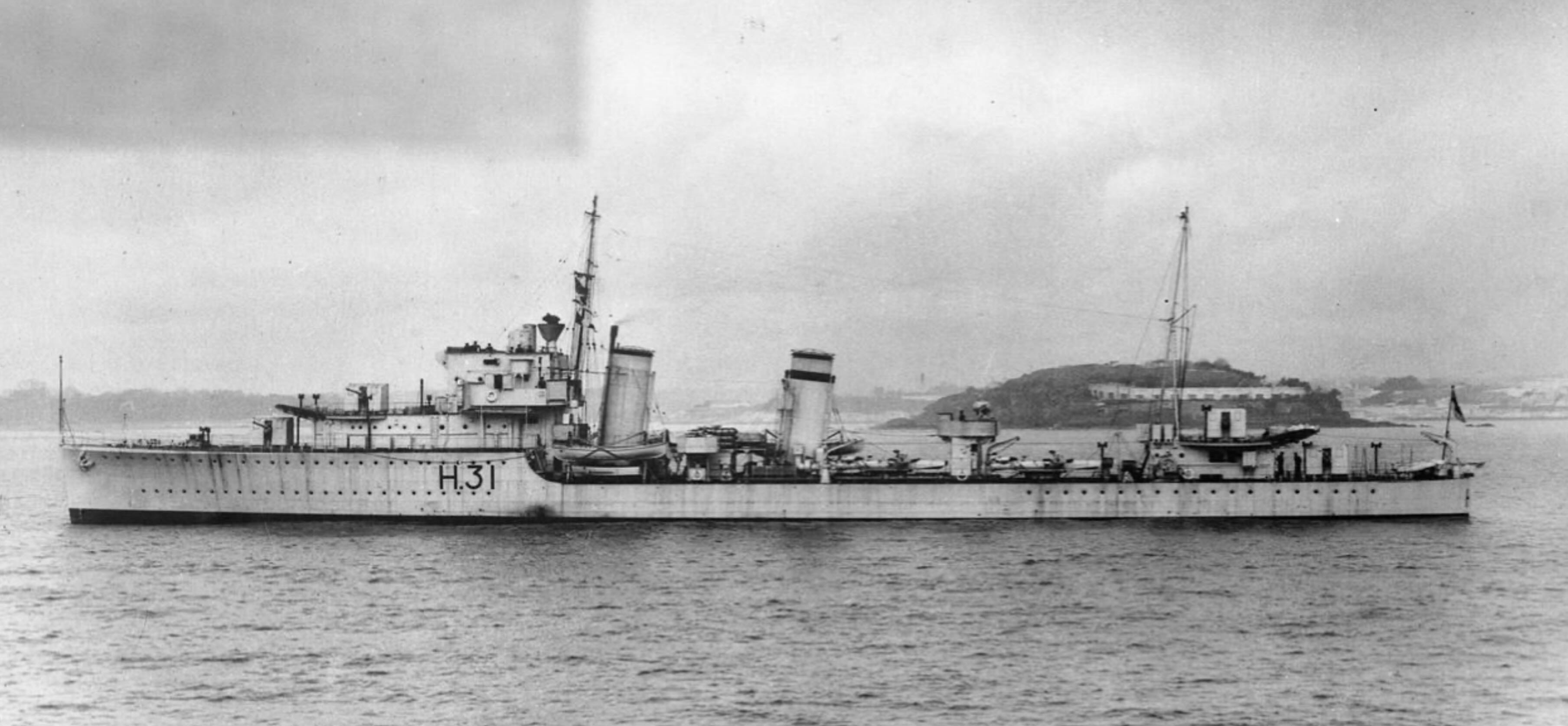
The workhorses of the fleet, the destroyers, were about to be pressed into action as never before. On board HMS Griffin, one officer was to be an eyewitness to much of this episode - Alec Dennis would eventually write a compelling memoir of his service at sea. The following excerpt from In Action with Destroyers 1939-1945 covers the days 29th-31st March:
Matapan
Three days later, it became clear that something else was in the wind. Shortly after dark, the whole fleet left harbour. The C-in-C was there in Warspite with Valiant, Barham, Formidable and nine destroyers, including ourselves. The subsequent action - the battle of Matapan - is well enough known.
As far as we were concerned, the next day was full of signals reporting action by our cruisers against the Italian fleet. Formidable flew fighter and reconnaissance patrols, which kept us free of attacks except for one brave but unsuccessful effort by two Savoia torpedo bombers. At dusk, it appeared that there might be some chance of catching up with the Italian battleship Vittoria Veneto, which had been hit by a torpedo from Formidable’s aircraft. So Jervis and four of the screen were detached to speed ahead to look for her. Lucky devils, we thought.
We remained with our own battle feet as screen: Stuart (Captain (D)), Greyhound, Griffin and Havock. Our leader, Stuart, was an Australian destroyer commanded by that great character Hec Waller (later lost in the Perth in the Java Sea, fighting the Japanese). Greyhound and ourselves were to port, the other two to starboard. We were all at action stations.
I was closed up in the director tower, being gunnery control officer, and in a good position to see everything. We were steaming into a black night at twenty knots, peering into the darkness through our binoculars. Suddenly we received an emergency signal to clear the screen and take station on the starboard side. Increasing to full speed, we started off, to receive in short order another signal from Warspite: GET OUT OF MY WAY, DAMN YOU.
At this moment, I spotted a dark shape ahead and got all the guns onto it. As we got nearer, it was obviously a large ship and one felt a little naked up there in front. Moments later, Greyhound, ahead of us, switched on her searchlight and in its silvery-blue beam was revealed a 10,000-ton cruiser heading towards us, quite close, and looking magnificent in her light grey, which stood out starkly in the beam.
I gave an estimated range and opened fire. ‘Ting-ting’ went the firing bell. Then hell broke loose. The enemy ship virtually disintegrated in an appalling series of explosions, flinging one of her turrets high in the air. ‘My God, did I do that?’ was my first reaction, forgetting that there were three battleships behind us.
A few seconds later a couple of Italian destroyers appeared, and as they were clearly our job, we went off after them. I got a few salvoes off but they had the legs of us and soon vanished, though another pair was sunk by Stuart and Havock. After pursuing our two, Greyhound and ourselves took a cast ahead, hoping to happen upon the damaged battleship. We found nothing, though had we been fitted with radar it is quite likely that we would have picked her up, as she was not very far away.
As it was we hustled off into the darkness. C-in-C recalled us. Having himself turned away after his action we reduced speed somewhat and sadly started back. After about an hour, when one was beginning to tire, the bridge sighted a darkened ship ahead. At once, we were alert, finger on the trigger. If it was the battleship, we could expect a salvo as soon as she spotted us. But equally we had a good chance to slip a fish into her.
Our torpedoes were already trained on the beam. Greyhound and ourselves reduced speed, keeping bows onto the enemy to reduce our visibility from her. As we drew nearer, it became clear that something very odd was going on.
A destroyer was close to a large ship on which flashing lights could be seen, moving about the decks. Once again, Greyhound shone her searchlight. Once again it revealed a light grey, 10,000-ton cruiser, lying stopped with her guns trained fore and aft. Then we could see that amidships she was glowing red and the decks were crammed with men. Obviously she was in no condition to fight, and the destroyer with her was one of our own - the Havock. We were just getting ready to go alongside and do an old-fashioned boarding party when Captain Mack in Jervis appeared on the scene. When we announced our intention of boarding we got a short reply: ‘No, I will.’ So we didn’t have that pleasure and had to content ourselves with picking up a large number of Italian sailors who were floating in the water astern.
Their morale was shot to ribbons. Many were drunk.
Their morale was shot to ribbons. Many were drunk. It turned out that this was the Pola, one of the three cruisers we had encountered. She had been hit by a torpedo from the Formidable’s aircraft earlier in the day, and stopped. The other two cruisers had been sent to her assistance and had just established contact when our battle fleet blew them to pieces. The Pola was already on fire down below and her crew were quite shattered by this experience. They had lost power, couldn’t fire their guns and were expecting a similar fate at any minute.
One sailor whom we picked up had on three lifebelts, all round his hindquarters, so he had been having trouble keeping his mouth above water. He spoke some English. When asked about his experiences he said that he heard a huge explosion, said to himself ‘Mama Mia! I cannot swim!’, and dived overboard. Our ship’s company formed a poor opinion of the survivors who complained about our food. Next morning the coxswain represented to me that our sailors wanted to throw them back. This request had to be refused.
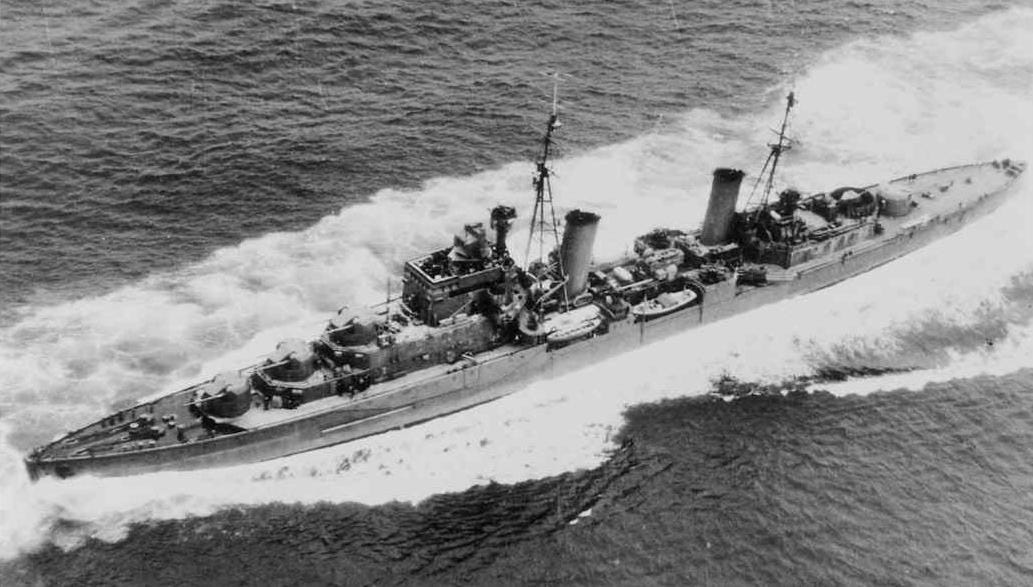
We started off … to pick up survivors, but were ordered back to the convoy.
Bonaventure
After the night’s excitements we rejoined the fleet, underwent some desultory bombing, and were detached to Piraeus to land our prisoners. With some pride we went alongside the Grimsby displaying our trophies and the 400 holes in our hull and upperworks. The battle, satisfactory though it had been, was disappointing in that we didn’t get the Vittoria Veneto. Nor did we, in Griffin, get a chance to fire our torpedoes. But we couldn’t complain, having had a bloodless victory (except for the crew of a Swordfish).
After fuelling in Piraeus we were off straight away escorting a convoy to Alexandria. By now, the British were starting to ship men and materials in quantity to Greece unfortunately to the detriment of our own cause in the Western Desert, a lack of which we were to feel in the next few months. On this occasion the ships were returning empty. Things seemed reasonably in hand; there was even some fighter protection, so our spirits remained high.
But just before 0300 next morning there was a heavy explosion astern. The brave Bonaventure had been torpedoed and sank very rapidly with great loss of life. We started off to her assistance, or at least to pick up survivors, but were ordered back to the convoy. This incident was doubly sad. We lost an old comrade who had so often beaten off air attacks; and, although we didn’t know it at the time, this represented the appearance of submarines on the scene (this one was Italian). Hitherto the Italians hadn’t bothered us too much, and our main worries had been from the air.
© The Estate of J.A.J. Dennis 2017, ‘In Action with Destroyers 1939-1945: The Wartime Memoirs of Commander J A J Dennis DSC RN’. Reproduced courtesy of Pen & Sword Publishers Ltd.

Affiliate Links
Recently on World War II Today ...

