

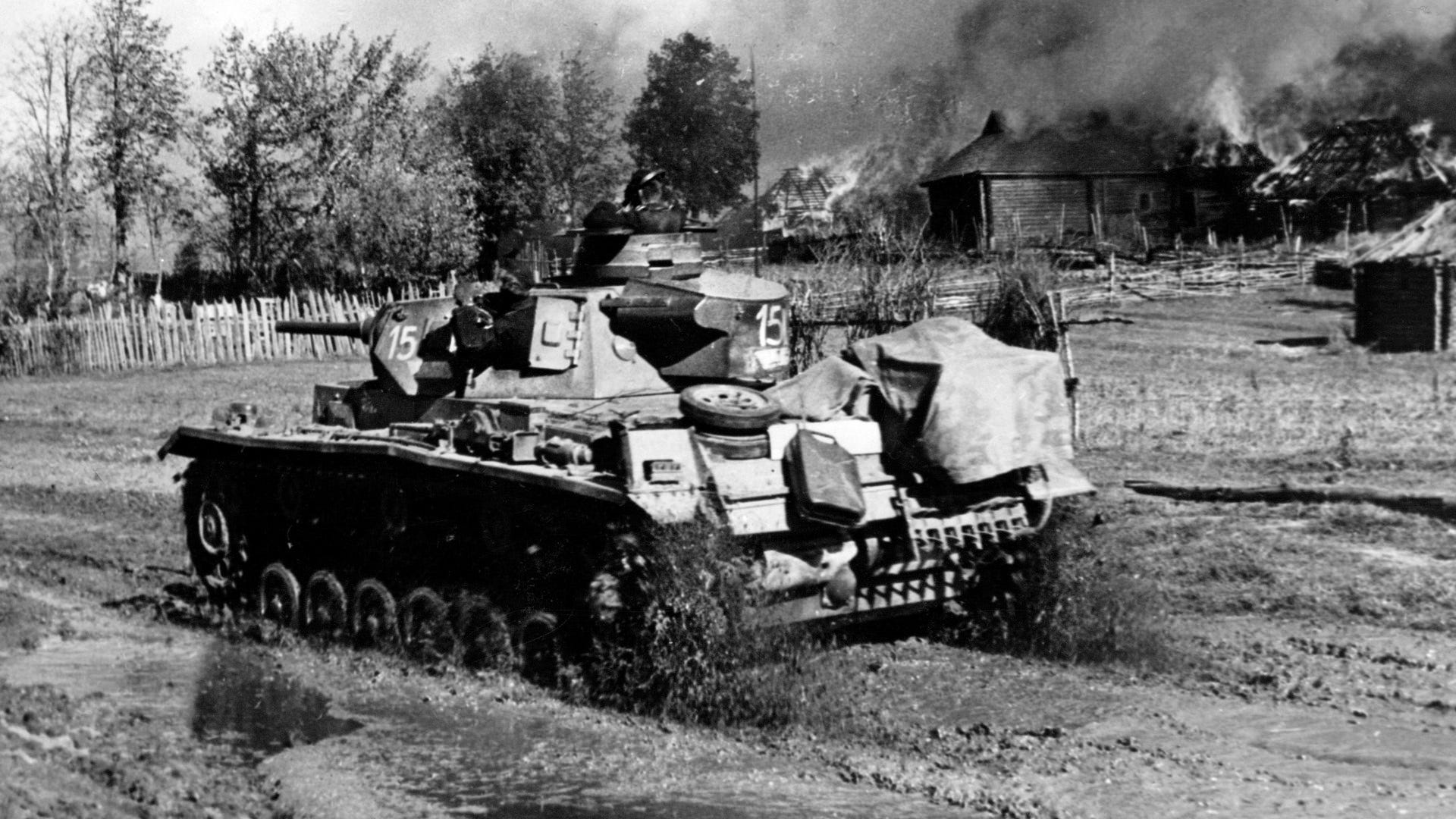
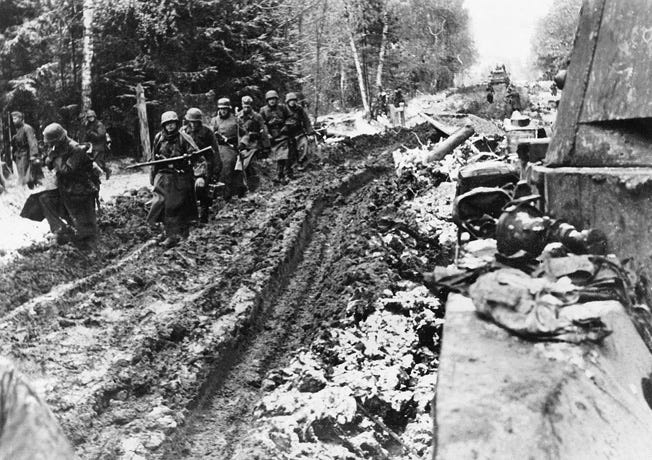
At the beginning of October 1941, Hitler launched the “final, main and decisive battle of the year”. The German invasion of the Soviet Union in the second half of 1941 is often characterised as wholly part of Operation Barbarossa, yet the German High Command saw the second phase, Operation Typhoon, as a distinct operation. It involved reorganising the spearhead, with Army Group Centre boosted by the transfer of panzers from Army Group North. The timetable was tight, as summer weather was already ending. And the supply chain was already creaking under the strain of the vast distances. Yet the Germans believed they could build on their successes since June 22nd, with more swift encircling thrusts destroying the considerable Red Army forces between them and Moscow.
The story of how those plans unfolded, and eventually came to grief, is told in The Drive on Moscow, Operation Taifun and Germany’s First Great Crisis in World War II. This comprehensive study, grounded in thorough research, builds a narrative around the strategic considerations facing the Germans, with many insights into the experience of the men on the ground. The following excerpt looks at how, despite some dramatic advances, everything changed over the course of just two months, and the final objective, Moscow, proved to be just a step too far:
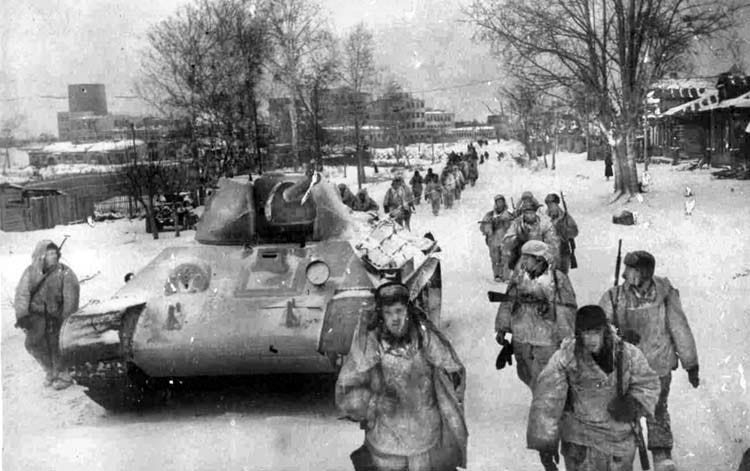
According to Vasilevsky, the Red Army had 4.2 million men, 22,000 guns and mortars, 1,730 tanks and 2,500 combat aircraft at the front early in December. These figures do not include Stavka reserves. These, positioned quite close to the front, amounted to more than 530,000 men with 4,100 guns and mortars. Evidently, the Soviet defenses were not on the brink of collapse.
Compared to Soviet forces, German strength, which barely totalled 2.5 million men in November and December, including reserves in the east, did not look that impressive. The Soviet forces were almost twice as large, and the contribution from Germany’s allies did little to alter the scales.
It is remarkable that the Red Army at this time, after suffering such horrendous casualties, actually held a significant numerical advantage. When the Germans attacked on June 22, 1941, the force ratio at the front was even. During the months that followed, the Soviet forces incurred casualties between five and ten times the German losses. Despite this, the Red Army was actually numerically superior after five months of gruesome war. This is ample testimony to the Soviet capacity to create new military resources, a capacity the Germans dramatically underestimated.
The German army high command continued to push von Bock to attack in force during December. The Army Group Center commander was thus sandwiched between his superiors and his subordinates, as the latter regarded reinforcements necessary to continue the offensive. Undoubtedly, von Bock’s situation assessment was closer to that of his subordinates. The Germans made no significant gains on December 1. They continued to search for tactically favorable situations that might allow local advances.
… the idea of an imminent Soviet collapse lacked any foundation in reality.
Undoubtedly, von Bock realized that his army group would not attain the ambitious aims advocated by the men in Germany. At best, he reasoned, he could capture some ground and knock out a few Soviet units, but any strategic achievements were highly unlikely. The field marshal again emphasized the fact that the idea of an imminent Soviet collapse lacked any foundation in reality.
If his units halted outside Moscow, they would be in very unfavorable positions, according to von Bock. The railroads and roads emanating from the city, resembling spokes from a wheel, made it easy for the Red Army to move reinforcements, while the Germans, who could count on few reinforcements, would have to reposition units laterally, which meant essentially movement between, rather than along, the roads. At this time, von Bock was responsible for a front stretching approximately 1,000 kilometers (620 miles) and he only had one division in reserve. The soldiers were exhausted after long campaigning. He believed they would be unable to withstand a determined assault.
These points, which von Bock pondered during the first days of December, were not his only concerns. Following the onset of low temperatures in November, the railroads and trains had ceased to function properly. This boded ill for an army so dependent on railroad transport.
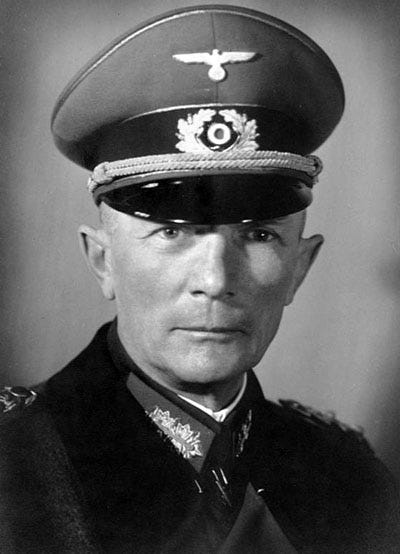
Field Marshal von Bock doubted that it would be possible to prepare suitable defenses and provide the units with adequate supplies while simultaneously conducting offensive operations, as long as the supply system was in disarray. He firmly believed that the men in Berlin did not realize the gravity of the situation, and again contacted Halder on December 1. The chief of general staff accepted von Bock’s description of the situation and said that it was in accordance with reports that the general staff had received from many of the units.
However, in the circumstances, it was difficult to convey objections that appeared too pessimistic.
On this day, Hitler replaced Field Marshal von Rundstedt, who had commanded Army Group South, with Field Marshal von Reichenau. The German corps that had captured Rostov had been attacked in the flank and withdrawn, and the question about how far it should retreat had turned into an argument leading to von Rundstedt’s dismissal. The 65-year-old field marshal retired, but not for long; he would be given another important command in 1942.
While von Bock worried about the overall situation, his soldiers did what they could to manage. Life was hard at the front, not only for the soldiers, but also for any civilians in the combat zone. A soldier serving in the antitank battalion of the 131st Infantry Division described events taking place at Aleksin on December 1. The town, situated on the Oka River east of Kaluga, had recently been abandoned by the Red Army after hard fighting. The Soviet forces had carried out extensive demolitions while retreating. Only a few buildings were still usable when the Germans entered Aleksin, and broken windows let the cold wind and snow into those that were still standing.
Bridges across the Oka had been destroyed and the German engineers had to work hard in the cold to create a pontoon bridge to connect the old town with the more industrialized parts on the other side of the river. The thermometer showed -30°C. A dead horse lay in the river, where it attracted the attention of some of the Russian civilians enrolled to work for the Germans. One of them held the carcass in position with a stake, while another hacked chunks of meat off the animal’s rump with an axe.
A strong wind made the bitter cold even worse and caused the snow to drift. Those German soldiers who slept in buildings were lucky, despite the broken windows. It was, after all, better than spending the night in foxholes outside the town. However, defense positions had to be manned. The fact that the Red Army had abandoned Aleksin did not mean that fighting had ceased.

Effectively, the German offensive had run out of steam. As predicted by von Bock, all the army group could manage at this stage was tactical efforts without any overall coordination. The 19th Panzer Division had been employed at Maroslavets since October, but had only fought local actions, despite the fact that only 60 kilometers (37 miles) separated them from Moscow, when the 1st Battalion of Panzer Regiment 27 initiated an attack.
At 5:00 a.m. on December 1, German tanks had driven to the positions from which they would launch the attack a few hours later. They had travelled along a road cluttered with carts, vehicles and other materiel belonging to a horse-drawn baggage unit. Despite these difficulties, the tanks had reached the designated positions in time. The crews calmly waited while the accompanying infantry climbed up on the steel monsters. The attack would be conducted in the 292nd Infantry Division’s sector and one of the division’s infantry regiments was responsible for the attack.
The commander of the 1st Panzer Battalion kept an eye on his watch. At exactly 6:45 a.m. he saw the first shells from the artillery explode in front of him. This signalled the beginning of a ten-minute barrage. When the German howitzers went silent, the tanks began to advance. In addition to the mounted infantry, a mine-clearing troop and an antitank platoon accompanied the attack, which was initially directed toward an intact bridge over the river Nara.
When the tanks closed in on the bridge, they saw German assault guns engaging an enemy they could not identify. Second Lieutenant Fröhlich led the forward platoon and he communicated with the assault-gun unit. He was informed that minefields prevented the assault guns from advancing further, and Fröhlich immediately passed the information on.
It proved fortuitous that the mine-clearing troop had accompanied the tanks, and it immediately set out to remove the mines. It was risky, but the soldiers did benefit from fire support provided by the tanks and assault guns. Before 10:00 a.m., enough mines had been cleared to allow the vehicles to proceed. They crossed the river Nara without any difficulties and then turned north to capture the village of Golovenkino, which turned out to be virtually undefended.
A few prisoners were taken, and they informed the Germans that the asphalt road leading north to Akulova was free of mines, but there might be extensive minefields on either side of the road. At this moment, the regiment commander instructed that a tank company should be sent north for a surprise attack on Akulovo.
The battalion commander set off north with the 2nd Company. The remaining elements of 1st Battalion were delayed at a narrow bridge where an assault gun had skidded half off the road and become stuck, blocking the entrance to the bridge. The 2nd Company dashing north was soon instructed to slow down, to avoid the alarming gap between the elements caused by the delay widening further.
The 2nd Company continued north at a slightly slower pace, with the battalion commander Major Mecke’s tank one of two in the lead. Suddenly a very powerful charge exploded and tore away a large part of the road and completely demolished the tank on it. A few seconds later, another charge detonated, again tearing apart the road and this time it was Mecke and his crew who met with misfortune. Their tank was completely destroyed and it was not even possible to identify the remains. However, Mecke’s pay book was found, establishing beyond doubt that he had been in the tank.
A moment later, yet another explosion broke the silence, but this time the Germans did not sustain any losses. The road had been rendered impassable by the exploding charges and the lead company turned back. Using alternate roads, the Germans finally reached Akulovo, which was surrounded by dense woods and bisected by a stream.
The Germans advanced slowly, and their caution was soon justified as they found that minefields and remote-controlled charges had been placed in the area by the Soviet defenders. The mine-clearing troop was again very useful, clearing many of the dangerous fieldworks, while the tanks fired on bunkers. A platoon entered the village at the same time and reached the bridge across the stream. more tanks from the battalion gradually reached Akulovo, tipping the scales in the Germans’ favor. The success did not come without cost, though, as two German company commanders and one doctor were killed.
By the time the rest of the battalion, and supporting infantry, arrived, the Germans had already captured Akulovo. The infantry soldiers took up defensive positions during twilight. The tired German soldiers hoped to get a chance to sleep in a decent building for a few hours, but the night was still young when Soviet artillery fire hit the village. Harassing attacks were also made during the night by Soviet infantry.
Early on the following day, Field Marshal von Kluge sent his greetings and expressed particular gratitude to the force that had fought in the Akulovo area. The fact that such a message was sent at this moment is illuminating. An attack of this scale had hardly been mentioned by an army commander during the first part of October. Circumstances had changed, and a regiment-sized attack now attracted attention out of proportion to its strategic significance. On the Soviet side, the raid was regarded as a desperate last attempt to reach Moscow.
It reached a point approximately 20 kilometers (12 miles) from the center of Moscow …
On December 2, the tank battalion and its supporting infantry and engineers remained at Akulovo. Fuel supply was uncertain, as the blown road could not be used by trucks. Further east, a small motorized German force drove on a minor road between the main Naro-Fominsk–Moscow road and the Mozhaisk–Moscow highway. It reached a point approximately 20 kilometers (12 miles) from the center of Moscow, but on the following day it had to turn back.
The tankers at Akulovo were also ordered to return. They received the order at 4:00 p.m. on December 3, but the retreat proved difficult. The blown roads made it almost impossible to recover damaged but repairable tanks. They were prepared for demolition before the withdrawal started at 3:00 a.m. on December 4. It was hoped that darkness would provide cover and this was correct to some extent, but the noise from the tank engines was loud and could be heard at least as well as during the day. The Soviet soldiers realized something was going on and called in artillery fire.
The withdrawal turned into a confused episode, but those tanks not previously damaged made it to the positions from which they had set out on December 1. The damaged tanks were blown up. Thus, nothing of lasting importance had been achieved, neither by the tank battalion that captured Akulovo, nor by the motorized battalion that turned back after glimpsing the outskirts of Moscow.
© Niklas Zetterling and Anders Frankson 2012, The Drive on Moscow, Operation Taifun and Germany’s First Great Crisis in World War. Reproduced courtesy of Casemate Publishers

Affiliate Links
Recently on World War II Today ...

