


This photograph, taken on 20 November 1941, shows Soviet troops in action on the streets of Rostov-on-Don in the far south of the Soviet Union, not near Moscow. It was here, rather than at Moscow, that German forces suffered their first obvious reverse, as they were pushed back from the Caucasus in late November 1941. They would soon also suffer a similar fate not only on the outskirts of Moscow but near Tikhvin, east of Leningrad. Note that the Soviet troops in this picture are still only equipped with rifles, as the submachine guns that would become almost ubiquitous in the Red Army were still not available in large numbers. Being equipped only with rifles would put Soviet troops at a disadvantage against German forces in some situations where German troops at least had some MP 40 submachine guns for use at relatively close quarters.
This week’s excerpt consists of a series of images from Soviet era archives, published in The War on the Eastern Front, The Soviet Union 1941-45 A Photographic History. For a long time, images portraying ‘The Great Patriotic War’ from the Russian perspective seemed limited to a small range of propaganda images released in the West during the war. Only recently have many more photographs from the archives started to become available. Alexander Hill’s selection of photographs portrays the course of the war, and each image is accompanied by a well-informed caption. Provides a fresh perspective on the war, often very close to the Red Army soldier on the ground.
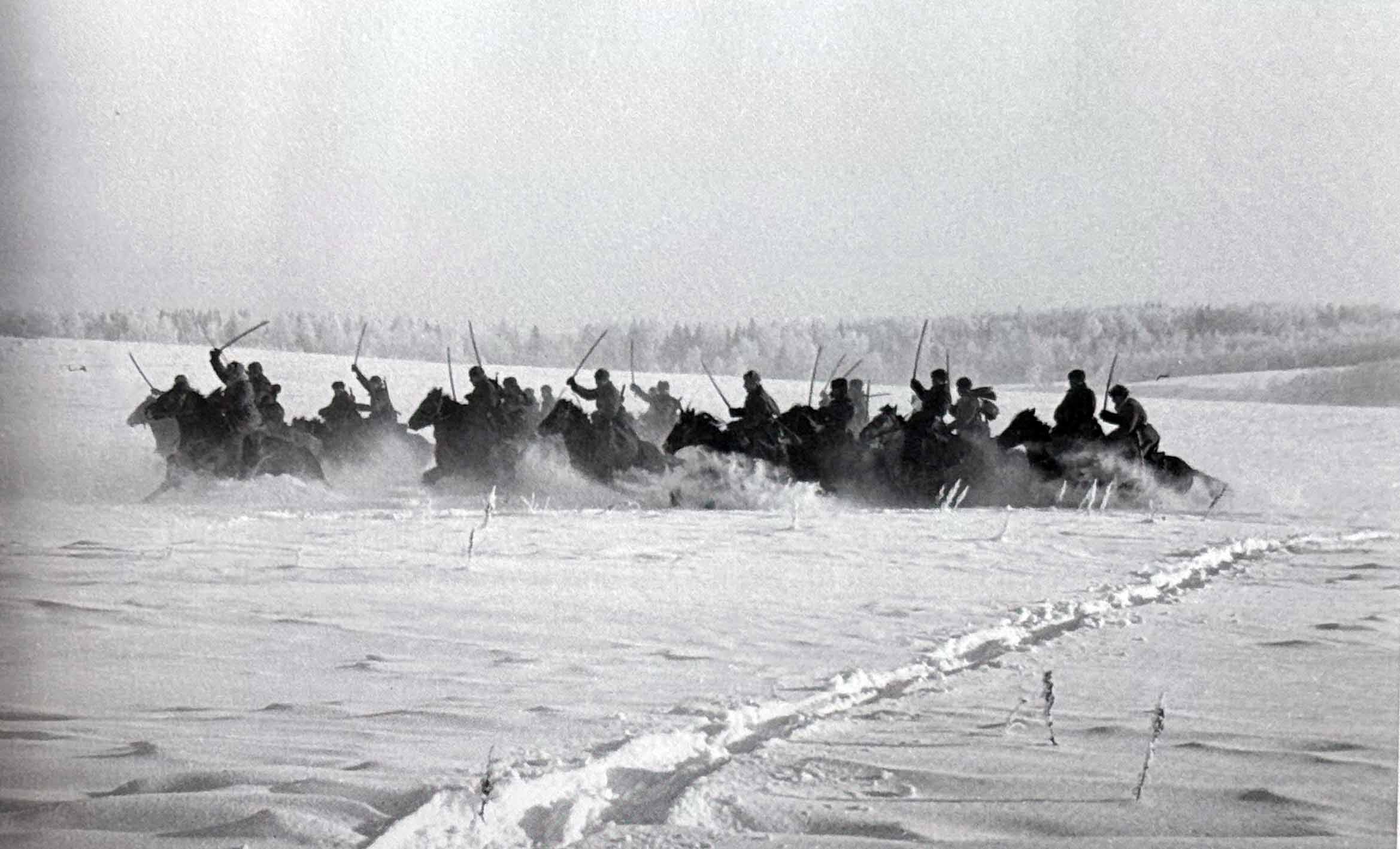
Sputnik 2549. In this photograph, Soviet cavalry are shown on the attack somewhere near Moscow on 2 December 1941. By this time Soviet forces were increasingly frequently engaged in local offensive operations that would soon snowball into a wider offensive near Moscow during the weekend of 5-7 December. Cavalry undoubtedly had a useful role to play over the vast expanses of the Soviet Union and Eastern Europe, and would continue to be employed by the Red Army through to the end of the war. As will be further discussed in Chapter 8, the horse offered considerable mobility to light forces even in winter.
Whilst creating a dramatic impression, cavalry charges such as this one were, however, only very rarely effective against any sort of organised opposition - the horse was best left as a means of ansport, not of assault.
In one particularly egregious instance in mid-November two regiments of he 44th Cavalry Division charged dug-in German troops of the 106th Infantry Division near Musino on the approaches to Klin to the north-east of Moscow. One German observer described some of the cavalry as offering ‘an unbelievably beautiful sight on a clear sunny winter landscape as they went into the attack with gleaming sabres above their heads’. The massacre that seems to have followed was in stark contrast to such words, offering ‘a nightmarish performance’ for the German soldiers.
Total losses for the 44th Cavalry Division from 16 November to 21 December 1941 were a horrendous 3,299 men (of whom 405 were reported as killed and 1,624 missing) and 3,595 horses (of which 1,830 were reported as killed and 1,471 missing).

Sputnik 2278743. Alongside partisans, there were other Soviet troops operating on German and Axis-occupied territory. Some of those troops were Red Army scouts, such as Senior Sergeant Frolchenko pictured here in August 1943 after he had participated in the Battle of Kursk. Frolchenko fought from the Battle of Stalingrad through to the Battle of Berlin. He is wearing a camouflage coverall as frequently worn by Red Army scouts during the latter half of the war, has a pair of binoculars, and is armed with the (by this point) ubiquitous PPSh submachine gun. Although such reconnaissance troops were more likely to be found closer to the front line, they sometimes penetrated deep into enemy-held territory.

Sputnik 491038. The first two photographs in this chapter capture something of the intensity and horror of combat. Here a British-supplied 'Matilda' tank - with accompanying infantry of the South-Western Front - is shown on the attack near Zmiev, south of Kharkov, during the summer of 1942. This is certainly not a staged photograph, with a casualty certainly evident on the right-hand side of the tank, and possibly also the left. Although the Soviet practice of having infantrymen ride on tanks into battle meant that tanks were more likely to have close infantry support - and to some extent made up for shortages in armoured fighting and other vehicles to carry infantry into battle - it also resulted in heavy casualties. There is, as is clear from this photograph, little protection for infantrymen on the back of a tank, and their desperation to get off the tank into some sort of cover is very much evident.

Sputnik 666554. This second photograph, taken moments after 491038, shows the body of one of the infantrymen on the ground in the front-centre part of the picture, with what is quite possibly a second casualty on the far left. None of the infantrymen here has a PPSh sub machine gun, a weapon that would become synonymous with tank-riding infantry as the war progressed. Consequently, the infantrymen here would be very much dependent on the firepower of the accompanying tank when engaging enemy positions at close range.

Sputnik 5646055. To open this chapter, which deals with a period starting with the Soviet counter- offensive near Stalingrad - Operation 'Uranus' - we have a picture taken on 20 November 1942, a day after the official start of the operation. Taken somewhere near Stalingrad, this picture is unusual in that it was taken at night, where achieving a good photograph without flash would have been far from easy. Fortunately in this instance the photographer has caught this T-34 at just the right moment to have the flash from the gun firing illuminate the tank. Tank buffs and those with a keen eye for such details will have noticed that this tank differs from those in earlier photos of T-34 tanks in this book and indeed from the tanks in Sputnik 882842 in this chapter (see p. 162), where the turret shape is significantly different. The tank pictured here is the 1942 variant of the T-34 tank. When comparing this variant to its predecessor, particularly important to note is the addition of a commander's cupola on the turret. This gave the commander much better vision from within the tank through vision blocks in the cupola than in the previous version of the tank.

Sputnik 5337. The German defenders of Berlin consisted of a range of troops from elite units of the Waffen-SS down to Volkssturm militia. The latter in particular were often equipped with weapons of First World War vintage, like the MG-08/15 machine gun shown partially on the body of the dead German in the foreground of this picture, taken towards the end of the fighting for Berlin. Behind him Red Army soldiers scurry for cover with their own equivalent of the MG-08, the trusted Maxim Model 1910. German resistance was at times fanatical, as highlighted by the pockets of resistance that did not surrender on 2 May on the orders of the garrison commander. The 1st Guards Tank Army, one of the Soviet formations fighting for the city, would record that despite the surrender early on 2 May it would suffer 63 killed and 228 wounded that day as a result of 'fighting that took place in isolated sectors because the enemy sought to put up [further] resistance and not lay down their arms'. In the process of suppressing resistance that day the army claimed to have killed 470 of the enemy. Overall, that the 1st Guards Tank Army claims to have killed more of the enemy than it captured during the period from 16 April through to 2 May 1945 - 24,192 compared to 17,573 - can also be taken as evidence of the ferocity of resistance.
© Alexander Hill 2021, ‘The War on the Eastern Front, The Soviet Union 1941-45 A Photographic History’. Reproduced courtesy of Pen & Sword Publishers Ltd.

Affiliate Links
Recently on World War II Today ...
