

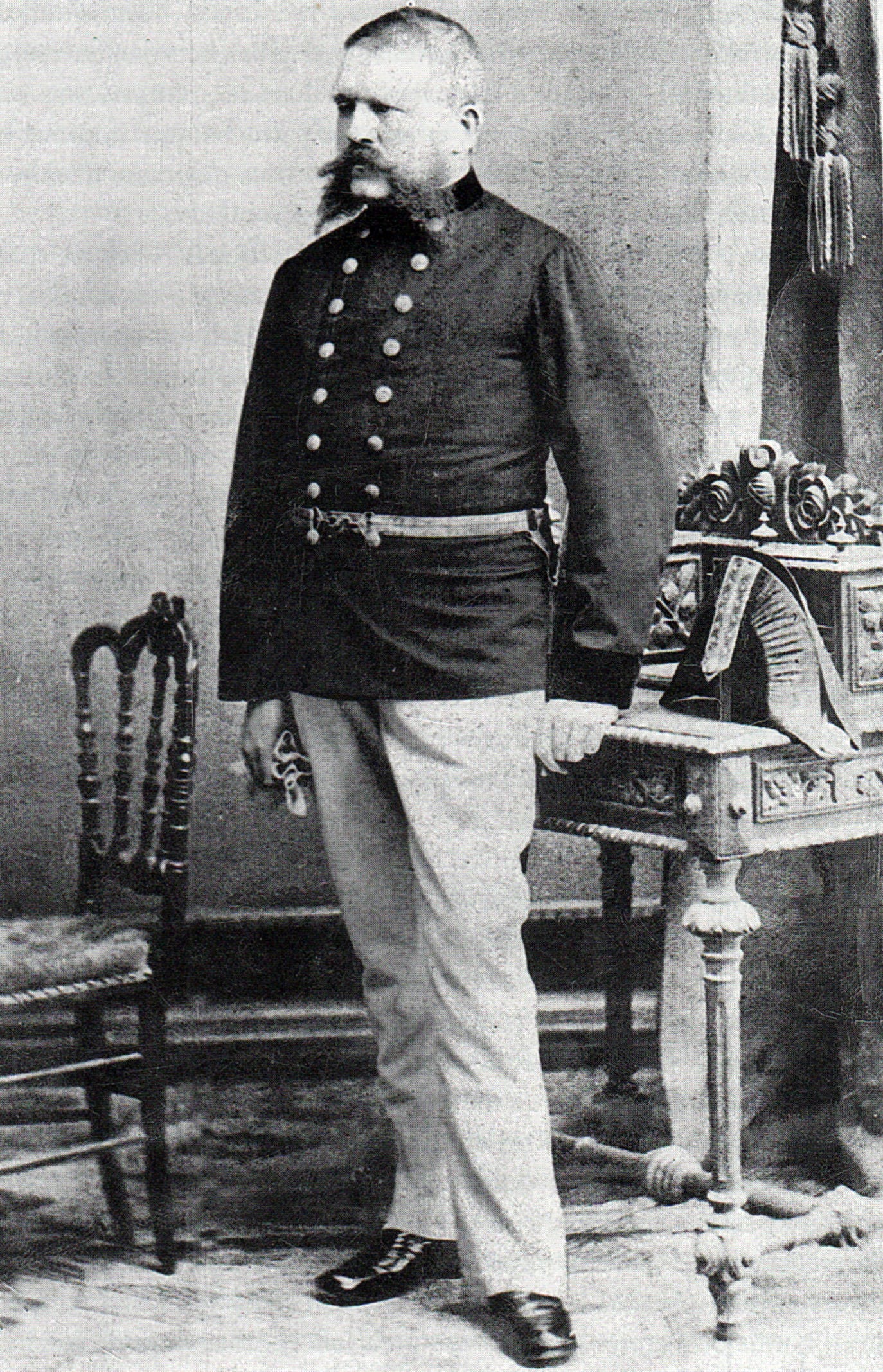
Roman Sandgruber estimates that there are over 150,000 published studies of Hitler and Nazism, and several hundred biographies of the man. The discovery of a collection of letters written by his father, Alois Hitler, led him to add to the literature and meticulously examine sources from Hitler’s earliest, formative years. Hitler’s Father - Hidden Letters: Why the Son Became a Dictator does not fully answer its own question, because one of its main conclusions is that much remains a mystery. Nevertheless, this study focuses on facts, uncovers new material, and avoids speculation and imaginative interpretation.
The following excerpt comes from the introduction:
Alois Hitler, alias Schicklgruber
Smoking pipes, sitting in the inn, breeding bees, striking his children. This is the basic tone of most statements about Hitler’s father: at home a patriarch, at work a pedant, in public right-wing, to the children a brutal despot. Alois Hitler was certainly not a pleasant husband, family man, work colleague or citizen. What he was certainly not, however, was an alcoholic or idle man who would have wasted his time in the inn and in the beehive, nor a bourgeois citizen or provincial official whose horizon would not have extended beyond Braunau, nor a husband to whom the family would have been completely subordinated to his own sexual needs or his professional advancement, and certainly not a child molester and devil charmer, as Norman Mailer portrayed him in his Hitler novel.
Alois Hitler failed in many fields: as a father, husband, educator, economist and ultimately as a human being, without many friends and without a real home. But there are also the other sides: the meticulous fulfilment of duty, the constant career awareness, the critical urge to educate, the interest in innovations, the joy of social gatherings.
Alois Hitler’s origins and childhood are surrounded by myths, inventions and assumptions. Firstly, because there are hardly any sources: Who would have been interested in a barely outstanding, neither rich nor particularly conspicuous and certainly not really high-ranking person in the Austrian province? Second, because Adolf Hitler, when he became known and powerful, did everything to hide his own history and that of his parents and ancestors, or to turn it in his favour, thus on the one hand eliminating sources and, on the other hand, creating myths. And thirdly, because most depictions of Adolf Hitler’s childhood are elaborated from a very long distance and above all without much knowledge of the way of life at that time in the rural petty bourgeois provincial milieu in which the Hitler family moved.
That Adolf Hitler’s murderous and violent political path could be derived Tyrannical fathers and loving mothers are not an isolated case in history. from this is not provable. But there are some hints. To overestimate oneself and not to accept other opinions and knowicage was already apparent in his father, as was the tendency to self-taught further education and contempt for all academic and school authorities.
The tendency to violence also shows parallels between the son’s political behaviour and his father’s style of parenting. In his sex life, on the other hand, the father differed quite conspicuously from the son, even if he was almost certainly not homosexual, which is remarkably often assumed in the latest literature.
The unresolved places and existing gaps in the family tree may have burdened the son more than the father. But why Alois Hitler had his family name changed from Schicklgruber to Hitler at the age of almost 40 and brought about a quasi-legitimisation of his illegitimate birth still raises questions about the course of events and the motives.
The region in which Alois Hitler moved throughout his life, he got to know through forced and voluntary changes of location to an above average extent for the time. This influenced his speaking and writing habits. In contrast to the Viennese subaltern central officials, whose Viennese was discoloured by the dialect of their mostly noble superiors in a way that was often perceived as condescending, Alois Hitler was dominated by the regional dialect, which had been polished by the many changes of milieu, which he used with High German phrases and excessive use of foreign words.
To attempt to give an officialauthoritarian tone to his use of words and bureaucratic diction, Alois wrote his letters, although without any higher education, in a stilted civil servant German mixed with technical terms, into which the use of dialects repeatedly mixed Alois Hitler’s origins were among smallholders, his status that of a middle official, but his longing was for a life as a master farmer and influential city citizen, for a country estate, for a horse and wagon and for a property that went far beyond beehives or the scope of an allotment.
They had servants. Relations were maintained with the city. The godparents of the children came from Vienna. They spent summers in the cooler Forest Area. The children were sent to secondary schools. What stands out in particular, however, is that they not only took part in political events, but also sought to actively shape them.
The numerous relocations had brought Alois to many different milieus: from the Forest Area to Vienna, from there to Saalfelden and Salzburg, Wels, Braunau, Passau, Urfahr, Fischlham/Hafeld, Lambach and finally Leonding and Linz. His son Adolf had taken part in it, starting in Braunau with his father.
The first ten or twenty years are the formative phases in a person’s life: it is clear that the language, eating and living habits, manners, education, religion, world view and sexual habits of the young Hitler were decisively influenced by his parents’ home and the environment. Adolf Hitler never wanted to talk much about his origins.
As Reich Chancellor, he forbade all publications about it. He had essential documents confiscated or destroyed. Much therefore remains a mystery. A biography is always a puzzle with many individual pieces from which the individual stages of life and the continuous life line are to be put together. But there are almost infinite days in between, uniform and yet eventful, about which one knows nothing at all. This is particularly the case with the young Hitler and his father.
...
Hitler himself also tried to conceal his origins. How much did he know? How much was he psychologically burdened by this? In Mein Kampf there are only two short, moreover contradictory, sentences about his father’s ancestors: ‘As the son of a poor, little housekeeper, he had not suffered at home ... and later, on the occasion of his own stay in Vienna: .. always the image of the Father in front of his eyes, who had once made his way from poor village and shoemaker boy to state official’
It was precisely in these sentences that he fought for a very long time for the formulation that originally should have been called ‘housekeepers and day labourers. In which light did he want and should he put his origins? Into the painful reality of a poor, low and unexplained origin? An incestuous circumstance? A lie?
Hitler’s sister Paula, in any case, claimed to the US Army in 1945 that she knew practically nothing about her father’s origin, unlike her mother’s: ‘My father did not care about the relationship. I didn’t know any of my father’s relatives, so we, my sister Angela and I, often said: we don’t even know that our father must have had relatives. And Adolf Hitler himself did not want to talk about it either.
© Roman Sandgruber 2022, ‘Hitler’s Father - Hidden Letters: Why the Son Became a Dictator. Reproduced courtesy of Pen & Sword Publishers Ltd.

Affiliate Links
Recently on World War II Today ...

