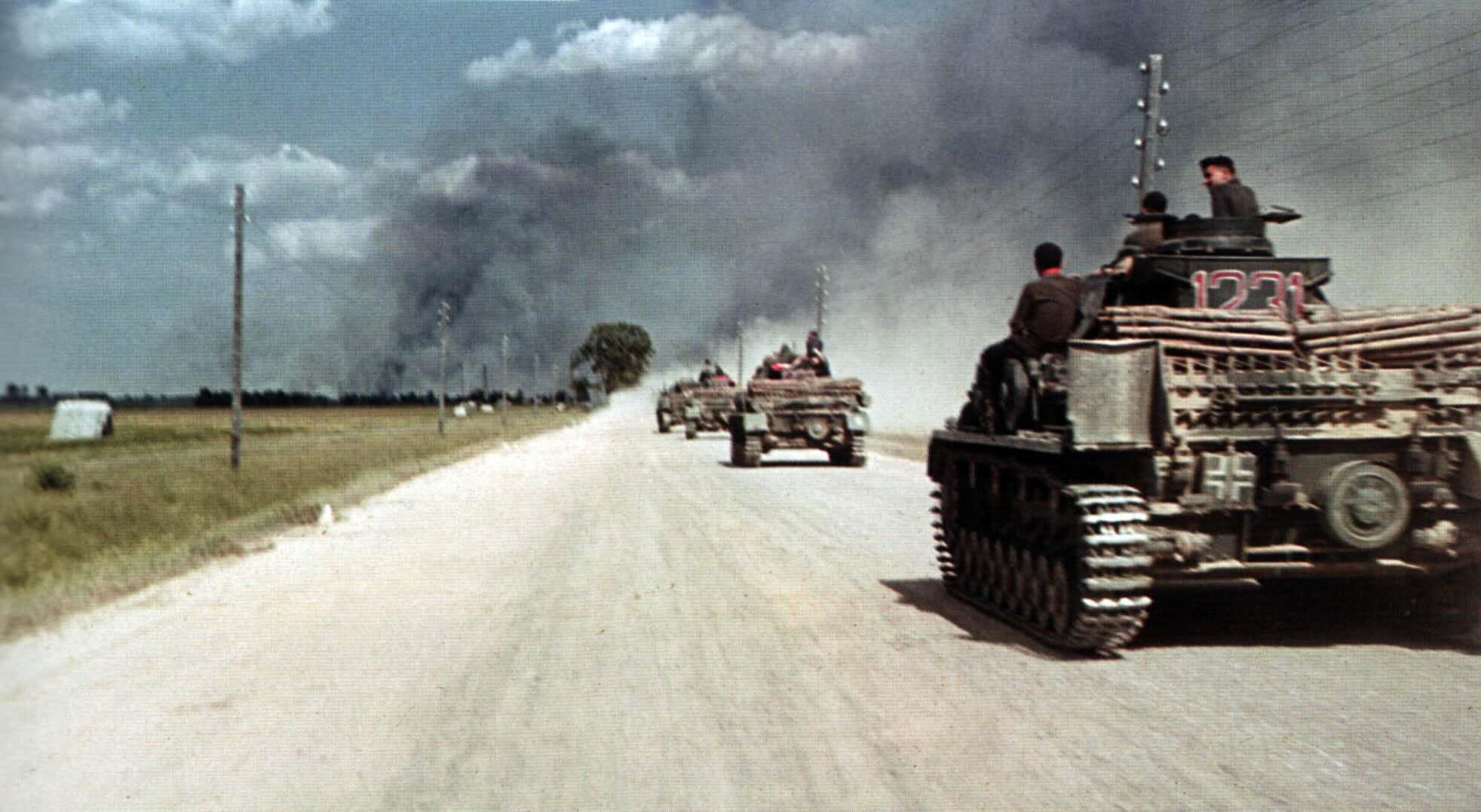
Panzers roll! On 22 June 1941 the Wehrmacht stormed into the Soviet Union. This column of Panzer IVs is very dusty. For some reason the rear vehicle has one of its track guards in a raised position. The fascine, or bundles of logs, on the engine decks of these tanks were intended to help the tanks traverse ditches and anti-tank traps. The rear of the hull bears the distinctive German national insignia known as the Balkan cross (Balkenkreuz). This was a development of the solid white cross used in the invasion of Poland, which was found to be too conspicuous. The white outline cross was standard between 1940 and 1942, by which time the black Balkenkreuz with white edging had become more popular. The billowing smoke in the background is probably the result of a dive-bomber attack. The drawback of dunkel grau was that it was intended to help vehicles blend in with the shadows cast by trees and buildings in western Europe. On the open steppe in Russia it simply made vehicles stand out as a solid object.
“There is a tendency to think of the Second World War, especially on the Eastern Front, largely in terms of black and white. Although colour film was available, it was expensive and often restricted. Colour ‘combat’ film footage was shot on the Western Front and the Pacific, most of it by American cameramen. In Germany, Agfa pioneered the use of colour in the 1930s, which was adapted into negative print and slide film, with the first German colour feature movie made in 1940.
This was in response to the development of Kodachrome and Technicolor in America, where Hollywood was just beginning to embrace colour. During the 1930s photography caught on in Germany in a big way. The country became an international centre of excellence for the manufacture of not only cameras and film, but also lenses. Agfa’s marketing was very seductive, especially when it came to urging Germans to take holiday snaps. Lens-makers such as Carl Zeiss based in Jena took a similar approach with their advertising. In 1941 the company proclaimed in the pages of Signal:
Snapshots of everyday experiences are lasting memories. But the rapidly changing scenes of everyday life bring with them opportunities for the photographer in which a good camera and the best lenses are necessary. - A reliable aid in obtaining better photographs is the ZEISS LENS, the eagle eye of your camera.
Joseph Goebbels, head of the Nazi Propaganda Ministry, immediately saw the value of Agfacolor to both the German film industry and Nazi propaganda. Initially, the Nazis did not make much use of colour photography, as much of their propaganda was illustrated by artwork designed to deliver very simplistic messages. Goebbels, though, understood the power of the moving image and stills photography to sway public opinion. Indeed, it was this that had helped the Nazis come to power.”
…
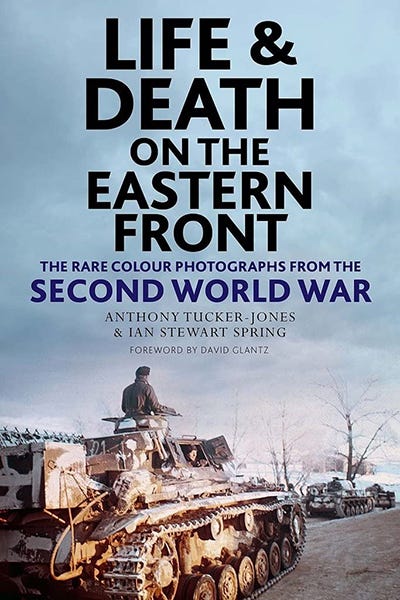
From the introduction to Life and Death on the Eastern Front. Most of the images contained in this volume are not from the Wehrmacht archives used in magazines like Signal but from private collections. Thousands of German soldiers took colour images of the campaign in Russia and sent them home to be developed. Many of those collections survive to this day, even if the majority of German soldiers on the Eastern Front did not survive the war.
The following images and the original captions represent the range of material presented here:
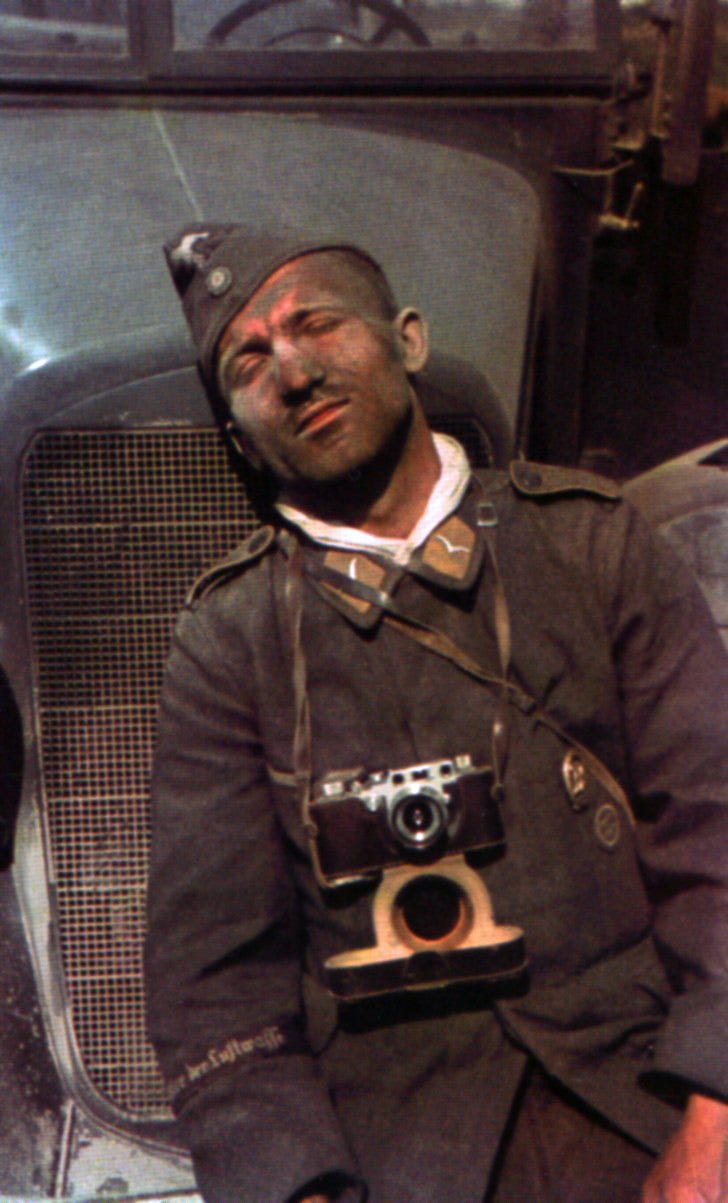
Just a brief moment of respite in the warm sunshine. A grime-covered Otto Vieth, who served as a combat photographer and reporter with the Kriegsberichter, a takes a break somewhere on the Eastern Front. He worked for the Luftwaffe's propaganda magazine Der Adler, with his dramatic photos regularly appearing on the cover. When Adolf Hitler invaded the Soviet Union in June 1941 such reporters operated with headquarters staff, but as the war progressed they were increasingly embedded with front-line units. Regular soldiers, although forbidden to do so, also recorded the war in Russia, using their own cameras.
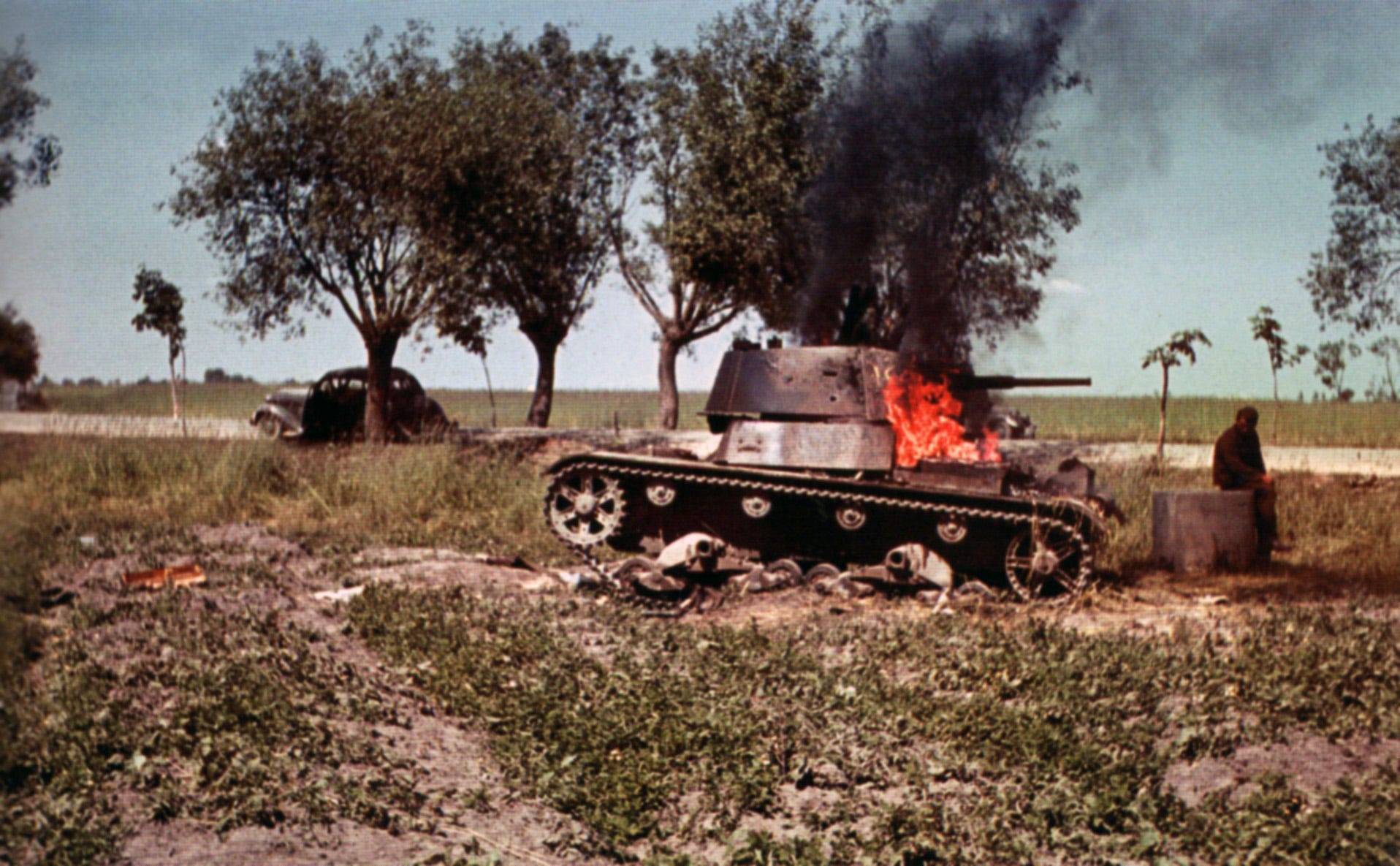
The driver of a German staff car rests by a burning obsolete T-26 Model 1939 light tank. The turret is in the reverse position, so it is being engulfed by the flames from the engine fire. The Model 1933 was the most common, with over 5,000 produced by 1937. The subsequent Model 1939 had the conical turret and improved armour, but only 2,000 were built. Production of both the T-26 and BT-7 was stopped in favour of the new T-34 medium tank that was just entering service.
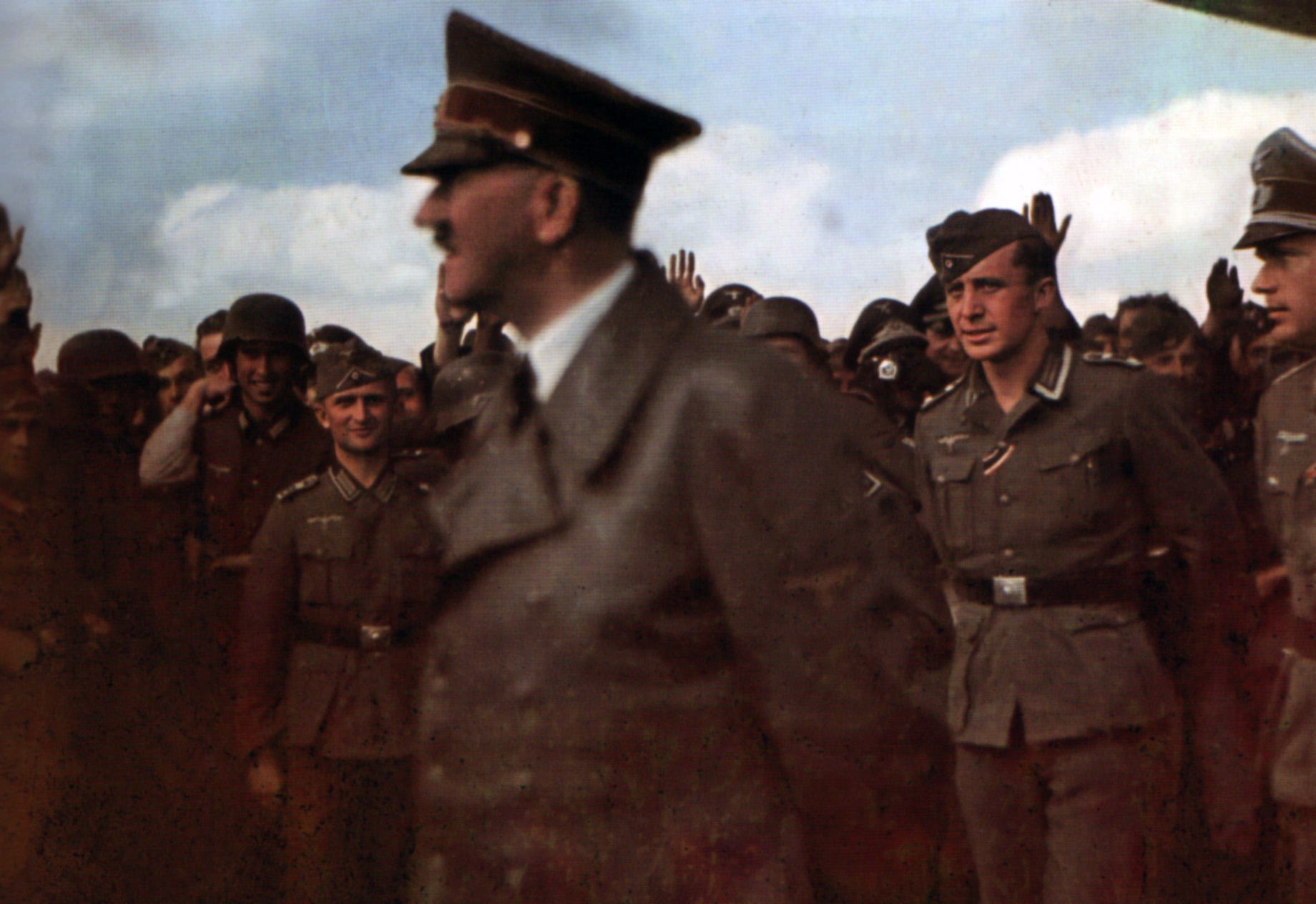
A triumphant Adolf Hitler arrives in Ukraine in 1941 to congratulate his troops and his generals. They had conquered a vast area and were poised to take Moscow. At this stage of the war there was no denying his genuine popularity. Hitler's wartime uniform naturally mirrored his dual position as supreme political leader and military commander. Therefore, he liked to combine elements of the Nazi Party and Army uniforms. For his visit to Ukraine he wore a leather trench coat, white shirt and black tie. His field-green cap has a brown velvet band with gold piping around the top and white around the band. The cap cords are gilt gold with a black or brown peak.
East meets West. These Jewish Russian peasants had little to rejoice about under German occupation. They would soon become victims of Himmler's murderous Einsatzgruppen (Action Squads) as well as the SS-Totenkopfverbände (Death's Head Units) who ran the concentration camps in Poland and Russia. In the Minsk ghetto alone 90,000 Jews would perish. When Himmler visited Minsk to witness the mass murder, his accompanying photographers were ordered not to take any photographs of the executions. Instead he was photographed benevolently confronting a Russian boy in what was clearly a staged scene. In Byelorussia the Germans were assisted by the quislings Ivan Ermachenko and Radaslau Astrouski. The Einsatzgruppen also became involved in the brutal war against the partisans. Neither side showed any mercy.
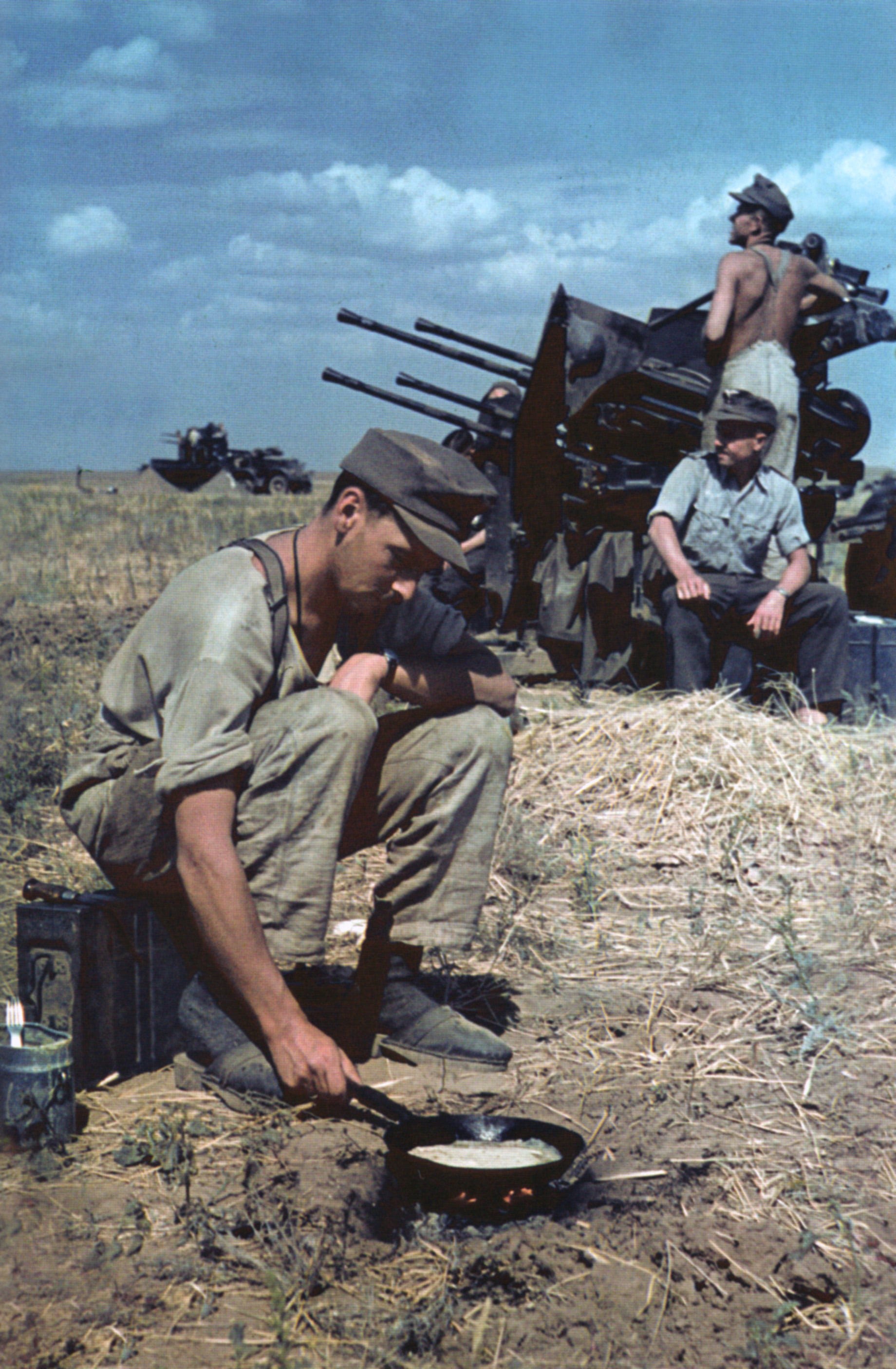
The crew are in a mixture of Luftwaffe tropical uniform, comprising cotton or canvas trousers, vests and shirts plus field caps. The man cooking pancake is wearing some sort of non-regulation wooden-soled slippers or clogs. On the quad, magazines for two guns could be reloaded while the other two continued to fire. The Flak 38 was also mounted on the Sd Kfz 7, an example of which can be seen deployed in the background on the left. Another variant carried a single 37mm flak gun.
Thanks for reading World War II Today! This post is public so feel free to share it.
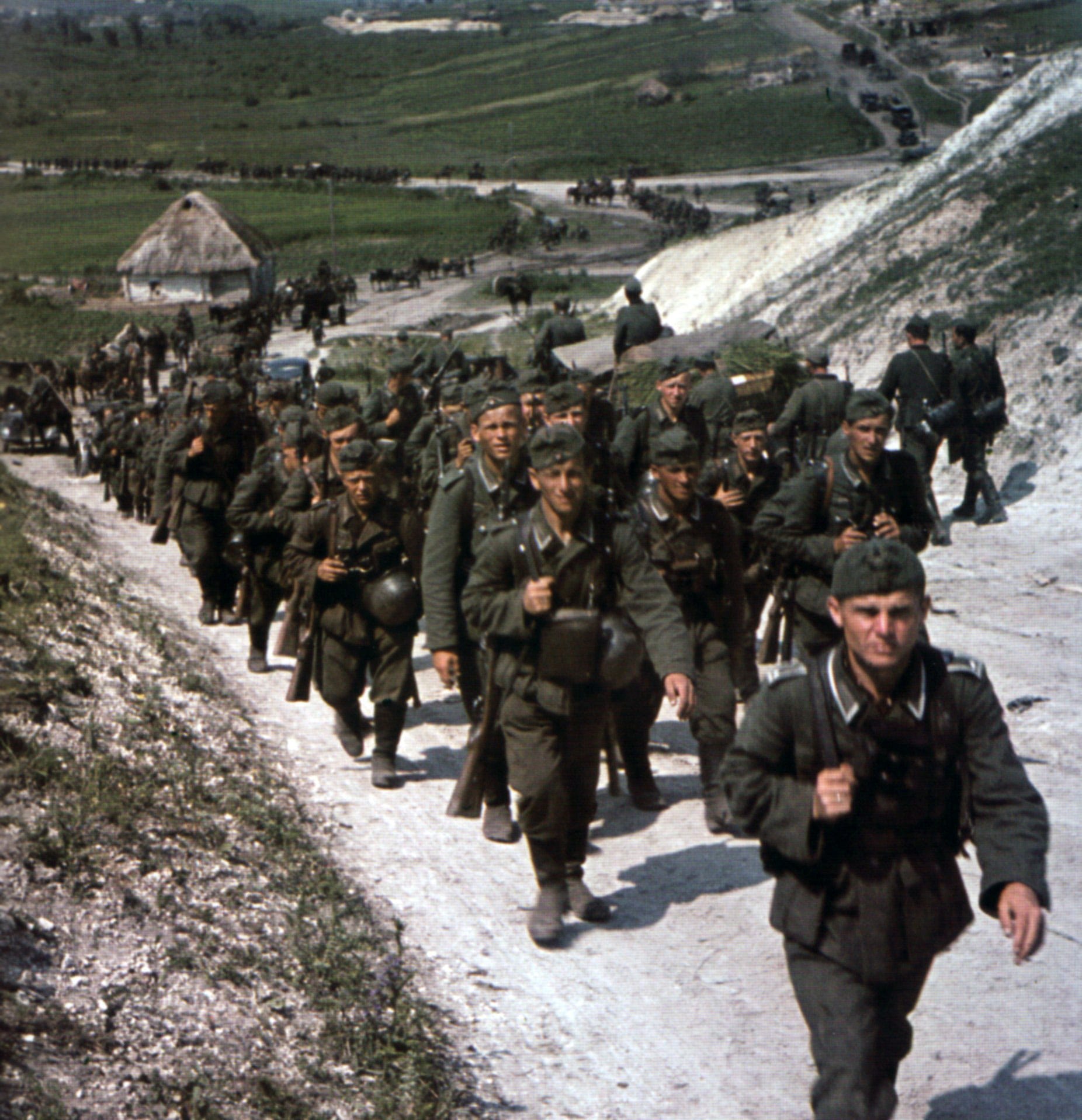
Members of the 164th Infantry Regiment on the march in the summer of 1942. They are carrying the standard German Mauser 7.9mm 98K rifle. German infantry divisions were far from motorised or even mechanised at the start of the Second World War. This unit's equipment is being carried by numerous Panjewagen.