

Previously unpublished diaries and memoirs from the war continue to emerge, as featured last week. But a growing genre is the reconstruction of an individual’s wartime service by living relatives, often supported by extensive archival research and background histories. These personal projects can be very illuminating explorations of what it was like to be in a particular theatre of war or branch of the services.
Taking this approach to a new level is The Glass Mountain, which has just been released in paperback (although I enjoyed the audiobook). Malcolm Gaskill is a professor of Early Modern History. So wartime Italy was unfamiliar territory for him. But from a snatch of conversation about extraordinary Great Uncle Ralph, a long personal adventure unfolded. The result is a great accomplishment, a combination of personal research, imagination and reflection.
Ralph’s memoir has been augmented not just by research but by a series of visits to the relevant sites in Italy. This is coupled with contemplation of what his generation went through. An unusual but fascinating approach to history, not just about one individual but about how we remember the past.
The following excerpt illustrates the author’s power to reimagine past events, as Ralph, accompanied by his fellow POW Charlie, breaks out of a prisoner-of-war camp:
The bulb outside the hut shone a pale cone on the threshold; the only light beyond was the sickly yellow glow of the fence lamps. The air was cool, the sky a ceiling of impenetrable black. They crossed the muddy path to the cookhouse, which was in complete darkness. Nodding to the Scots Guards sergeant on watch, they hurried through the door.
Inside, with its smell of grease and huge kettles and ranges, they pulled off their greatcoats. Waiting in the stoke-room were RSM Alderson and the three camp policemen, their faces just visible by the faint light washing through the windows. Alderson reported that the guards with the mobile arc light had gone, meaning the coast was clear. They moved towards the rear of the building, where the door was already open, framing illumination from the fence just a few yards away.
It was like the curtain had lifted on a dazzling stage and this was their cue. Charlie went out first, dropping onto his front behind a mound of firewood that one of the warrant officers had helpfully stacked outside the door. Ralph followed. Pulse racing, he realized that even the Gazala Cauldron, where he’d been chased by Rommel and dive-bombed by Stukas, hadn’t prepared him for this. For a moment, he wished himself elsewhere:
Now that the moment for action was here, I didn’t feel too good . . . there was a lot to be said for washing the whole thing out, withdrawing quietly, and popping back to a nice warm bed. Such things passed through my mind as I waited there during what might be termed the initial minute of my escape.
But what Ralph considered childish thoughts and feelings were swiftly chased away. He was determined to prove himself to RSM Alderson and his policemen hiding in the shadows, and to Charlie, with his unwavering composure.
Behind the first fence, too feet to the left, loomed a watchtower mounted with a machine gun, its line of fire directly down the corridor between the two walls of wire. The sentry box to their right was much closer, barely fifteen feet away. They could see the tips of the guard’s boots and couldn’t move until he did. Minutes ticked agonizingly by. Then at last the guard strolled away. Passing the wire cutters to Charlie, Ralph signalled to the ex-Derby constable, who ran across to the WOs’ hut to alert Hugh Owen.[who had contrived a method of short circuiting the camp electricity]
There and throughout the camp, magically, the lights waned to a fuzzy pallor. The Bradford man began singing ‘Roll Out the Barrel’ so raucously that Ralph and Charlie barely heard RSM Alderson whisper ‘good luck!’ as they left the cover of the wood pile, wriggling towards the fence. They were fully exposed, albeit in a much reduced glare.
The ten-foot fence was tightly criss-crossed with barbed wire. By now, Ralph’s heart was thumping in his ears like a steam hammer, palms running wet as he waited for Charlie to make the first cut. It was tougher than they’d imagined. Ralph had a go. Grasping the cutters in both hands, he just about managed to snap the downwires near their base, as they’d planned, then propped up the cross wires with a pair of specially-made notched sticks. This allowed just enough clearance for Charlie to shuffle under on his back, pushing with his heels.
It seemed to take an age. Once Charlie was clear, Ralph repeated the manoeuvre, but the belt of his overalls snagged on a barb, snaring him there until Charlie crawled back to help. They replaced the wires as best they could, then approached the next barrier. Hearing the reassuring voice of their Greek Cypriot accomplice, Ralph tackled the second fence. But it was a tussle, and the sweat was pouring out of him.
Charlie touched his shoulder. ‘There isn’t time, Sleuth. It’ll take too long,’ he hissed. ‘There’s only one way now and that’s over the top.’
The escapers pressed themselves against the fence, squinting back at the Cypriot, who was casually chatting with the sentry barely fifteen yards away. There was no way back now, but still Ralph’s thoughts were gripped by the madness of what they were doing. They knew Hugh Owen wouldn’t be able to keep the lights down much longer, and if they came back up while he and Charlie were on top of the fence, the guard operating the machine gun would knock them off like a pair of coconuts in a shy.
Charlie, who an hour earlier had barely been able to walk, was up there like a monkey, and for a split second Ralph saw him silhouetted against a shaft of dimmed lamplight. Then he was over and disappeared into the darkness.
Now it was Ralph’s turn. He clambered up the same way, struggling to hold the wire cutters and water bottle. Keeping an eye on the dark shapes in the watchtower, he lowered himself down the curtain of wire into the unfinished Sector 1. Charlie was waiting. Though unfamiliar, they knew this part of the camp was routinely patrolled, so they picked their way through the building materials and equipment in a brisk yet cautious crouch.
Behind them they could hear no raised voices or alarms, only their Bradford singer who, Ralph noted, had progressed from music hall to The Mikado and was leading the others in a full-throated rendition of ‘A Wand’ring Minstrel, I’ - A thing of shreds and patches, Of ballads, songs and snatches .. . And dreamy lullaby.’
They scampered into a half-built blockhouse, where Ralph wiped his face and sighed with relief. Hastening along the dark central corridor, they exited at the far end. The camp lights flicked back to brightness, but already they were hidden from view on the far side of the building. They continued the short distance to the outer perimeter, a low wall at the edge of a dell. In the distance lay the town of Altamura, barely visible in the blackout, which they planned to skirt round in a wide southern arc to remain concealed in what they hoped would be sparsely populated countryside.
They tore down the hill - ‘like a couple of pursued hares’, Ralph recalled - and up the other side, stumbling on stones as their vision fully adjusted to the night. After negotiating this rough terrain for what felt like hours, they paused, both men blowing hard yet tingling with excitement. Out of range of the mobile arc light, they looked back on the camp with wonder. It suddenly seemed small, diminished, planted in a pool of light that illuminated a canopy of cloud drawn low across an indigo sky.
Ralph checked his watch, amazed it was only 10.45 p.m. Charlie struck a match to read the compass and maps, and predicted that in a mile they should reach a railway line. This they must put quickly behind them. Trains and stations were under strict military control, and if news had been wired from the camp, any soldiers in the area would be on high alert.
They set off again, and after another thirty minutes came to the top of a small rise. Peering over, they could just make out the railway track and a farmhouse to their left. They lay still a while, ears pricked up, then, hearing nothing unusual, descended towards the track, which cut across the open fields on a raised layer of ballast. A dog at the farm started barking, prompting the escapers to scurry forward under the loose signal wires and over the rails and sleepers.
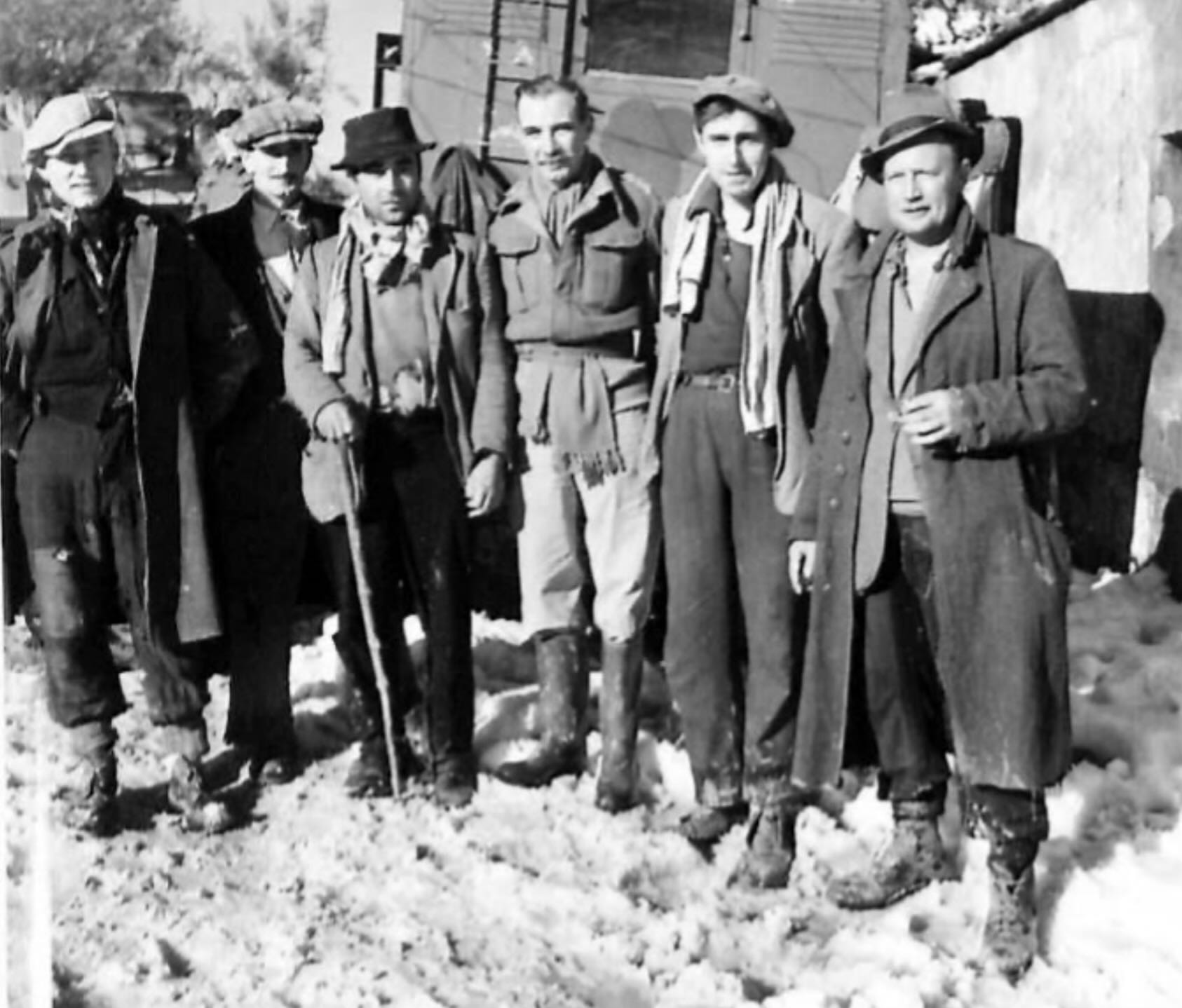
© Malcolm Gaskill 2025, ‘The Glass Mountain’. Reproduced courtesy of Allen Lane (The Penguin Press) Ltd. NB The above image is not from this title.

Affiliate Links
Recently on World War II Today ...


@John Rinaldo