

The small RAF fighter force on the island of Malta was already feeling the strain of the Luftwaffe’s arrival in the Mediterranean. Mike Spick is an acknowledged authority on the Luftwaffe, with over sixty publications to his name. Luftwaffe Bomber Aces: Men, Machines, Methods is an overview of the entire war, so Malta is just a small part of the story. But the title is fully justified, as Spick integrates many different personal accounts with insights into the planes they flew and the tactics adopted.
The following excerpt, illustrative of this approach, comes from the Prologue:

There were hundreds of guns firing at us, as if they’d been brought here from the entire Empire to guard the artery of world power. Flashes appeared from all over the island. It was a veritable wasp’s nest. Through the glass of the cockpit I could see the airfield at Luqa steep below me. We were not going to make it!
Then Helbig’s aircraft tilted down, and the entire Staff Flight went with him. The light blue underbellies of all the aircraft showed simultaneously. No waverers! A second later I lowered my dive brakes, put the nose down, and throttled right back. Out of the comer of my eye I watched my wing men. I looked ahead. I was right behind Helbig in the vic of the Staff Flight. The Staff Flight aircraft were racing down ahead of me but seemed to be poised, motionless, over the target area, their wings like narrow lines, as if on an aerial photograph. Press on!...
At last! Ahead and below me there was movement in the formation. Almost as if they were rocket-propelled, the staff aircraft, pulling out of their dive, swept out from the target, so that in a flash I could see the imperial crosses on the upper surfaces of their wings. Our turn now! I held my aim down to the smallest ring of light in my sight. The alarm klaxon blared out: that meant that I was 800 metres above the ground. I could see my target clearly ... I pressed the bomb release.
This was the first sortie by Hans-Joachim (Hajo) Herrmann against Malta in February 1941. A Junkers Ju 88 pilot, he had flown the He 111 against Poland and Norway with KG 4, then the Ju 88 against France and England. A holder of the Ritterkreuz, he was now Kommandeur III/KG 30, and was destined to go on to still greater things. Malta was at this time defended by anti-aircraft guns and a handful of RAF Hurricanes, and was not yet the hornet’s nest it later became. Leading the raid was Joachim Helbig, at this time Kommandeur I/LG 1 (Ju 88), who already held the Ritterkreuz with Eichenlaub, and who, a little more than one month earlier, had led attacks on the British aircraft carrier HMS Illustrious in the Mediterranean which had all but sunk her, putting her out of the war for eighteen months.
Malta was just beginning to win her reputation as ‘the unsinkable aircraft’, earning a reputation which would be justified by future events. The raid described was recorded as having destroyed eight Wellington bombers and severely damaged another seven, thus helping to secure the supply lines to North Africa, where the Deutsches Afrika Korps under Erwin Rommel, combined with the Italian Army, battled with the British Empire for control of Egypt and the Suez Canal. Had Rommel been successful in this undertaking, the Wehrmacht would have been free to advance to the oilfields of the Middle East. The loss of oil—the life blood of war—would have been critical to the Empire. Nor would German difficulties have been extreme: Iraq, in particular, was to a degree anti-British.
The primary air weapon was the bomb. When one considers it, this was an extremely primitive weapon. If released in straight and level flight, it accelerates downwards at the rate of 32ft/sec2 while retaining to a degree the forward speed of the releasing aircraft. Given that it is correctly sighted, and in still air conditions, a lapse of one-tenth of a second from an altitude which gives a falling time of 30 seconds and a forward speed of 180mph (290kph) will give an error of 792ft (241m). Given a crosswind of 30mph (48kph), the bomb will drift a considerable distance to the downwind side of the target. The counter to this is to establish the wind direction on the ground, then to bomb directly into it, or directly against it. This should in theory counterbalance crosswind error. It does not always do so because wind direction tends to vary at different altitudes. But even if the wind direction does not vary, and the attack is made directly into, or with, the prevailing wind, its strength is still an unknown quantity. Assuming a wind strength of 30mph (48kph) in either direction, even with precise aiming a significant longitudinal error is incurred. Level bombing was therefore an inexact science. It must also be appreciated that what could be achieved on the range from a moderate altitude bore little relationship to actual combat conditions. When the bomb aimer was being shot at, and in imminent danger of extinction, the’margin of level bombing error increased by a factor of three.
In the Second World War there was just one possible alternative. Dive bombing radically decreased the relative speed over the ground; in fact, if a 90- degree dive angle could be achieved, it became zero. At the same time, the release height of the bomb was greatly reduced and, with it, the time of flight.
Ironically, the Luftwaffe adopted this - ironically for two reasons. First, while it paid lip service to the idea of a strategic bomber force, dive bombers could be little other than tactical aircraft supporting the surface forces, whether army or navy. Secondly, stressing aircraft for dive attacks involved weight increases, which significantly reduced payload/range capacity. The Luftwaffe never succeeded in producing a true strategic bomber in the entire war—an omission that it came to regret.
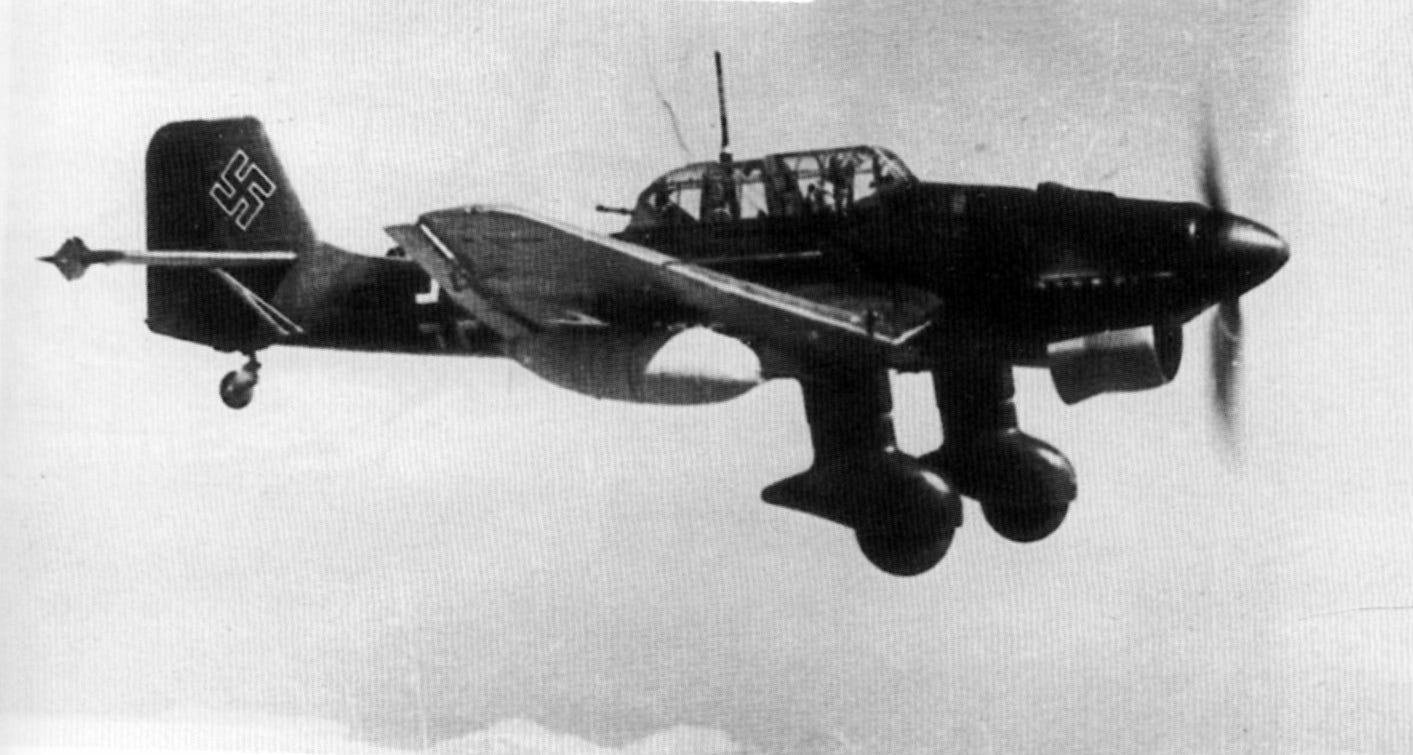
The fact is that the dive bomber was extremely vulnerable to anti-aircraft fire. Tipping over into a dive against a defended target made it a fairly easy, slow, no-deflection shot for ground fire. The supreme irony of this was that Germany led the field in Flakartillerie. Had Poland, France or Britain had the numerical and technical equivalent of the ’88, the dive bomber would have been shown for what it was—a slow and unhandy non-starter. But they did not! And so, in the early days of the Second World War, the Ju 87 Stuka and the Ju 88 built a legendary reputation, which was to a large degree founded on the weakness of their opponents.
On the Russian Front, matters were even worse. Many German Ju 87 pilots notched up more than 1,000 sorties. The historical record shows that they could not have done this in the West. This made for tremendously increased accuracy, allowing pinpoint attacks.
© Mike Spick 2001 & 2016, Luftwaffe Bomber Aces: Men, Machines, Methods. Reproduced courtesy of Pen & Sword Publishers Ltd.

Affiliate Links
Recently on World War II Today ...

